What a turntable conveyor retrofit does on a live line
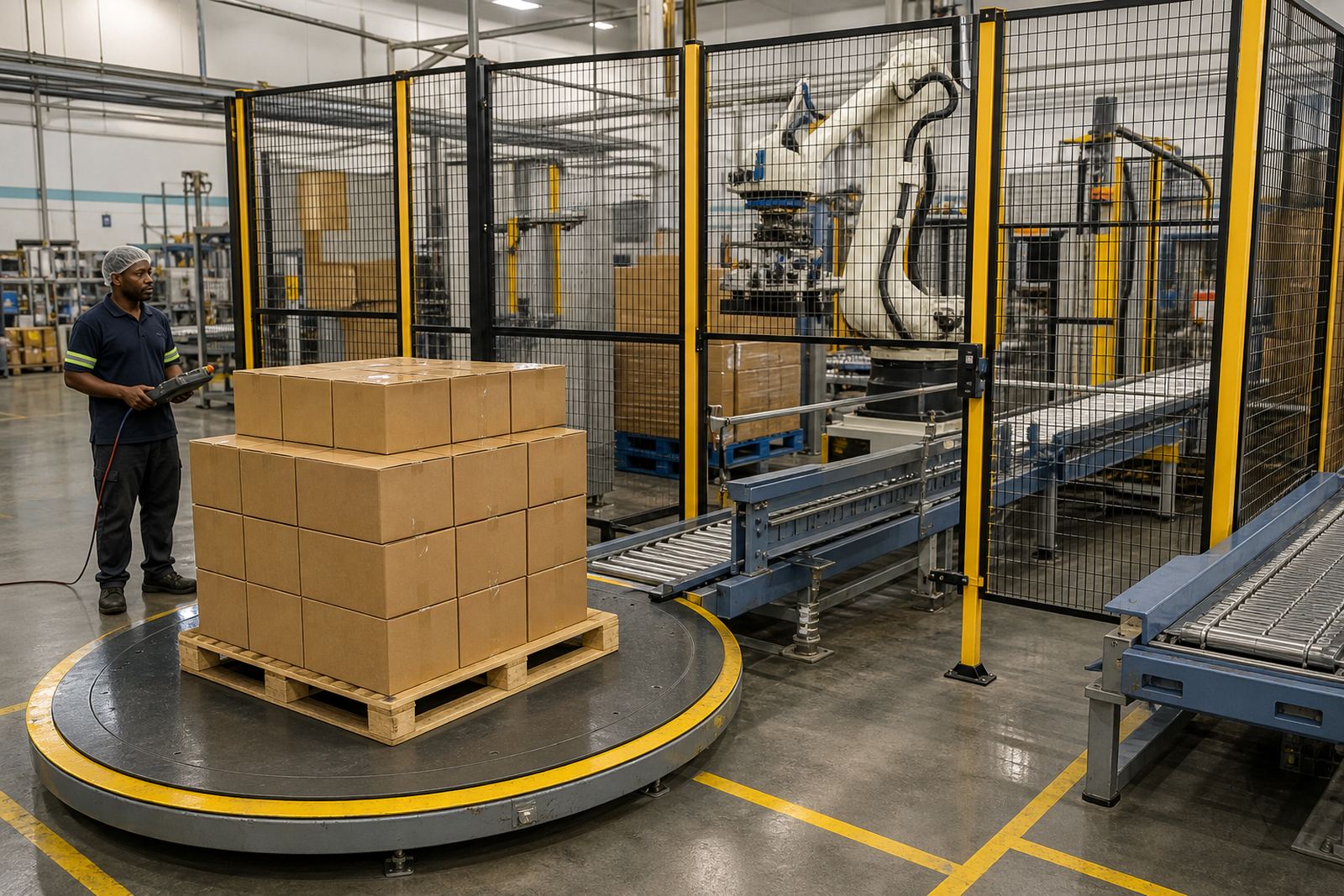
A turntable conveyor retrofit is used where a load, pallet or pack needs to turn through 90 degrees, 180 degrees or another set angle before the next stage of the line. Instead of reworking the whole conveyor layout, a turntable gives you controlled rotation at the point where space is limited or product flow needs to change direction.
On packing and palletising lines, this can help align cases for a palletiser, turn pallets for stretch wrapping, or hand product over to another conveyor run without sharp transfers. It is common on busy sites in Kempton Park, Johannesburg, Pretoria, Durban, Cape Town and Gqeberha where every metre of floor space has to earn its keep.
- Changes product or pallet orientation in a compact footprint
- Helps connect conveyors that do not run in one straight line
- Supports manual, semi-automatic and automated packing lines
- Can be added to an existing layout with limited civil work
Turntable sizes, load ratings and configuration choices
Turntable retrofits are usually sized around the pallet footprint, the heaviest expected load and the speed of the surrounding conveyor. Common working footprints include 1 000 x 1 200 mm, 1 200 x 1 200 mm and other made-to-measure platforms for cartons, crates or drums. The deck height, approach height and roller or chain transfer method must match the existing line so the product moves on and off cleanly.
Options can include low-profile frames, powered rotation, indexing rotation, top plates with rollers or plain top surfaces, and motor arrangements matched to the duty cycle. Where loads are unstable or tall, side guides and hold-down measures may be added as part of the retrofit. If the site handles mixed packs, the control logic can be set up for different rotation angles and line speeds.
- Standard and custom footprints for pallet and case handling
- Rotation angles set to the line layout and end use
- Frames and deck materials selected for the product type
- Designed to suit existing conveyor infeed and outfeed heights
For coastal sites, corrosion resistance matters, especially where humidity and salt air can affect steel parts, fasteners and electrical enclosures. Inland sites may need a different balance between dust protection and washdown access. The right finish and component selection help reduce wear over time, and yes it makes a difference.
Where a turntable retrofit suits best
This solution suits packing and palletising lines where a direct straight-through transfer is not possible. Typical uses include turning pallets before wrapping, changing the direction of cartons after packing, feeding a label or check station from another angle, and moving loads around columns, doors or narrow aisles. It is also useful where forklifts, pedestrian routes or fire exits limit how the line can be laid out.
Manufacturers often ask for a retrofit when they are expanding into an existing building, moving line sections, or improving flow after a packaging change. A turntable can also reduce manual handling by removing the need for workers to lift, twist or drag loads to change direction.
- Fills awkward gaps in older factory layouts
- Useful where straight conveyor runs are blocked by space constraints
- Supports retrofits in food, beverage, chemicals, building materials and general manufacturing
- Can be combined with cobots, palletisers and case packers
Installation, power supply and site needs
Every site starts with a line survey and a review of the existing conveyor, product flow and safety requirements. The retrofit may need mechanical fixing, electrical cabling, control wiring, encoder feedback, photoelectric sensing and integration with the site PLC or local control panel. If the turntable is fitted into a conveyor system already carrying live traffic, installation planning must be careful so the line can be isolated safely and brought back into production with minimal interruption.
Most robotic cells need a power supply sized for the drive load, control gear and any added devices such as sensors or safety stops. Gas is usually not needed for a turntable conveyor retrofit.
- Electrical supply and motor sizing depend on load mass and cycle rate
- Control integration can include interlocks with adjacent conveyors
- Safety guarding and access gates must suit the site layout
- Installation should allow for maintenance access and emergency stopping
Safety guarding and risk assessment support
A turntable is a moving machine component, so it needs proper guarding and a site specific risk assessment before commissioning. The exact guarding arrangement depends on the load, the speed, the operator access points and how the turntable ties into the rest of the line. One site may need fixed guarding, another may need interlocked gates, and another may require light curtain protection or restricted approach zones.
The assessment should look at crush points, shear points, pinch points, manual intervention areas, cleaning access and restart procedures. Where operators need to clear faults or change settings, the controls should be arranged so the machine cannot restart unexpectedly. Safety is not a box ticking exercise, it has to match the way the line is actually used.
- Guarding selected according to the line layout and access needs
- Emergency stops placed for practical reach along the line
- Risk assessment should include cleaning, maintenance and fault recovery
- Lockout and restart procedures must be clear for operators and technicians
Care, servicing and checks before ordering
Turntable conveyor retrofits need regular checks on bearings, drives, alignment, fasteners, sensors and controls. The platform should rotate smoothly without knocking or drifting, and the transfer points should stay true to the infeed and outfeed conveyors. On dusty or humid sites, scheduled cleaning and lubrication help avoid early wear. In our climate, even small alignment issues can turn into bigger problems if they are ignored.
Before ordering, confirm the pallet or pack size, maximum load, minimum and maximum cycle rate, approach direction, floor space, available power, access for installation and the required rotation angle. It also helps to know whether the turntable will handle one product size or several, and whether the site wants manual control, automatic indexing or connection to a larger line control system.
- Load mass and footprint
- Required rotation angle and throughput
- Infeed and outfeed conveyor heights
- Available electrical supply and control details
- Guarding, access and maintenance space
- Operating environment, including dust, moisture and washdown conditions