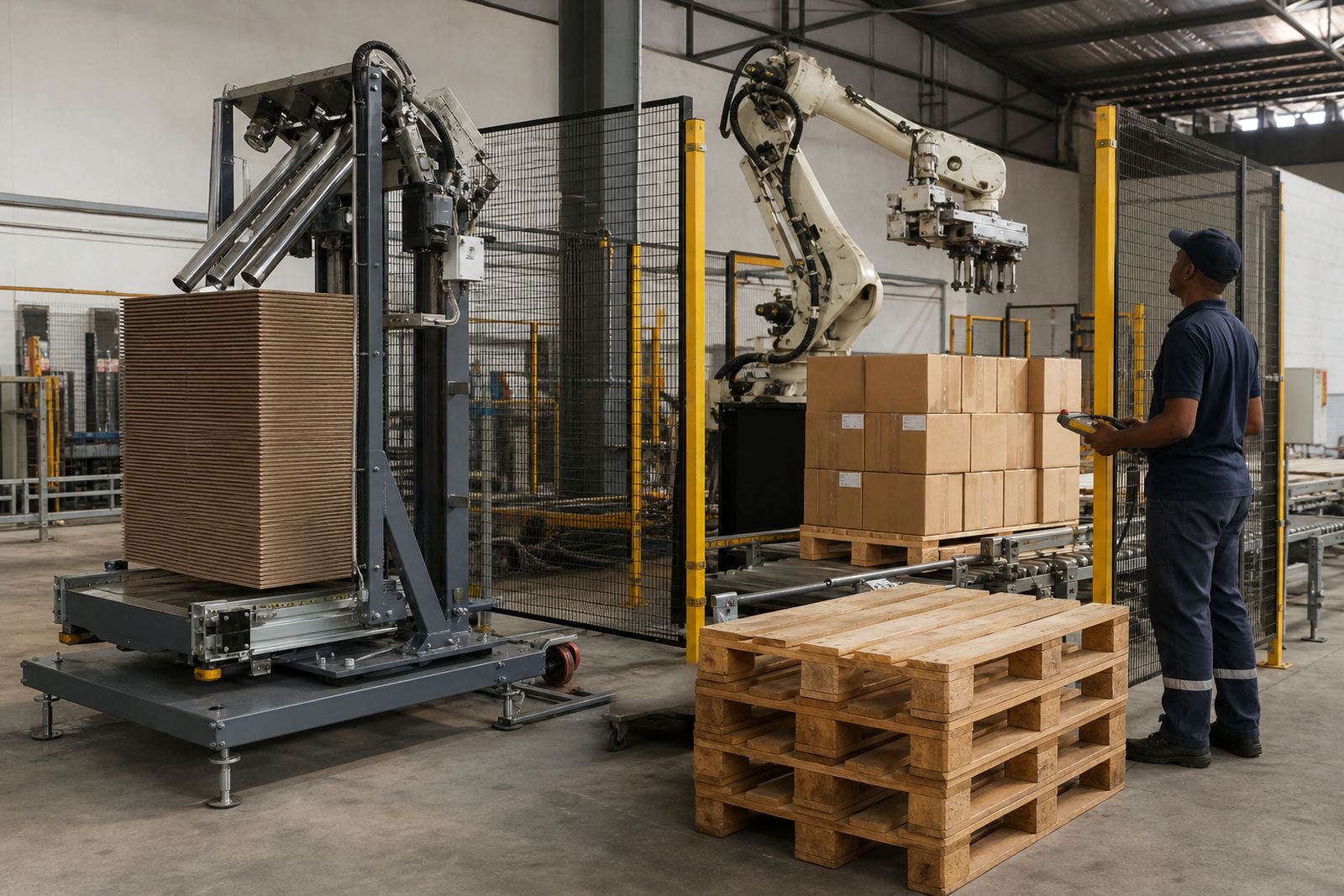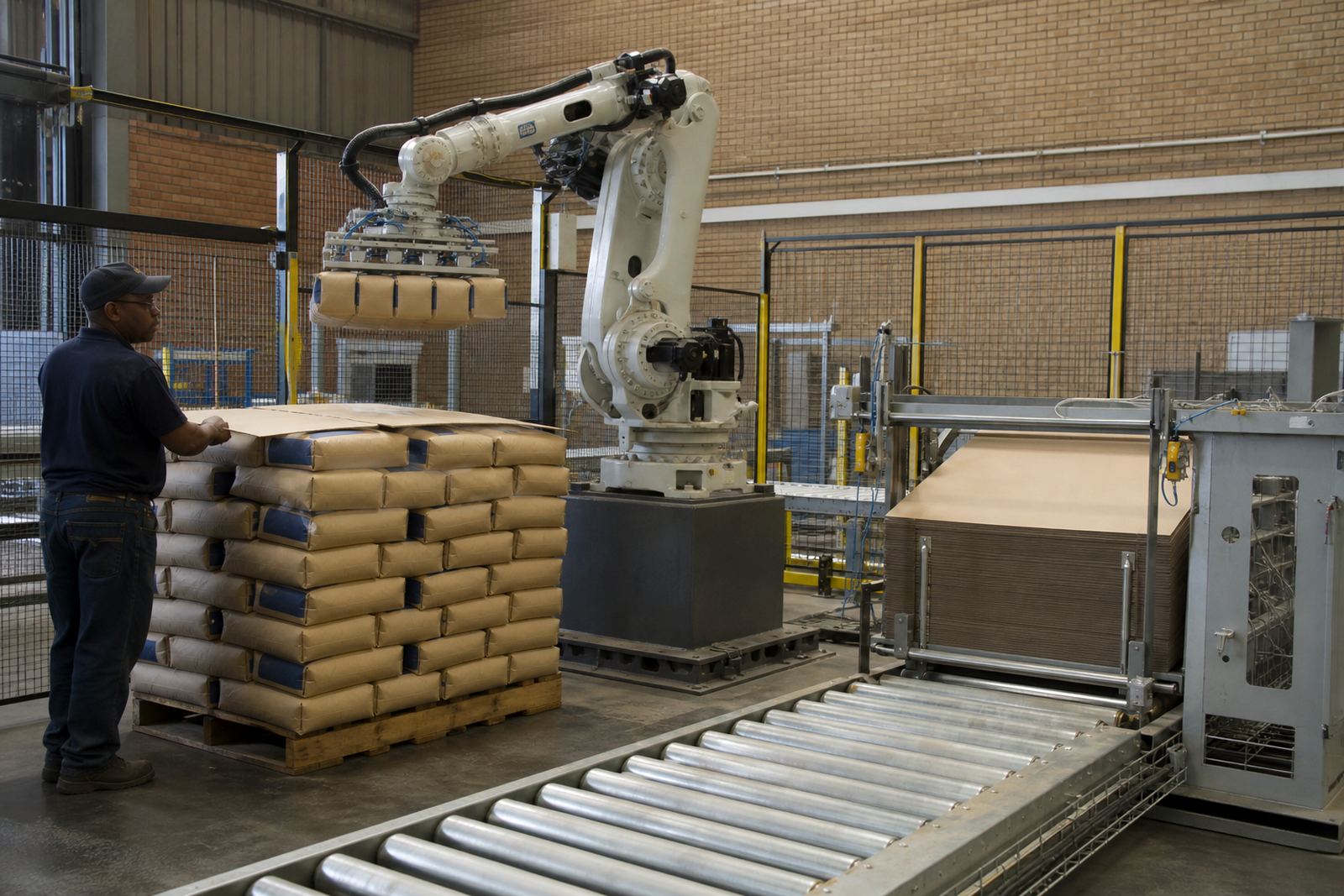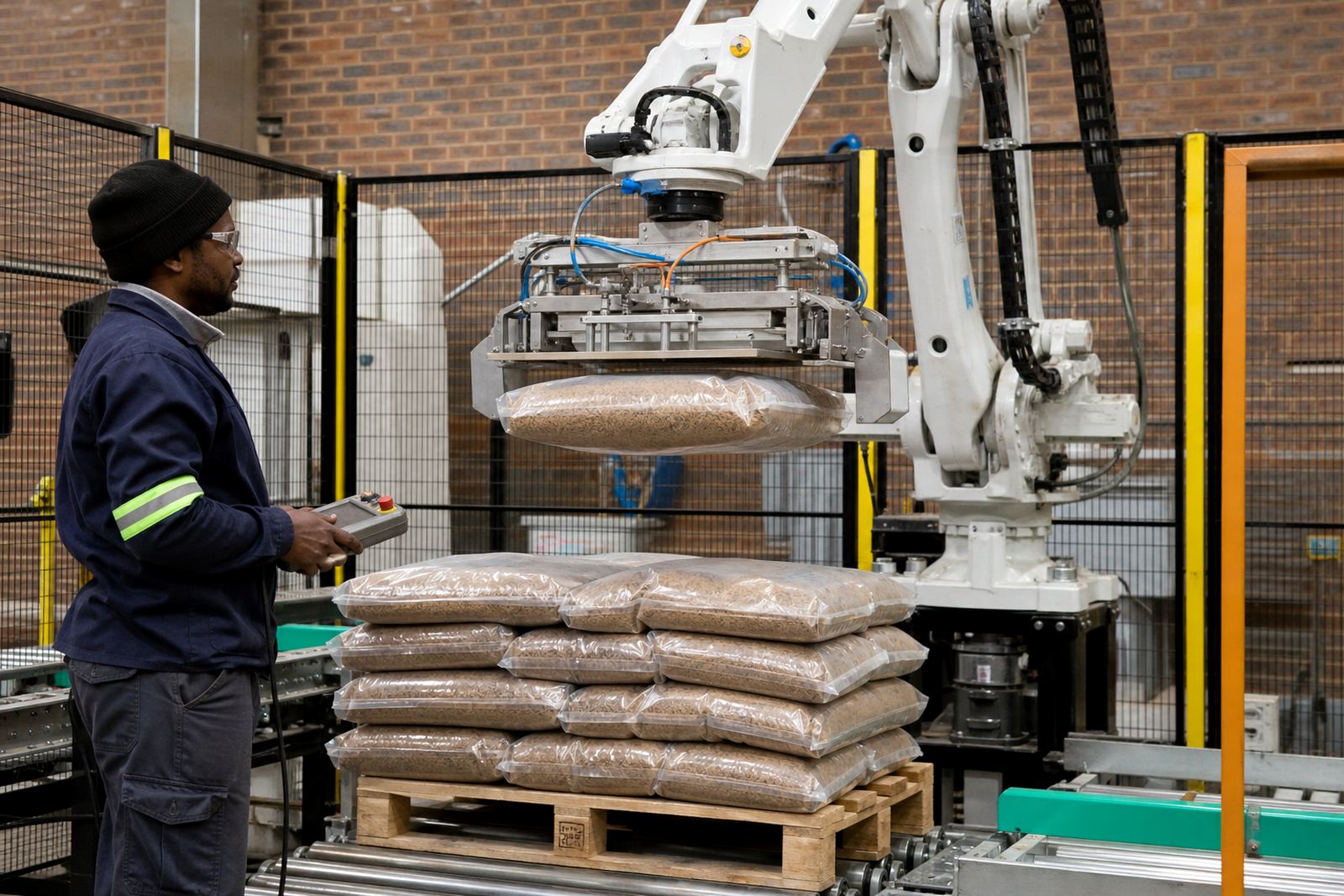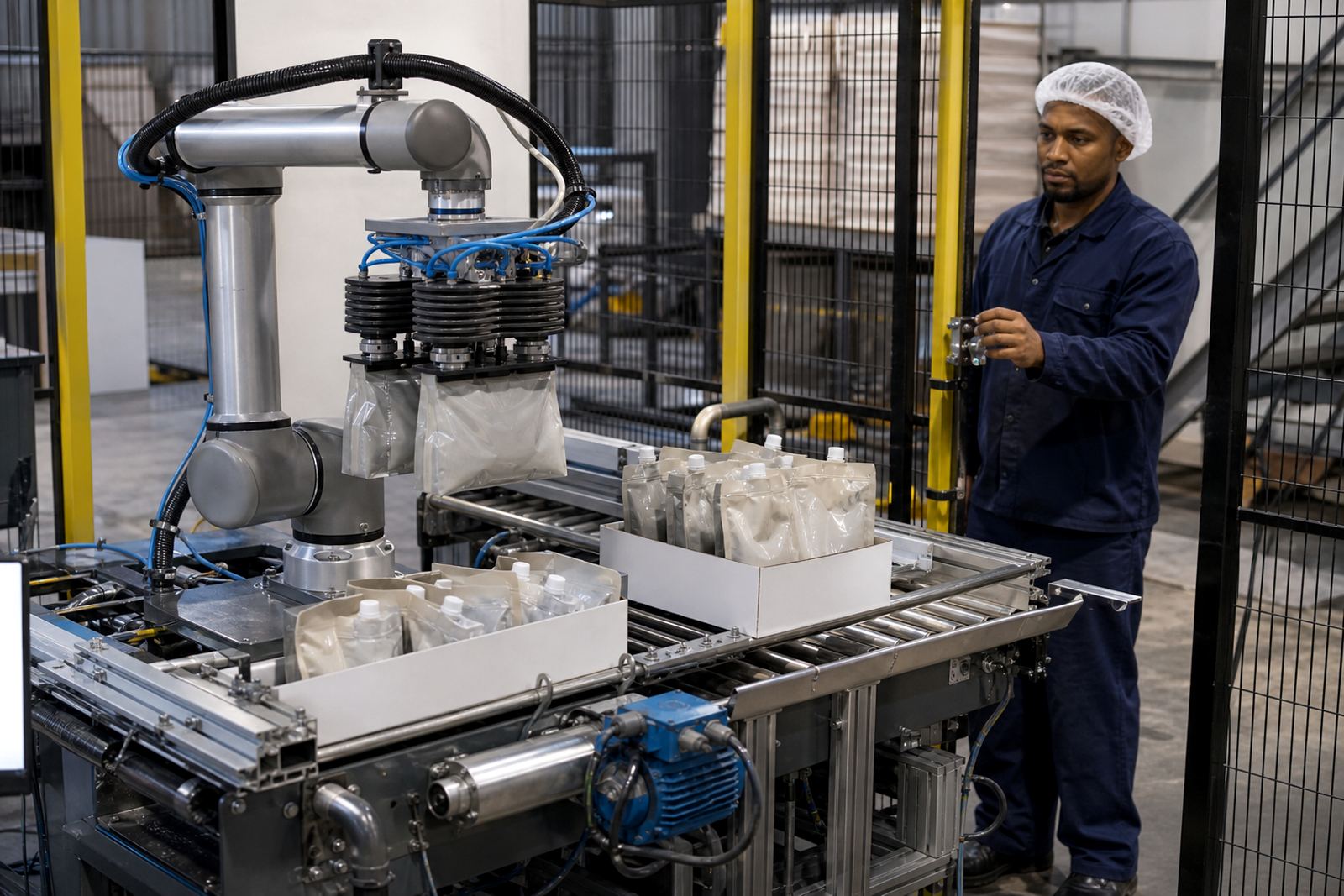
What A Pouch Packing Cell Does On A Live Line
A pouch packing cell is built to pick flexible packs from a conveyor, orient them correctly and place them into cases or trays with repeatable motion. It is often used where pouches can shift, slide or wrinkle, so the handling has to be gentle and the timing has to match the packer, case erector and conveyor speed. The retrofit works around your current line layout rather than forcing a full plant change.
In Spartan, Kempton Park or on a site in Durban, the practical issues are usually the same: enough infeed buffer, safe access for operators, and clear handover points between conveyors, sensors and the robot. Each line needs its own risk assessment before final layout is signed off.
Typical Cell Layouts, Sizes And Options
Pouch packing cells can be set up as compact single-lane stations or wider multi-lane systems, depending on pouch size, case format and throughput. A smaller cell may fit into a line footprint of about 3 m by 4 m, while a larger layout with infeed accumulation, guarding and discharge conveyors can take more space. The exact size depends on reach, case presentation and whether the robot works over one or two case positions.
Common options include vacuum or soft grip handling, pouch orientation devices, reject handling, barcode or vision checks, and automatic case advance. If the pouches are light and flexible, a cobot may suit slower speeds and closer operator interaction, but many packaging lines still need an industrial robot for higher output. The right choice depends on the product, the duty cycle and the level of guarding needed.
- Single-lane or multi-lane infeed
- Case or tray packing
- Pick from conveyor or accumulation table
- Stacking pattern changes for different case counts
- Integration with upstream and downstream equipment
Where This Retrofit Suits Best
This type of retrofit suits food, personal care, household products, agricultural packs and light industrial goods where pouches are sealed, labelled and ready for final packing. It is useful where labour is stretched, packaging quality must stay consistent, or the line has grown in stages and now needs better control. We see strong demand from manufacturers in Johannesburg, Pretoria, Cape Town, Gqeberha and Durban who want to automate the end of line without rebuilding the whole plant.
It also suits operations that need cleaner case loading and less product damage. Flexible packs can be awkward to handle by hand, especially when shifts are long or the plant runs in heat and humidity. A properly set cell keeps the pack count steady and reduces rework caused by crushed corners, skewed placement or missing packs. Small typo in the realities of packing, the line must still be easy to operate and simple to maintain.
- High labour content at the end of line
- Mixed pack sizes with repeatable case patterns
- Sites with limited floor space for new equipment
- Plants needing safer handling and less manual lifting
- Lines that must keep existing conveyors and controls in place
Installation, Power And Utilities You Should Plan For
Installation starts with a site line survey, then retrofit design, controls integration and a shutdown plan that fits your production schedule. We work to the existing conveyor heights, case flow and operator access points wherever possible. If there is old equipment in the line, we assess what can stay, what must be modified and how the new cell will talk to your current controls. The aim is to keep disruption manageable and make the changeover practical, not dramatic.
Power needs depend on the robot size, vacuum generation, sensors and any auxiliary equipment. Most pouch packing cells need a stable electrical supply, proper earthing, clean compressed air if pneumatic actuators are used, and enough floor loading capacity for the base frame and guarding.A well planned cell should restart without the operator having to wrestle with product jams.
- Electrical supply sized to the selected robot and auxiliaries
- Compressed air for actuators or end-of-arm tooling where required
- Safe access gates and interlocks fitted to the final layout
- Conveyor handshakes checked before commissioning
- Restart and fault recovery steps defined for operators
Safety Guarding And Risk Assessment Support
Every pouch packing cell needs guarding or controlled access that matches the actual site conditions. That may include fixed fencing, interlocked doors, light curtain protection, area scanning or cobot speed limits, depending on the final layout and task. The same machine can need different protection at a warehouse in Midvaal than at a busy plant in Pretoria because traffic, product flow and operator movement are different.
We provide risk assessment support so the line is judged against its actual hazards: pinch points, reach-in zones, case transfer, maintenance access and unexpected restart. This includes checks for cleaning routines, jam clearing and safe lockout practices. The end goal is a cell that is practical to run and easy to isolate when service is needed. That is where many retrofits go wrong if the planning is rushed.
- Fixed guarding for higher speed applications
- Interlocks and access control for service areas
- Operator instructions for clearing simple faults
- Maintenance isolation points marked clearly
- Site specific risk review before commissioning
Care, Servicing And Spare Parts Planning
Like any packing line equipment, a pouch packing cell works best when it is cleaned, checked and kept in adjustment. Daily housekeeping should remove dust build-up, film scraps and carton offcuts from sensors, guides and conveyor transfer points. Weekly checks should confirm that tooling is aligned, vacuum cups or grippers are holding correctly, and the safety devices are functioning as intended.
For longer term support, maintenance planning should cover wear parts, gripper pads, vacuum components, sensors and common electrical spares. We also support breakdown assistance, so faults can be traced quickly and the line brought back into service with less downtime. In humid coastal conditions, corrosion and sticky build-up can become a nuisance, so material choice and cleaning routines matter more than people expect.
What To Check Before You Order A Retrofit
Before ordering, the key questions are simple: what pouch size range must be handled, how many packs per case, what line speed is required, and what space is available for the cell and guarding. It also helps to know whether the pouches arrive in one lane or several, whether they are slippery, and whether case presentation is manual or automatic. Those details shape the tooling and the conveyor interface.
You should also confirm the site power availability, compressed air supply, existing control system details and any plant rules that affect access or shutdowns. If the line is in Johannesburg, Durban, Cape Town, Gqeberha, Pretoria or anywhere on the East Rand, local site conditions can change the final layout quite a bit. A proper brief saves time later and helps avoid costly changes after fabrication has started.
- Pouch dimensions and pack weight
- Case count, pattern and case size range
- Line speed and shift pattern
- Available floor space and ceiling clearance
- Existing conveyor heights and controls
- Utility supply and downtime window for installation
Key facts
| Application | Retrofit pouch packing cell for case loading |
|---|---|
| Product handling | Flexible pouches, sachets or flat packs into cases or trays |
| Typical footprint | About 3 m x 4 m to larger multi-lane layouts, depending on reach and case flow |
| Utilities | Electrical supply, compressed air where required, stable network and control signals |
| Integration | Works with existing conveyors, case handling and upstream packing equipment |
| Support | Site surveys, installation management, commissioning support, training and maintenance |