What Clamp Gripper Tooling Does on a Line
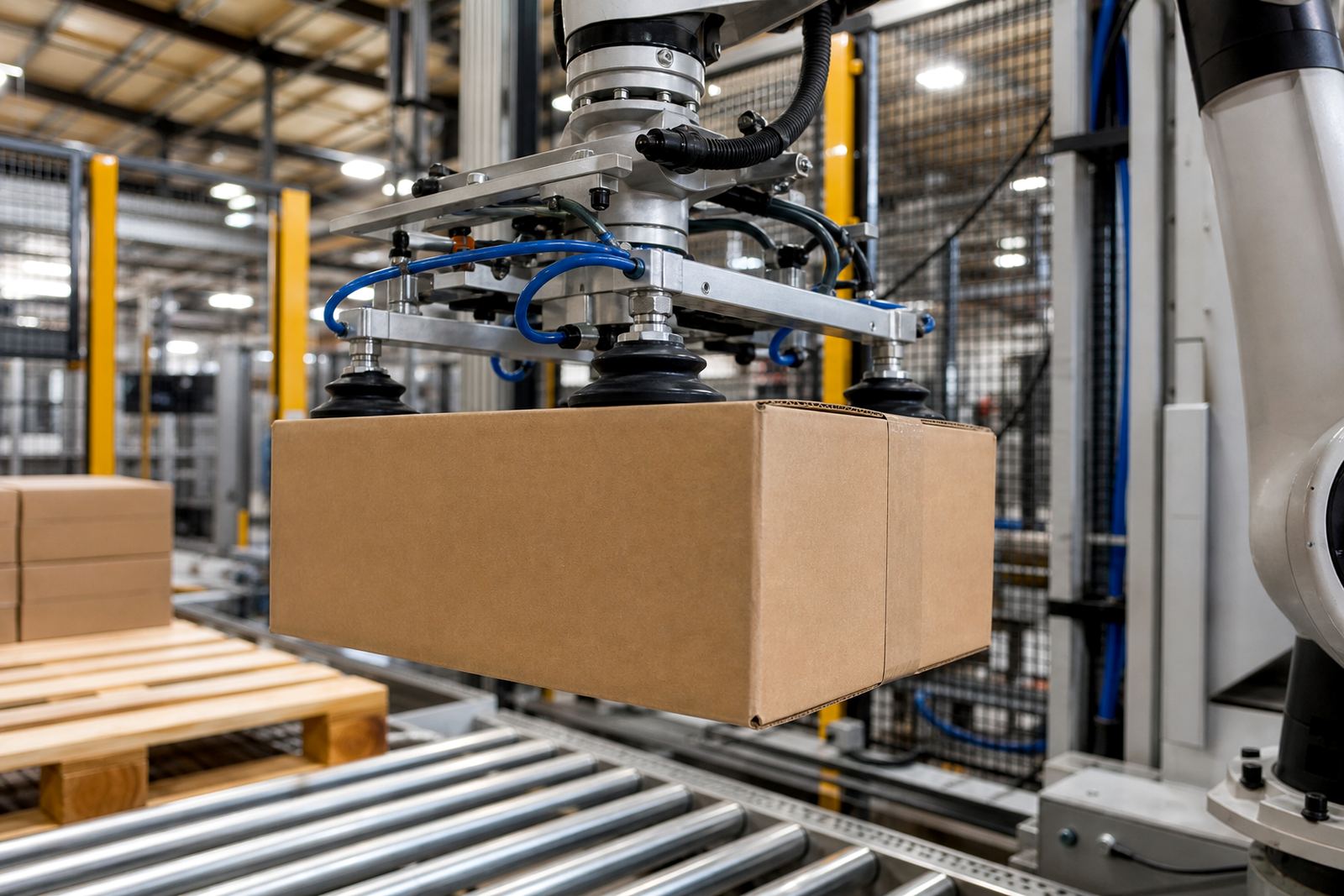
Clamp gripper tooling holds a carton, sack, tray, bundle or similar pack from the sides so the product stays controlled during movement. On a palletising line, that side support helps with square placement, neat layer building and consistent transfer from conveyor to pallet. On packing lines, it can assist where packs need to be held steady before grouping, staging or loading.
This type of tooling is often chosen when top gripping is not suitable, or where the product surface is uneven, dusty or too soft for suction. It is also useful for items that need to stay aligned as they pass through a conveyor handover or a robot pick and place sequence. For some lines, the clamp forms part of a simple end of arm arrangement. On others it is combined with guides, sensors and controlled stops to suit the product flow.
As with any retrofit, the best clamp style depends on the item, the weight, the finish and the way it moves through the line. A site survey helps confirm the available space, conveyor heights and the point where the robot must grip the product. That matters on older lines in Johannesburg, Durban, Cape Town, Pretoria and Gqeberha where conveyors, guards and posts are already in place.
Clamp Sizes, Jaw Faces and Holding Options
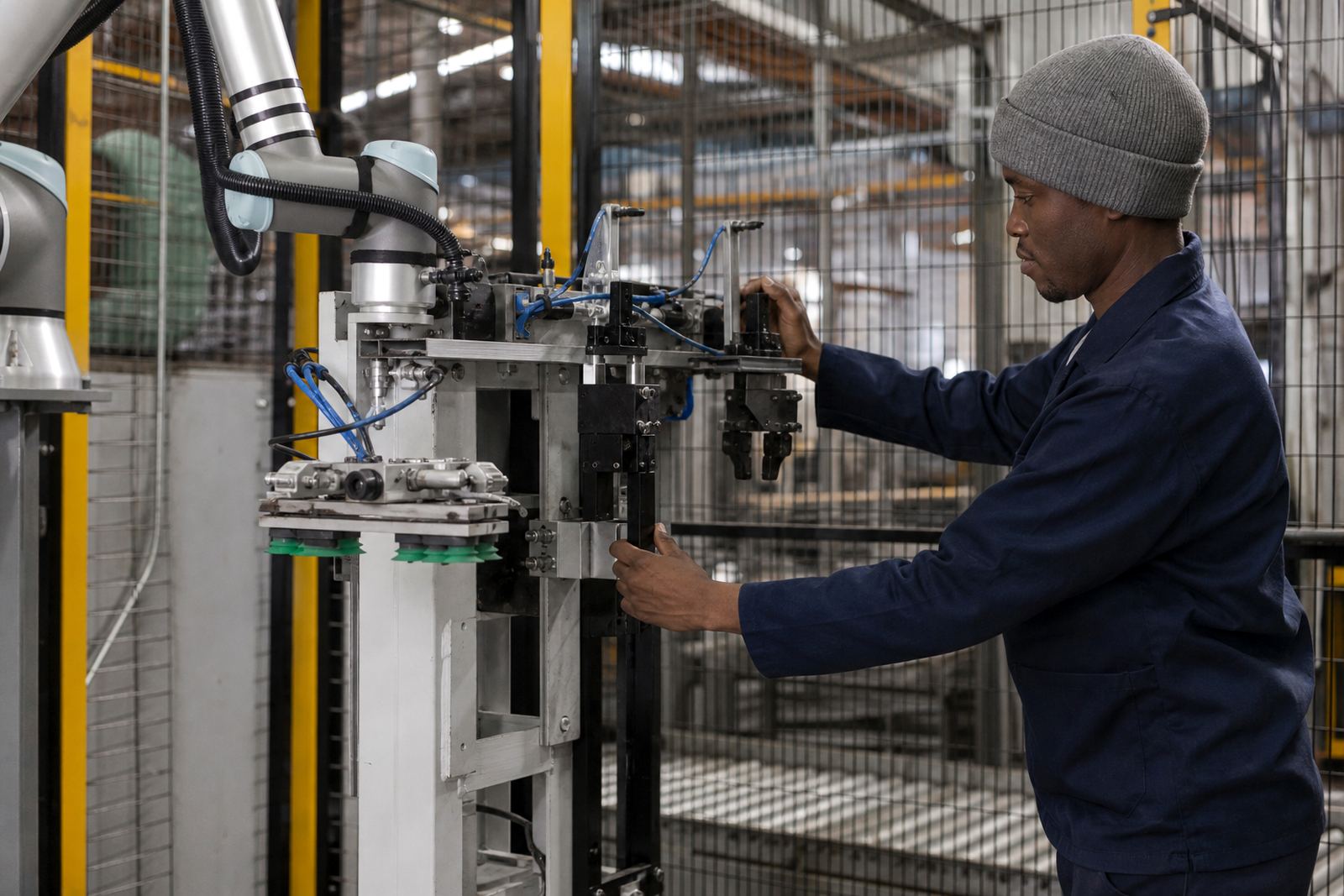
Clamp gripper tooling is built to suit the product envelope and the required holding force. Some jobs need wide jaws for cartons or crates. Others need compact jaws for smaller packs with limited side contact. In a retrofit, the goal is to match the tool to the product without slowing the line or crushing the pack.
Common options include adjustable jaw spans, fixed jaw plates, padded contact faces and wear resistant liners. Jaw faces may be smooth, ribbed or lined to improve grip on printed cartons, shrink wrapped packs or slightly irregular surfaces. Where product damage is a concern, softer contact materials can help reduce marking. On dusty or humid sites, especially near the coast, the contact faces and guiding parts must be selected with maintenance in mind.
- Jaw span matched to the product width and any carton variation
- Opening stroke set for the pick point and release height
- Clamp pressure set to hold firmly without deforming the pack
- Optional product guides for narrow or unstable loads
- Tool mass kept within the robot or gantry payload limit
Clamp tooling can be supplied for single packs, twin packs or grouped units depending on the arrangement of the line. If a pallet layer needs multiple items handled at once, the tooling must be sized for that layer pattern and the transfer speed. That is why the layout needs to be checked against the actual product samples, not only the drawing.
Where Clamp Grippers Suit Packing and Palletising Retrofits
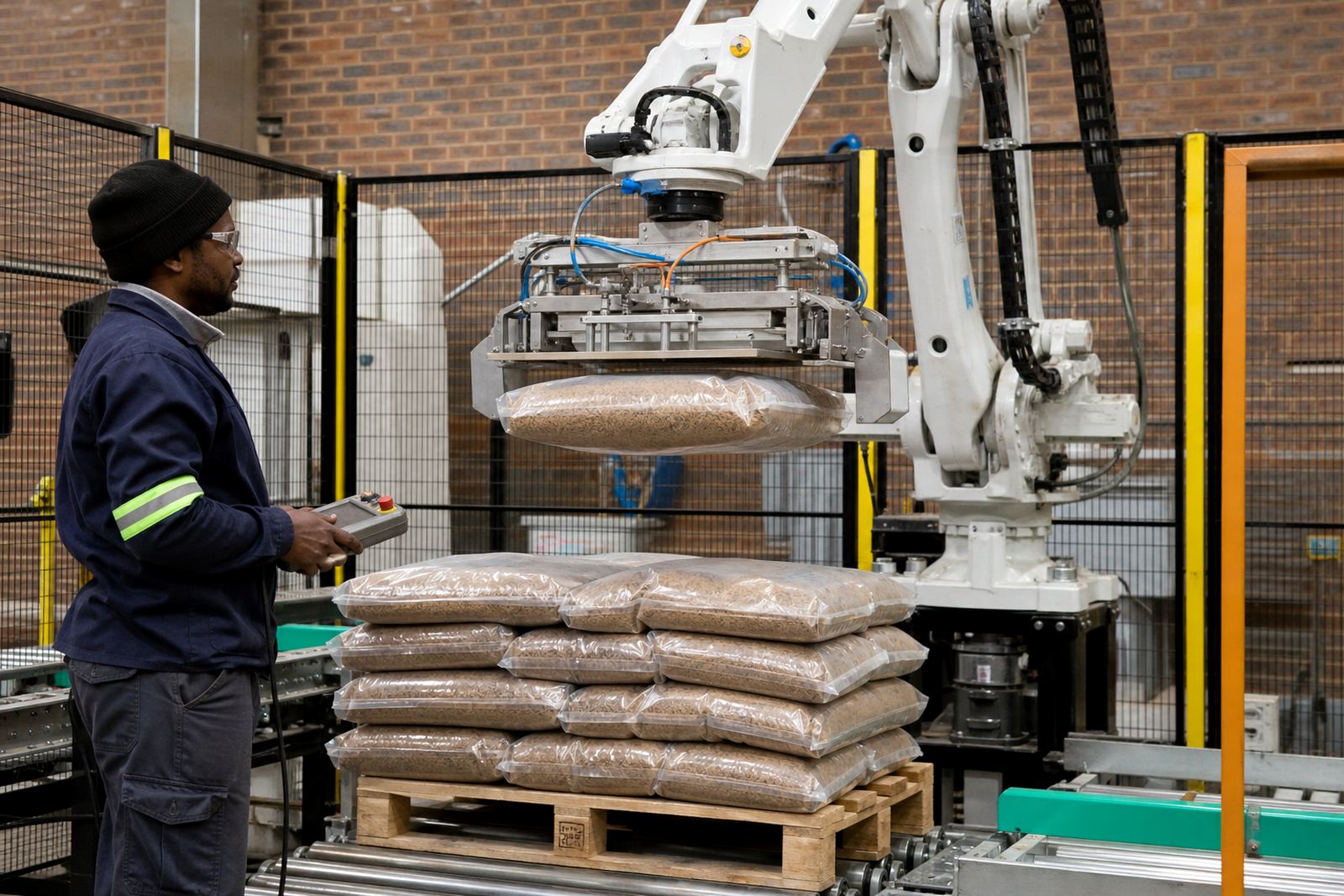
Clamp grippers suit operations where products need firm lateral support and repeatable placement. They are often used on cartons, boxed goods, pails, trays, bundling products and certain wrapped packs. They can also work on some bagged products if the bags are stable enough and the grip points are chosen carefully. For fragile packs, the clamping force must be set conservatively and tested on site.
They are a good fit for factories that want to reduce manual lifting, improve packing consistency and keep operators away from repetitive side loading tasks.In coastal areas, the equipment also needs to cope with moisture, salt in the air and regular washdown practices where applicable.
Clamp gripper tooling is not the answer for every item. Loose sacks, highly compressible goods, very soft packs or irregular shapes may need another gripping method. For that reason the product assessment should look at actual samples, weight, surface finish, pack rigidity and how the load behaves at speed. The aim is to avoid unnecessary damage and keep changeover practical for the operators on shift.
Installation, Power and Air Requirements
In a retrofit, clamp gripper tooling must integrate with the existing conveyor system, robot or transfer axis and the line controls. The physical fit is important, but so is the timing. The clamp must open, close and release at the correct moment, while the conveyor stop or accumulation section presents the product in a repeatable position.
Depending on the design, clamp tooling may use pneumatic actuation, electric actuation or a mix of both. Pneumatic systems usually need clean, dry compressed air at the correct pressure and stable flow. Electric systems need suitable power, control signals and protection for the wiring route. Where compressed air is used, the site should plan for filtration, moisture management and access to isolation points. This is especially important where compressors already serve multiple machines.
Power and utilities should be checked before fabrication starts. You need to know what supply is available, where the isolation points are and how the new tooling will tie into the existing panel. A site-specific risk assessment and controls review should also check emergency stops, interlocks, access gates and restart behaviour after a power interruption. Each site needs its own assessment, no matter how similar the line may look to another plant.
- Confirm robot or handling axis payload and wrist loading
- Check available compressed air pressure and flow, if pneumatic
- Allow for cable routing, hose routing and snag protection
- Verify guard openings, sensor positions and access for maintenance
- Plan for controlled restart after stoppages or events
Safety Guarding and Risk Assessment Support
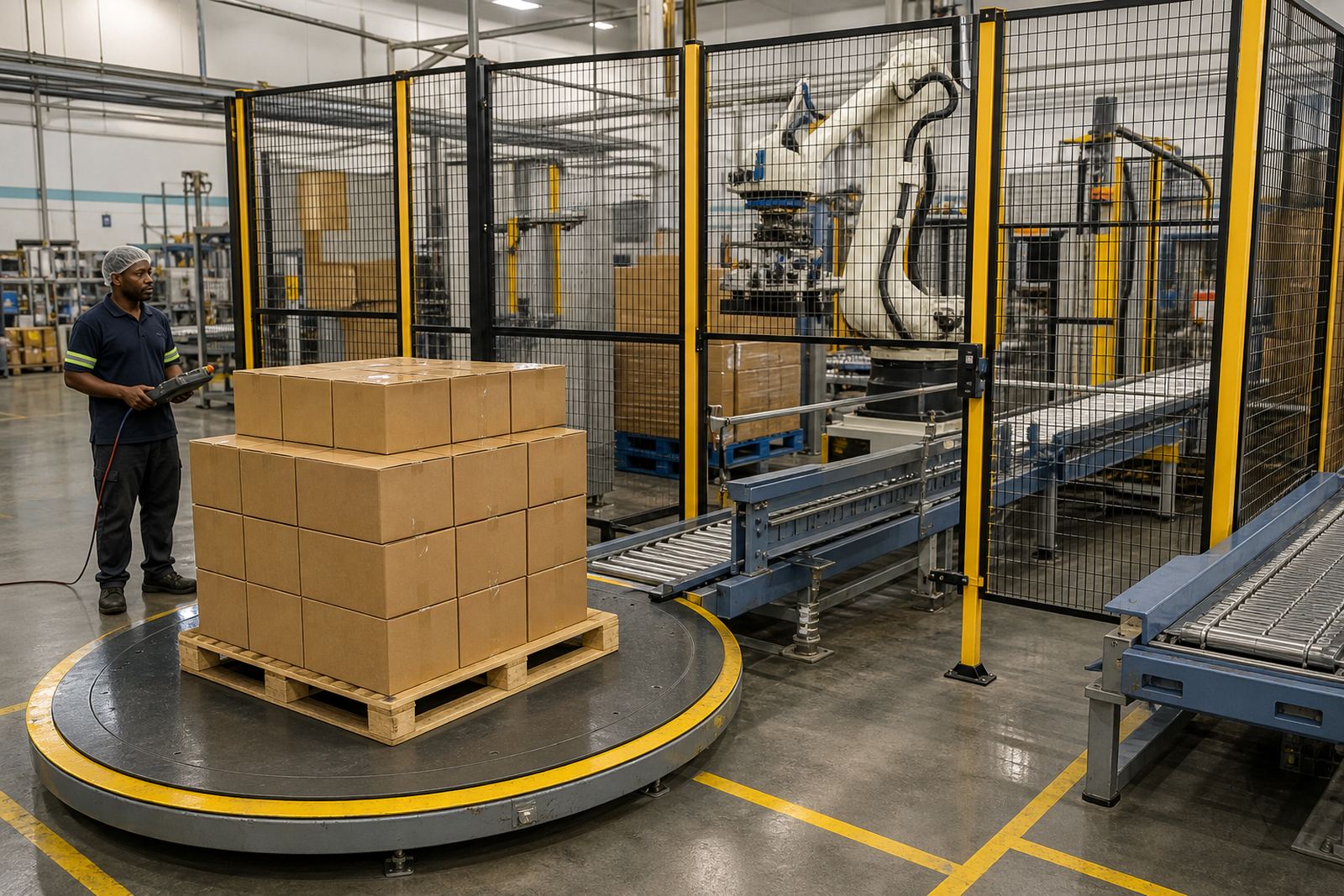
Clamp tooling must be installed as part of a safe system, not as a stand-alone attachment. The clamp points, moving axes and transfer areas must be guarded or otherwise controlled so operators cannot reach into danger zones during operation. Guarding may include fixed panels, interlocked doors, light curtains or a combination depending on the line layout and the task at hand.
The safety approach should be based on the real site conditions, the speed of the line, the product weight and the operator tasks around the cell. For example, a palletising cell in Pretoria with frequent fork truck movement will need a different layout from a smaller packing line in Midvaal. The line must also allow for safe access during setup, cleaning, fault finding and maintenance.
Risk assessment support should cover pinch points, crushing hazards, trapped energy, dropped loads and the possibility of a product slipping from the jaws. It should also consider manual intervention points such as rework, clearing jams and sample changeovers. The goal is practical safety that suits the factory, not a generic drawing that misses the way the line is actually used.
Care, Servicing and Ordering Checks
Clamp gripper tooling needs routine checking to keep holding force consistent and prevent wear from building up. Jaws, pads, guide rails, pins and hoses should be inspected for looseness, scoring, air leaks or contamination. If the tooling works on dusty cartons or shrink wrapped goods, build-up on the contact faces can reduce grip and should be cleaned on a regular schedule. On humid coastal sites, corrosion checks should be added to the maintenance routine.
Servicing is usually straightforward if the tooling was designed for access from the start. Wear parts should be easy to remove and replace, and the operator should be able to spot damage before it affects product quality. Spare parts planning matters too, especially where the line runs two shifts or where downtime is costly. A sensible spares list can include seals, pads, fasteners, sensors and any hoses or fittings that tend to wear first.
Before ordering clamp gripper tooling, have the following ready:
- Product dimensions, weight and surface type
- Required pack orientation and layer pattern
- Conveyor height, pick point and release point
- Line speed, cycle time and available utilities
- Any special handling concerns such as fragile packs or coated cartons
- Photos or samples from the actual line, including the surrounding guards and transfer points
With the right information upfront, the clamp can be sized to the job and integrated cleanly into the existing line. That reduces trial and error on site and helps the retrofit settle into normal production faster.
Key facts
| Product type | Clamp gripper tooling for packing and palletising retrofits |
|---|---|
| Typical use | Side grip transfer, stacking, layer build and controlled placement |
| Grip styles | Adjustable jaws, fixed jaws, padded faces, wear liners |
| Typical actuation | Pneumatic, electric or combined, depending on the line |
| Integration | Suitable for existing conveyors, robots, transfer axes and controls |
| Site note | Each installation needs its own risk assessment and line survey |