What a Bag Palletiser Retrofit Does
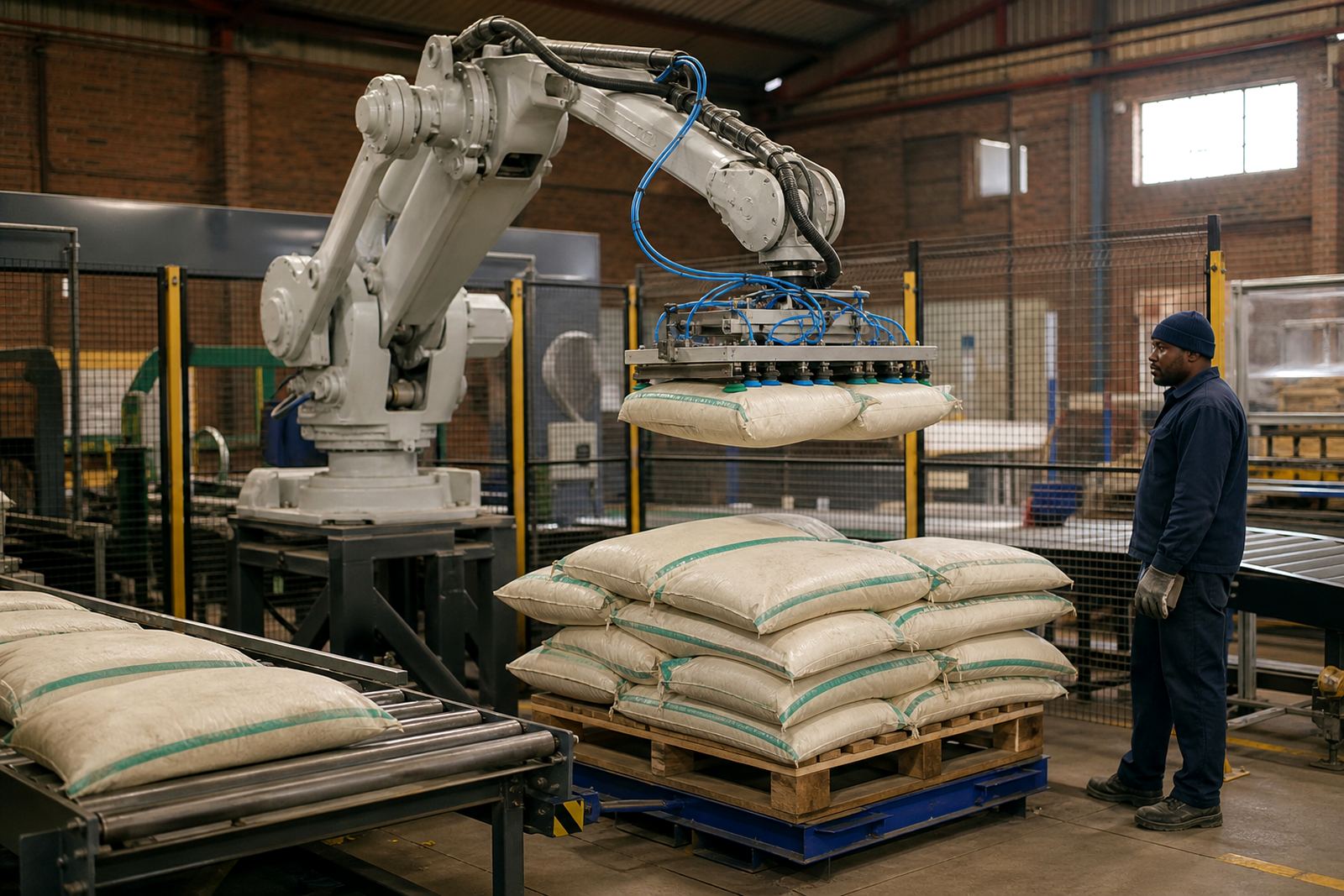
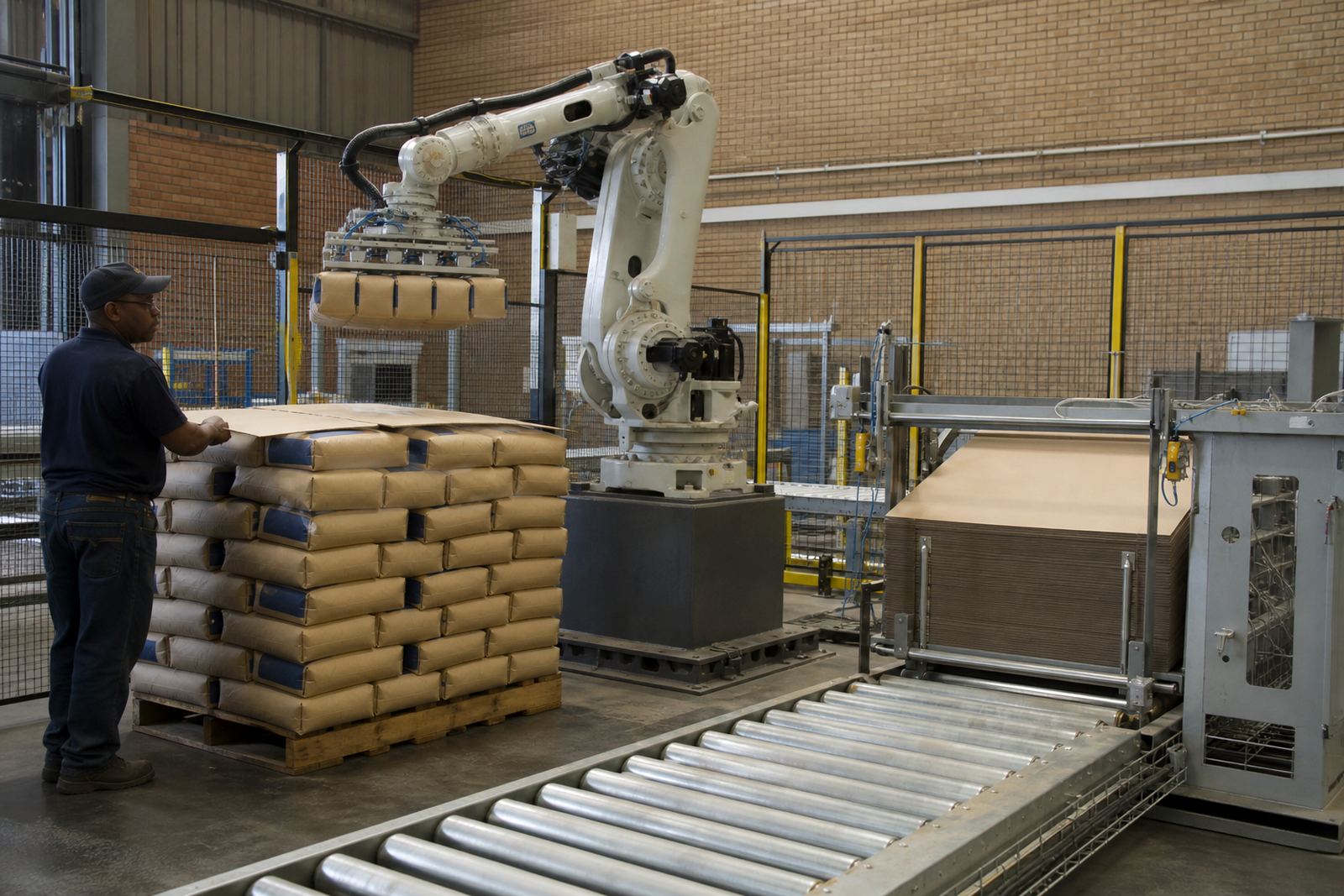
A bag palletiser retrofit adds robotic or cobot based palletising to an existing packing line, using bags coming off your current conveyor discharge and placing them into a set stacking pattern on a pallet. It is suited to dry goods, granular products, feeds, powders and similar bagged product where repetitive lifting is slowing the line or putting strain on operators.
At our base in Spartan, Kempton Park, we work on retrofits that fit into live plants without rebuilding the whole line. The aim is to keep your existing infeed, conveyor heights and pallet staging where practical, then add the robot cell, controls and safety layers around that flow.
This is not the same setup for every site. Bag size, weight, bag surface, pallet height and available floor space all affect the cell layout, end effector choice and stacking pattern. A proper site survey is the starting point, especially where aisles are tight, floors are uneven or shutdown windows are limited.
Where It Suits and What It Handles
Bag palletising retrofits suit plants that need consistent pallet quality and less manual stacking at the end of line. They are common on feeds, cement additives, fertiliser, food ingredients, animal products, building materials and many other bagged goods moving on conveyor.
The retrofit can be planned for a single discharge or for more than one line feeding a shared palletising point.
- Typical bag weights: 5 kg to 50 kg, depending on the product and handling method
- Typical bag lengths: around 300 mm to 900 mm
- Typical pallet footprints: 1 000 x 1 200 mm and 1 100 x 1 100 mm, or site specific sizes
- Common output: one palletising point per line, or a shared cell with accumulation
Retrofit Options and Cell Layouts
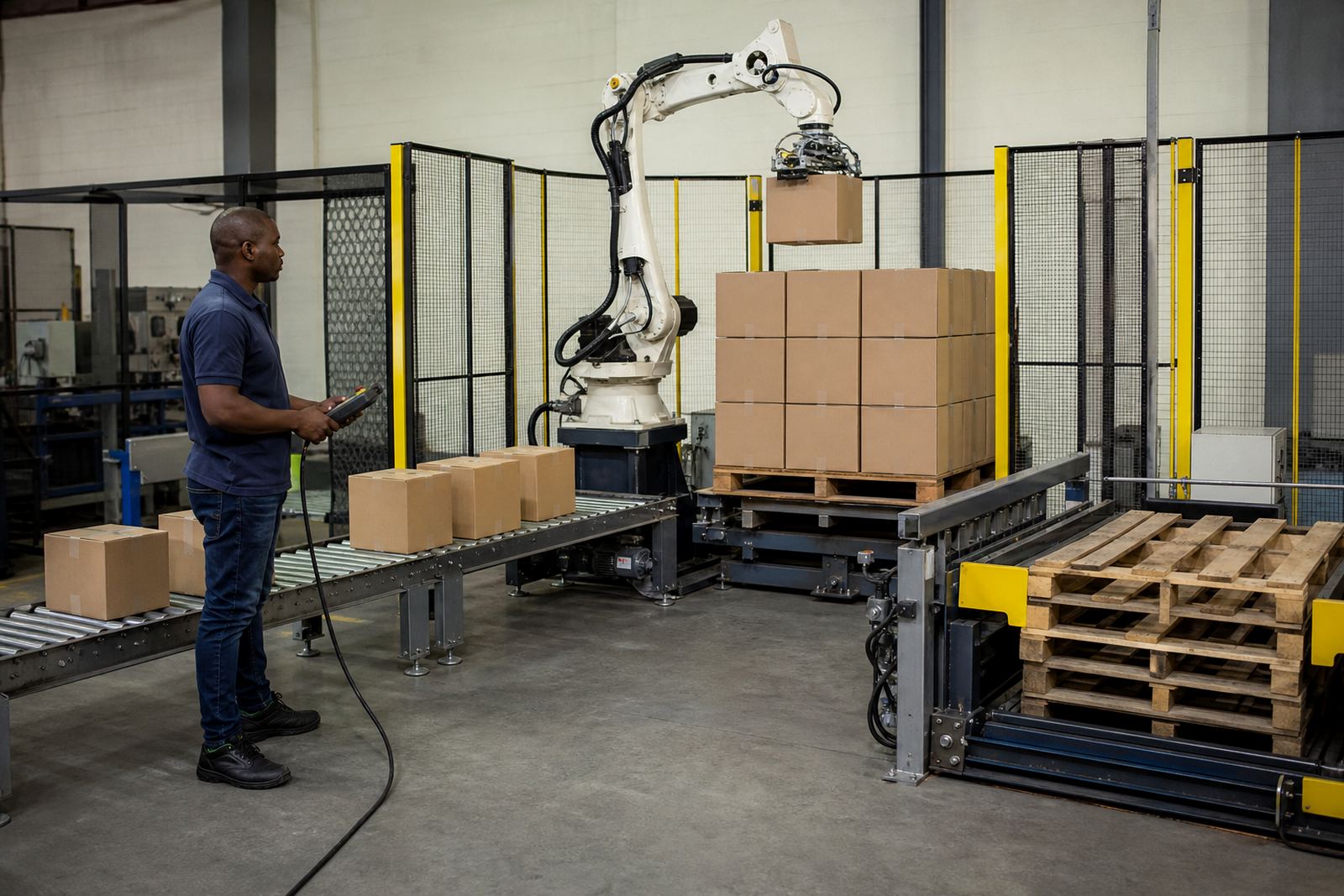
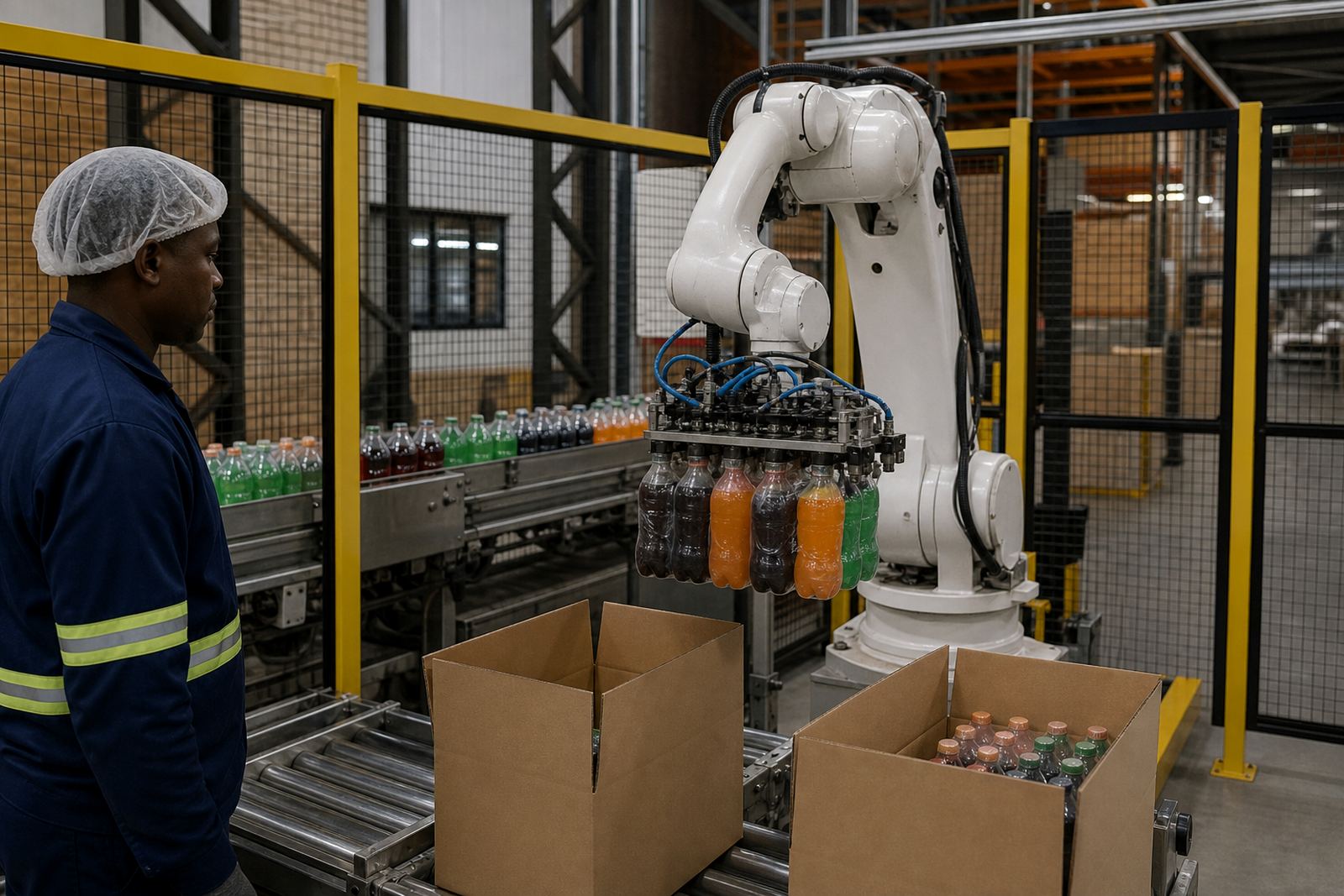
There are several ways to configure a bag palletiser retrofit, depending on your space and throughput. Some sites need a compact articulated robot beside an existing conveyor, while others suit a cobot based cell with lower speeds and closer operator interaction. In heavier duty environments, a fully fenced robot cell with pallet infeed and stretch wrap staging is often the better fit.
We look at how the bags arrive, how they are de-aerated or settled if needed, and how the pallet is indexed. If the bags are slippery, soft or uneven, the gripper needs to be chosen carefully so the bag is held without distortion. When the stack pattern is complex, the controls logic must manage layer changes and slip sheets if used.
- Side entry or end of line pallet build layout
- Single pallet or dual pallet staging
- With or without layer pads or interleaves
- Optional pallet dispenser and empty pallet magazine
- Integration with existing wrap station or downstream transfer
Safety Guarding, Risk Assessment and Controls
Every site needs its own risk assessment. General safety rules are not enough on their own because each plant has different access points, traffic routes, product behaviour and operating pace. A retrofit normally includes guarding, interlocked access gates, warning devices and safe stop functions matched to the site layout.
Controls integration links the robot with your existing conveyors, sensors, pallet presence checks and emergency stops. This is where a retrofit succeeds or fails. If the line has old panels, mixed voltage circuits or unclear wiring histories, those issues must be found early so the new cell can be handed over safely and in a way maintenance staff can support later.
In South African plants, we also allow for practical concerns like municipal noise limits where applicable, safe pedestrian routes and lockout procedures during maintenance. The goal is a cell that can be operated by trained staff without constant intervention or risky shortcuts.
Installation, Utilities and Start-Up
Most bag palletiser retrofits are installed in phases so the line can keep running for part of the project. ReAutomated manages installation coordination, mechanical fitment, controls tie-in and commissioning support, working with your production team to limit disruption.
Power demand depends on the robot size, gripper package and any auxiliary equipment fitted. Many installations call for a three phase electrical supply, with correct earthing and local isolation in place. Compressed air may be needed for certain grippers, bag handling aids or pneumatic gates, but not every layout uses air.
- Site Line Surveys before final design
- Conveyor Integration and Controls Integration
- Installation Management and Commissioning Support
- Operator Training before handover
Care, Servicing and Breakdown Support
A palletising retrofit works best when it is treated as part of the line, not a once off install. Bags shed dust, pallet wrap can snag and conveyors need alignment checks. Routine care keeps the cell accurate and reduces unexpected stops.
We support maintenance planning, spares planning and breakdown assistance for sites across Kempton Park, Johannesburg, Pretoria, Durban, Cape Town, Gqeberha, East Rand and Midvaal. Typical care tasks include checking gripper wear points, cable condition, safety devices, sensor alignment and conveyor transfers. On coastal sites, corrosion control and enclosure cleanliness matter more, while inland sites may need extra attention to dust build-up and heat.
Trained operators should know the correct start-up sequence, fault reset steps and what not to override. Small issues handled early save bigger downtime later, especially where the line is running long shifts or seasonal peaks.
What to Check When Ordering
Before ordering a bag palletiser retrofit, gather the basic line details so the design matches your plant instead of forcing your plant to fit the machine. The more accurate the information, the cleaner the installation and commissioning run.
- Bag type, weight range and product behaviour
- Required bags per minute or bags per hour
- Available floor space, ceiling height and pallet staging room
- Existing conveyor height, speed and direction of flow
- Preferred pallet size, stack pattern and maximum pallet height
- Available power supply, air supply and any site shutdown windows
If you are unsure about any of these points, a site line survey will narrow it down. ReAutomated is based in Spartan, Kempton Park, where the team handles surveys, retrofit design, controls, safety guarding and service support.
Key facts
| Product type | Bag palletiser retrofit for existing conveyor discharge lines |
|---|---|
| Typical payload | 5 kg to 50 kg bags, subject to product and gripper design |
| Stacking method | Layered palletising with controlled pattern changes |
| Integration | Existing conveyors, sensors, pallet staging and wrap station |
| Utilities | Three-phase mains and plant air where the cell design calls for it, with no process gas for standard robot cells |
| Coverage | Kempton Park, Johannesburg, Pretoria, Durban, Cape Town, Gqeberha, East Rand, Midvaal |