What a Crate Handling Robot Retrofit Does
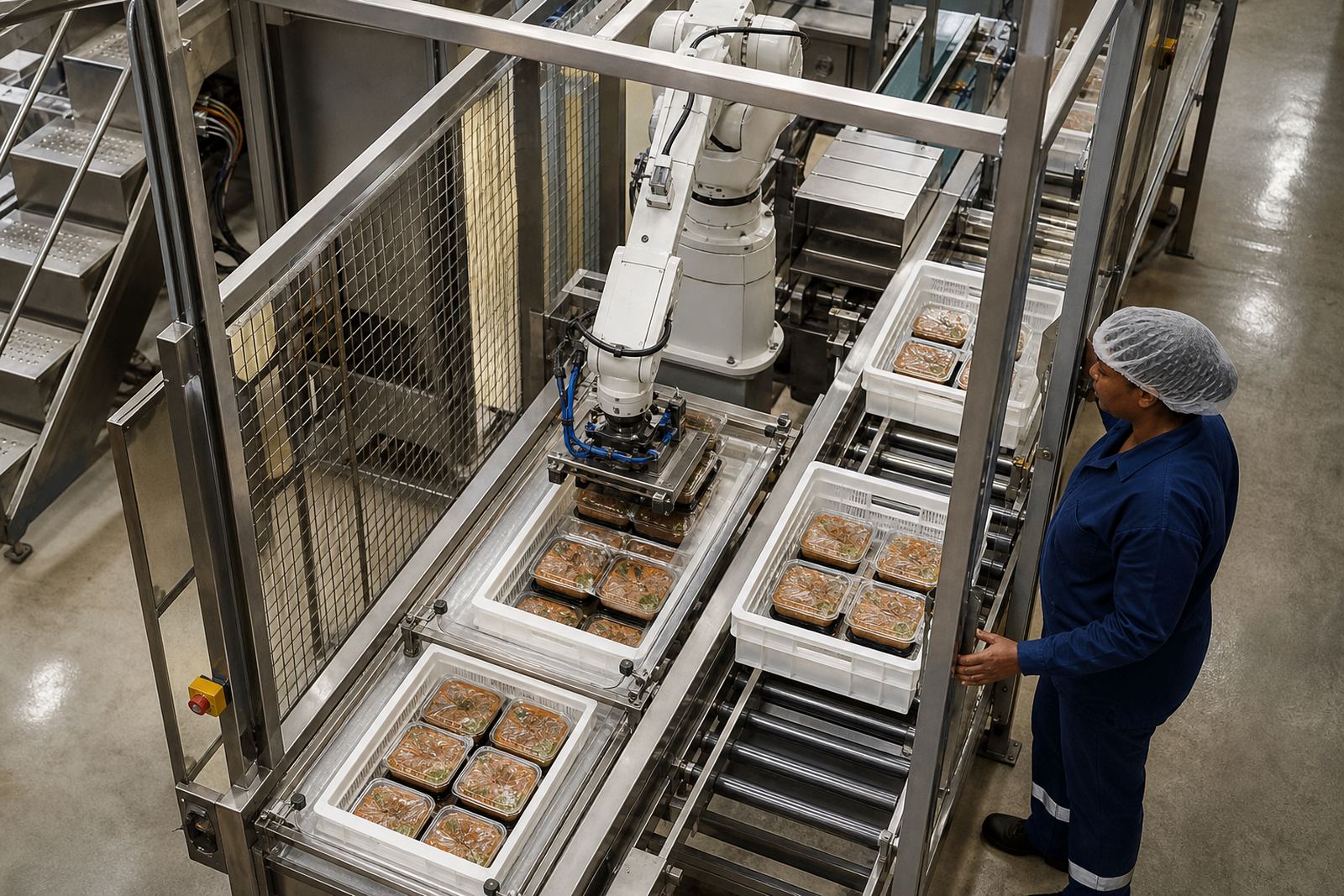
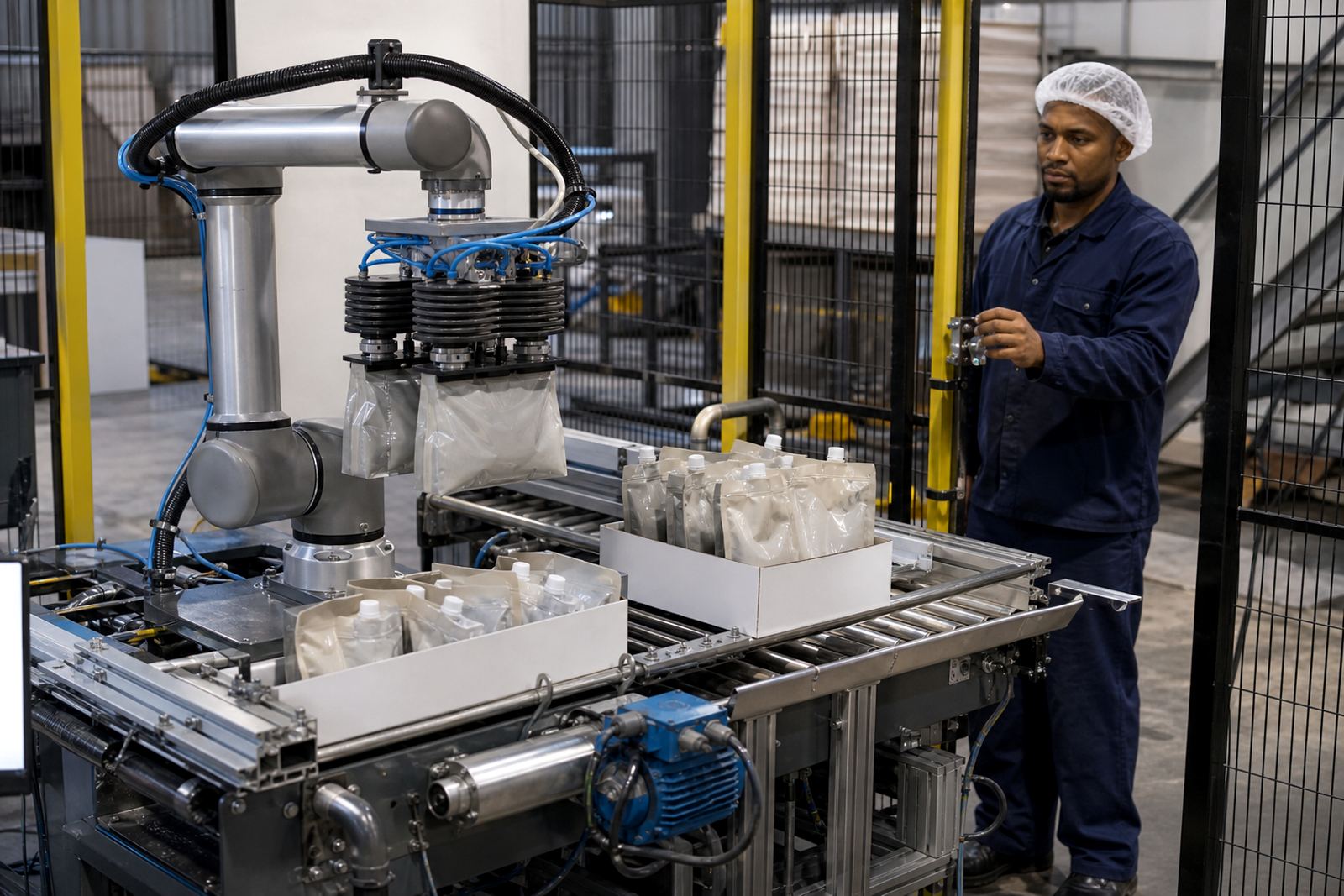
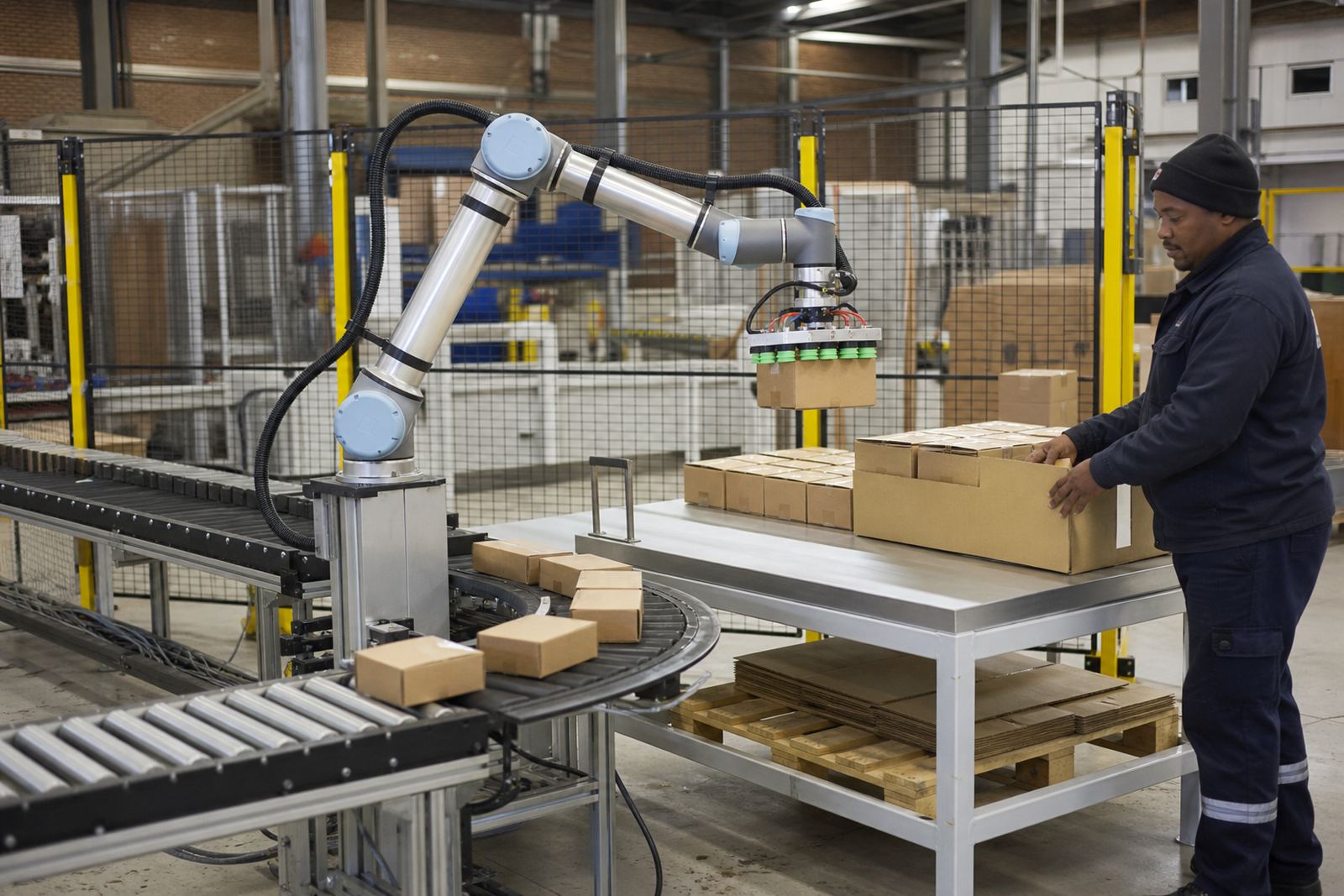
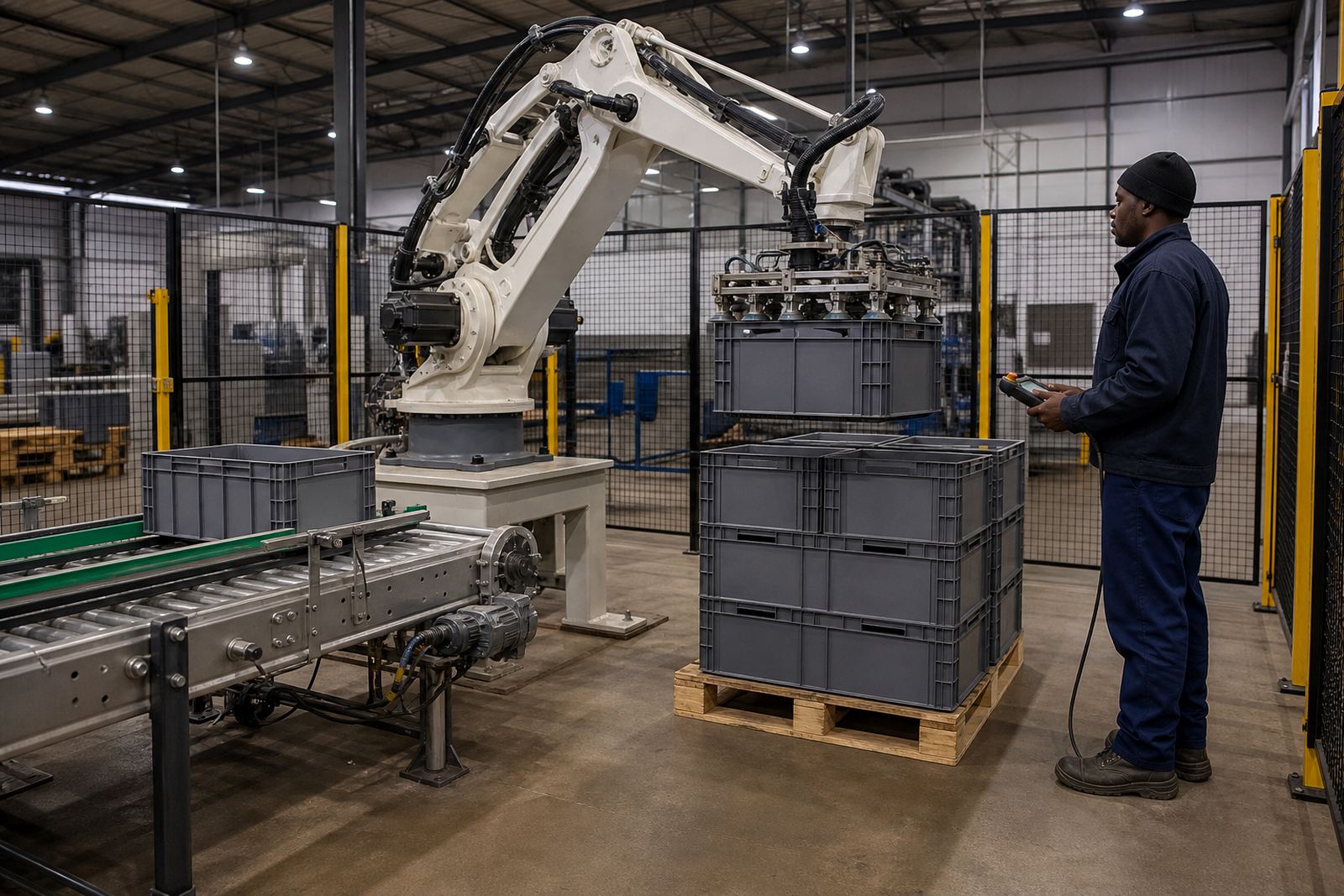
A crate handling robot retrofit is used where workers are still lifting, shifting or stacking crates by hand along a packing line. The robot can pick from a conveyor, move the crate to another conveyor, place it onto a pallet pattern, or hand it off to a shuttle or accumulation section.
These systems are usually fitted into an existing line, so the conveyor height, approach angle, pallet position and available floor space all matter. The crate may be full, empty, open top or lidded, and that affects the gripper design and the transfer method. Some sites need a simple pick and place unit, while others need a robot working with sensors, stops, reject points and palletising logic.
For manufacturers in Johannesburg, Pretoria, Durban, Cape Town, Gqeberha and across the East Rand, the main benefit is consistency. A properly designed retrofit can keep crate orientation correct, reduce product damage and make line handling more predictable for operators and supervisors alike.
Typical Sizes, Reach and Layout Options
Crate handling systems are sized around the crate dimensions, weight and the speed of the line. In most retrofit projects, the robot arm or gantry is selected to cover the infeed point, the transfer point and the pallet build area without forcing major changes to the rest of the conveyor layout. The work envelope should be checked against the stack height, pallet height and any overhead structures before ordering begins.
Common options include floor mounted robots, side-mounted units, and enclosed cells where space is tight. In some plants a cobot may suit lower-speed handling or assisted loading tasks, but it is not the right answer for every application. Crate handling still needs proper guarding or safety-rated separation where people and moving equipment share the area.
- Crate size range: small tote style crates through to larger industrial crates, subject to gripper design
- Payload range: depends on the crate weight and the reach required at full extension
- Reach options: short reach for compact cells, extended reach for wider pallet patterns
- Line speeds: from slower manual replacement lines to higher-throughput packing areas
- Layout types: conveyor-to-conveyor, conveyor-to-pallet, pallet-to-conveyor and mixed transfer cells
Where Crate Handling Fits Best
These retrofits suit plants where crates move through repeated handoffs, especially where workers are lifting from one conveyor to another or stacking into neat pallet patterns. They are common in food, beverage, agricultural packhouses, plastics, distribution, and general manufacturing where crates are used for staging or dispatch. In humid coastal conditions, as in Durban and Gqeberha, equipment selection should account for corrosion risk and dust ingress, while inland sites often focus more on dust, heat and vibration.
It also helps where there is limited labour available for repetitive work, or where operators are being pulled off the line to manage other tasks. A crate handling robot can work alongside existing conveyors, pallet dispensers, wrap stations and label points, provided the controls are planned properly. If your plant uses mixed crate sizes, the gripper, detection and recipe setup need to be checked early, not left until commissioning week.
- Suitable for repetitive crate transfer between conveyor sections
- Useful where manual stacking is slowing down packing output
- Works well in plants needing more stable line flow and fewer handling errors
- Can be combined with palletising, depalletising or buffer accumulation
Installation, Power and Site Requirements
Every retrofit starts with a site line survey and a look at the existing conveyor route, structural support, pallet position and operator access. ReAutomated plans the install around the plant’s real conditions, including floor quality, available mounting space, cable routes and the shutdown windows allowed by the factory. On older lines, it is common to find uneven conveyor heights, worn rollers or limited guarding space, so the retrofit must allow for practical adjustments.
Power needs vary by the robot size and the control package, but the site should expect an electrical supply suitable for the drive system, controls cabinet and any ancillary equipment such as sensors, clamps or pneumatic devices. Air supply may be needed where a gripper uses pneumatic actuation, while some end-of-arm tools are fully electric.
The installation normally includes mechanical fitment, conveyor integration, control wiring, guarding and final testing. Where personnel work near the cell, safety guarding design must follow the site risk assessment and the line’s specific access points. No two plants are identical, so the final arrangement always depends on the product, the flow and the people working around it.
Controls, Guarding and Risk Assessment Support
Crate handling automation only works well when the controls and safety layers are planned together. The robot must communicate with the conveyors, interlocks, sensors and stop circuits so that crates arrive in the right sequence and the system does not clash with upstream or downstream equipment. For some sites, this means integrating into an existing line control system; for others, it means adding a dedicated local control panel for the retrofit area.
Safety guarding design is based on the actual installation, not a generic drawing. That may include mesh fencing, light curtains, access gates, warning devices or safety-rated scanning in the right places. The exact solution depends on the risk assessment, the available floor space and how operators load, inspect or clear jams. Each site needs its own assessment, especially where there are forklift routes, pedestrian walkways or shared packing areas.
- Controls integration with existing conveyors and upstream or downstream equipment
- Safety guarding designed around access, maintenance and product flow
- Risk assessment support for the final installed arrangement
- Operator training for safe loading, clearing and restart procedures
Care, Servicing and Ordering Checks
Crate handling robots need regular cleaning, inspection and checking of moving parts, fasteners, gripper wear and cable condition. In dusty or coastal areas, this matters even more because fine dust, moisture and corrosion can shorten the life of components if the cell is not maintained properly. Routine servicing should also cover safety devices, sensor alignment, gearbox condition where relevant, and the conveyor interfaces that feed the robot.
For long-term support, spare parts planning should be done from the start. That includes wear items, sensor replacements, seals, and any special gripper parts that may be hard to source quickly. A plant manager should also keep a record of any layout changes, crate size changes or recipe changes, because those affect future support and breakdown response.
Before ordering, check the following:
- Crate dimensions, weight and whether the crate is full, empty or lidded
- Required cycle rate and expected operating hours per shift
- Available floor space, ceiling height and conveyor centre lines
- Power availability and whether pneumatic air is needed
- Whether the line needs full guarding, partial guarding or a cobot style arrangement
- Any special hygiene, corrosion or municipal compliance requirements for the site
Working With ReAutomated in Gauteng and Beyond
ReAutomated is based in Spartan, Kempton Park and works with manufacturers across Kempton Park, Johannesburg, Pretoria, Durban, Cape Town, Gqeberha, the East Rand and Midvaal. The team handles site line surveys, retrofit design, conveyor integration, controls integration, safety guarding design, risk assessment support, installation management, commissioning support, operator training, maintenance support, breakdown assistance and spares planning.
Led by Sibusiso Hlongwane, the team includes Annelise Abrahams, Thabo Malherbe, Farah Khoza, Johan Booysen and Lerato Khanye. That mix matters on retrofit work because crate handling is never just a robot on its own. It has to fit the line, suit the operators and run properly after handover, whether the plant is in a high-output warehouse or a busy factory dealing with daily changeovers.
If your packing line needs more orderly crate transfer, safer handling and less manual lifting, a crate handling retrofit is worth planning properly. The right design starts with the crate, the conveyor and the real production flow, then builds from there.
Key facts
| Application | Retrofit robot system for crate transfer, stacking and pallet handling |
|---|---|
| Typical install type | Existing conveyor line integration with robot pick and place cell |
| Payload | Depends on crate weight, gripper and reach selection |
| Power requirement | Site specific electrical supply for robot, controls and ancillaries |
| Air requirement | May be required for pneumatic grippers or actuators |
| Safety | Site specific guarding and risk assessment required before installation |