What a Can Pack Retrofit Does On An Existing Line
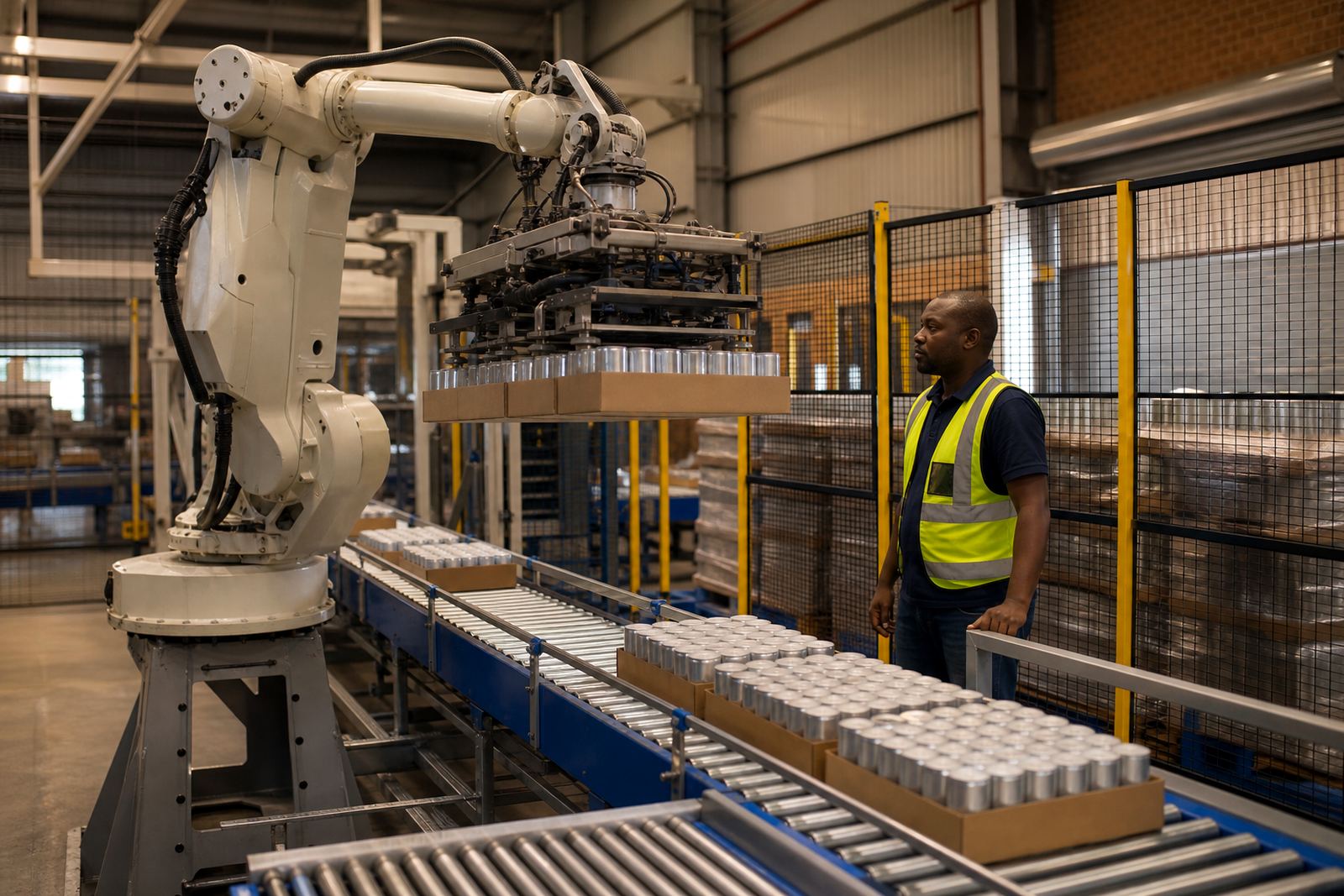
Can pack retrofits are normally planned around the can diameter, height, pack count and carton or tray format you use. Common options include compact cells for tighter floor areas, extended reach units for wider conveyors and higher speed systems for busier lines. Where floor space is limited, the cell can be arranged with side entry or end entry transfer depending on your layout.
For some sites, a cobot is enough for lighter duties and lower speeds. For heavier loads, faster cycles or larger pack counts, a standard industrial robot may suit better. The right choice depends on your product, the available footprint and the way your line feeds cans into the packing point. In a plant, the same cell can often be set up with adjustable gripping to handle more than one can format, which helps when production changes during the week.
- Single lane or multi lane infeed handling
- Tray pack, case pack or wraparound case transfer
- Compact footprint for tight plant rooms and packing floors
- Changeover options for different can sizes and pack counts
Where A Can Packing Retrofit Suits Best
This type of retrofit suits food and beverage operations, contract packers and manufacturers that run repeated pack patterns through the shift. It is also useful where labour is hard to keep, where manual handling causes tiredness, or where product damage is happening from hurried packing. Plants in Durban, Cape Town and Gqeberha often ask for guarded robotic handling where salt air, washdown routines or busy dispatch areas make consistency important.
It works best where cans are already arriving in a stable formation and the upstream line can keep feeding at a regular rate. If your product moves from filler to conveyor, then to grouping and into pack formation, the retrofit can slot in at the final handling stage. It can also help on lines that need a cleaner handover into palletising later, since the pack output becomes more uniform and easier to stack.
- High repetition secondary packing lines
- Plants with labour shortages or heavy manual lifting
- Operations needing steadier pack quality and better line balance
- Facilities planning future palletising upgrades as well
Installation, Power And Air Requirements
Installation starts with a site line survey and a review of the actual conveyor route, clearances, power supply and product flow. The retrofit can then be designed around your plant layout, taking into account access for maintenance, operator walkways and existing machine positions. In many Gauteng sites, installation needs to fit around live production windows, so the cutover plan should be agreed before any steelwork or wiring begins.
Power needs vary by robot size, controls package and ancillary equipment. Some cells need a three phase supply, while others only need electrical power and signal interfacing with the line. If your operation uses compressed air for guides, gates or product control, the air supply must be checked for pressure and quality. Good packing results depend on stable infeed, so conveyor speeds, timing sensors and case presentation all need to be matched properly, not guessed at.
- Three phase electrical supply usually required for industrial units
- Compressed air may be needed for guides, stops or case handling
- Floor loading, anchoring and guarding positions must be checked on site
- Integration should include conveyors, sensors and stop logic
Safety Guarding And Risk Assessment For Each Site
Every robot retrofit needs its own risk assessment because no two plants are the same. The guarding layout will depend on access routes, operator interaction, product transfer points and the type of robot selected. A proper design may include fixed guarding, interlocked doors, light curtains, area scanners or combination safeguarding, but the exact arrangement must be decided for the site and the task.
The goal is simple: operators should be able to work safely around the line without unnecessary exposure to moving equipment. Emergency stops, safe access for clearing jams and clear signage all matter. On a busy packing floor, especially where forklifts and pedestrians share the area, the guarding plan needs to suit the real movement patterns on the site. Safety is not one-size-fits-all and the retrofit should be set up that way from the start.
- Site specific risk assessment required before final design
- Guarding can include fencing, interlocks and sensing devices
- Operator access must be planned for cleaning and changeover
- Emergency stops and isolation points need to be easy to reach
Care, Servicing And What To Confirm
Once installed, a can packing retrofit needs regular checks on grippers, sensors, cables, guards and conveyor alignment. Dust, sticky residue and vibration can affect performance over time, so planned maintenance helps avoid stoppages. Where plants run through long shifts or hot summer periods, condition checks become even more important. Good servicing keeps the cell predictable and reduces surprise breakdowns.
Before ordering, check your can sizes, pack patterns, line speed, available floor space and the condition of the existing conveyors. It also helps to confirm where product enters, where cases leave and whether future pack sizes may change. If your site is in a coastal area like Cape Town or Gqeberha, moisture and corrosion resistance should be considered too. The best retrofit is the one that fits your line properly and leaves room for maintenance, not the one that looks good on paper but is awkward in practice.
- Confirm can dimensions, pack count and case or tray format
- Measure conveyor heights, widths and transfer points
- Check available power, air and space for guarding
- Ask about spares planning, training and breakdown support
Key facts
| Application | Robotic packing retrofit for grouped cans into trays, cases or wraparound packs |
|---|---|
| Typical products | Food cans, beverage cans and other similar rigid can formats |
| Integration | Existing conveyors, sensors, stop gates and case handling equipment |
| Options | Industrial robot or cobot, single lane or multi lane infeed, tray or case pack |
| Utilities | Electrical supply, optional compressed air, site specific controls interfacing |
| Support | Installation management, commissioning support, operator training and maintenance |