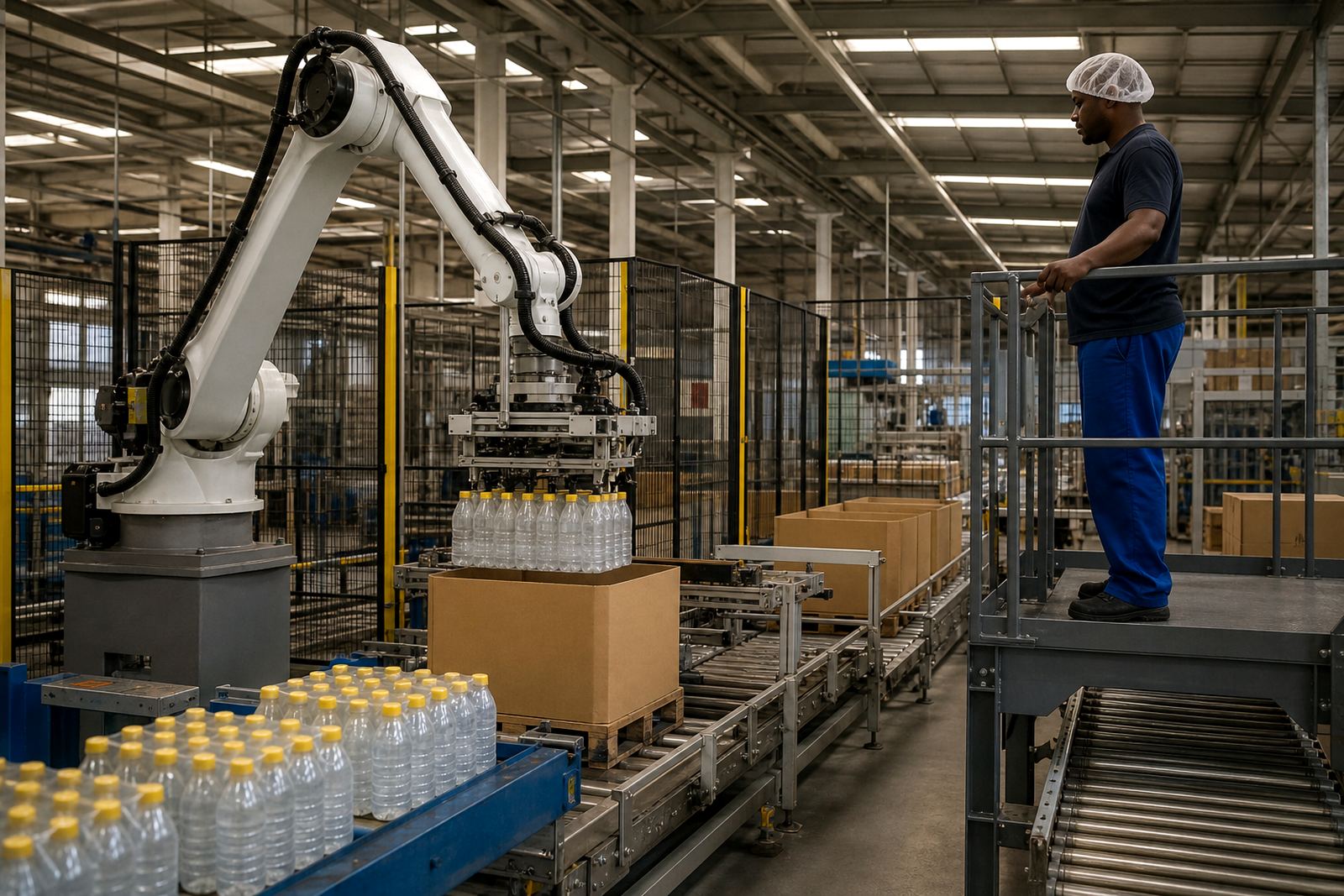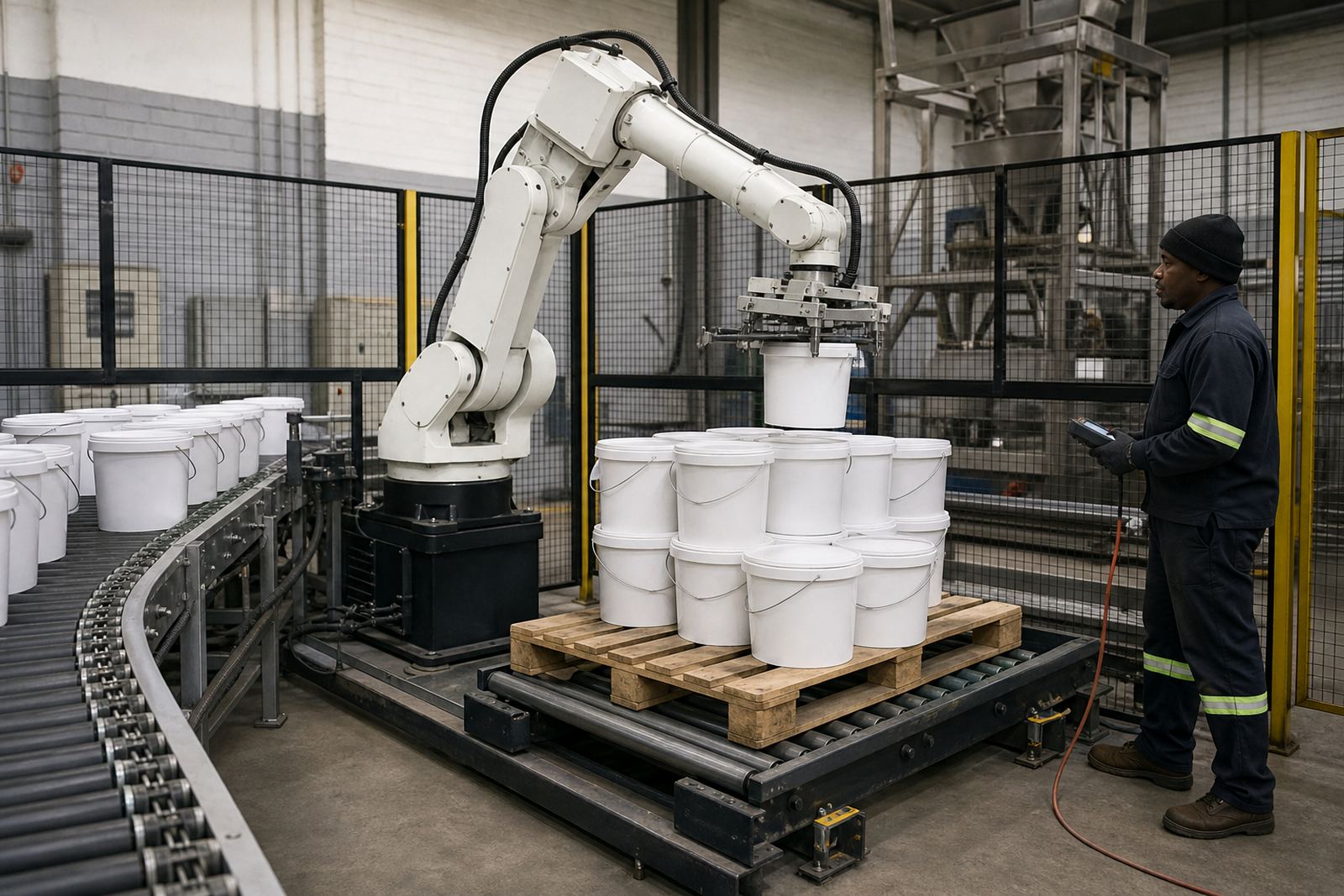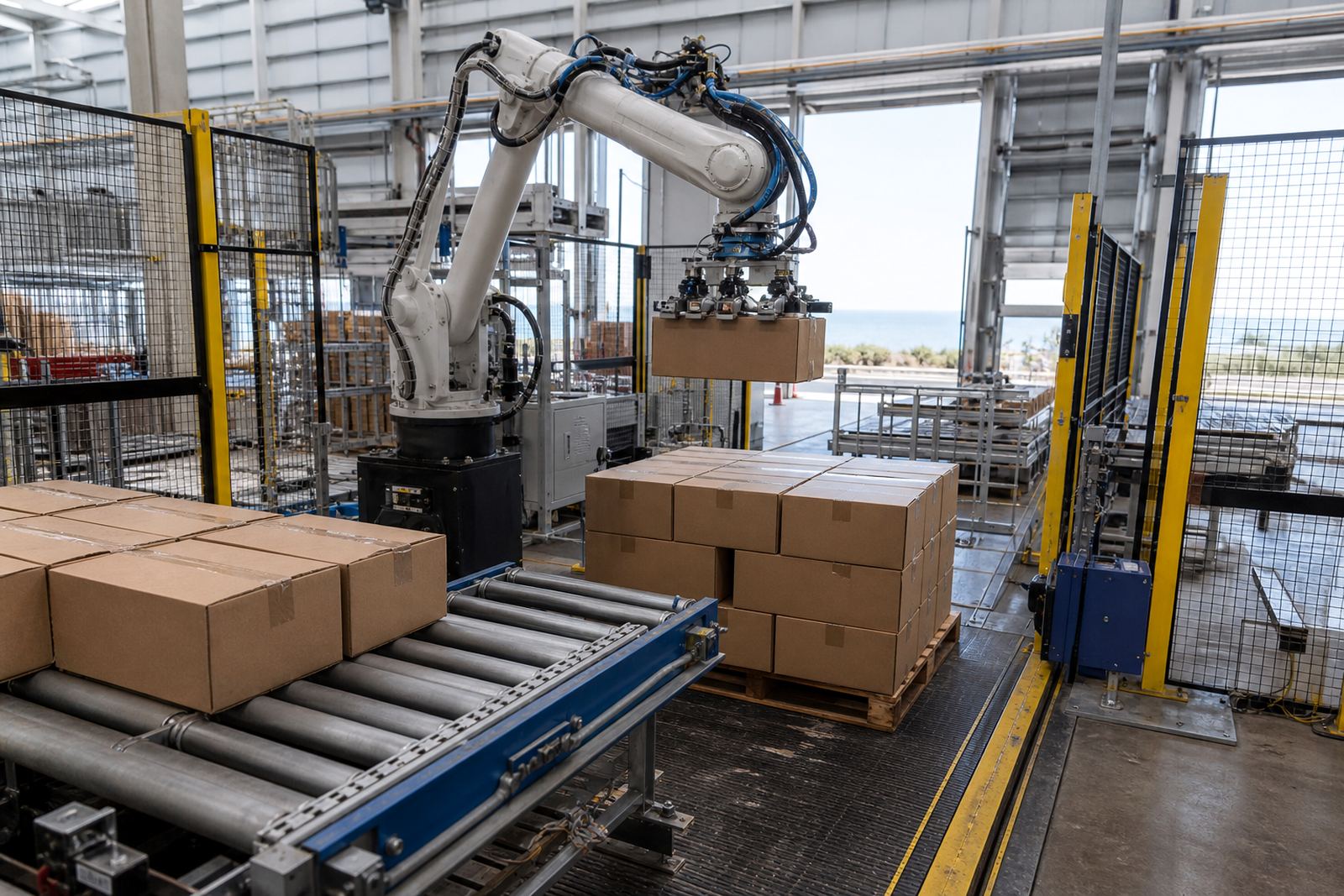
What the Uitenhage site needed from the retrofit
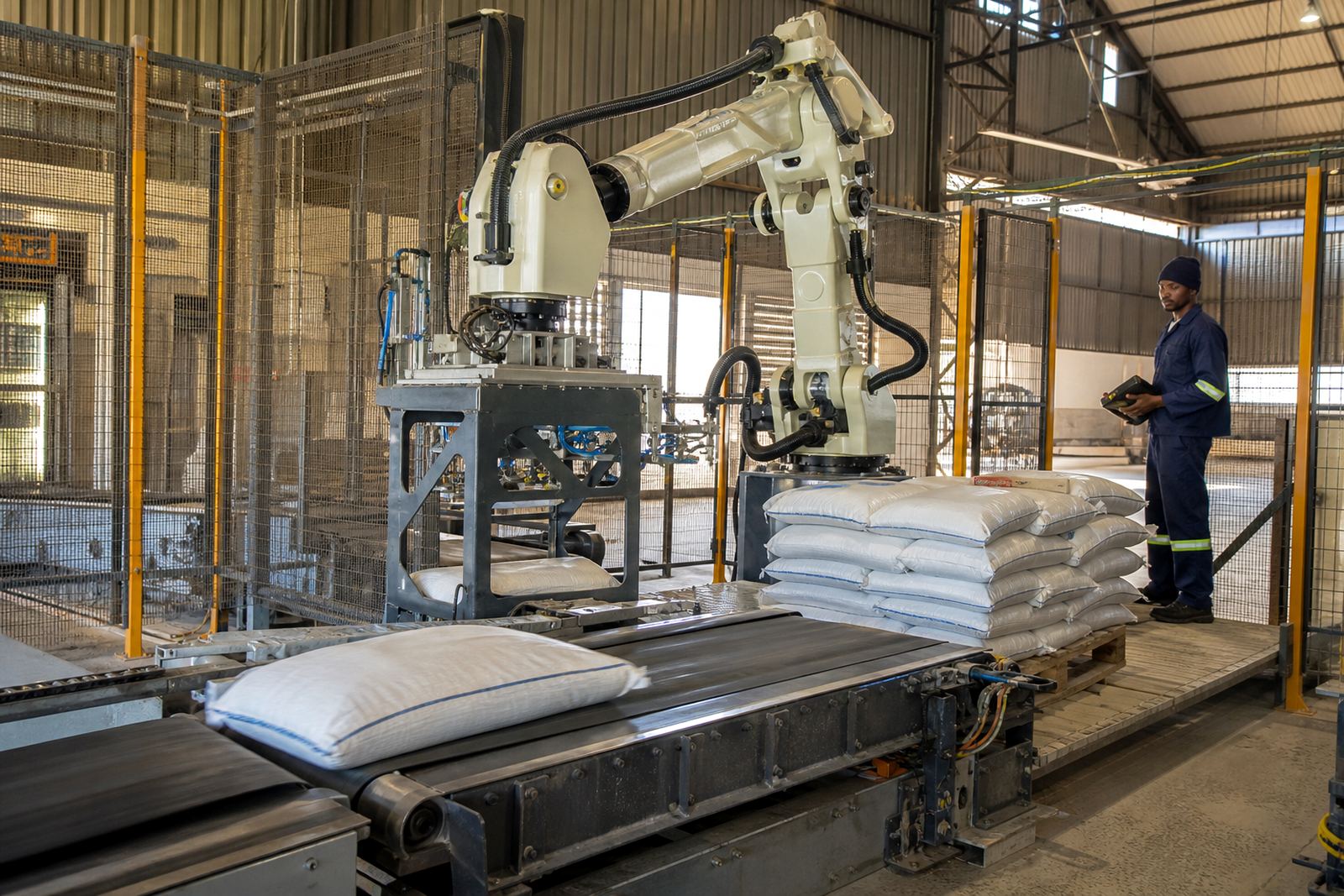
The site was a mid-sized feed packing operation supplying bagged product into regional distribution. The line was still doing a lot of manual palletising at the end of packing, which put strain on staff and created uneven pallet quality when the shift was under pressure. The brief was clear: automate the palletising step as far as practical, keep the existing conveyor route in service, and avoid a long shutdown that would disrupt deliveries.
We started with a site line survey to map the bag discharge point, pallet positions, available floor space and the movement needed for forklift access.The retrofitting work had to fit the plant as it stood, not a greenfield layout, and that meant careful planning around the conveyor heights and the bag presentation pattern.
- Site type: feed packing and bag palletising
- Location: near Uitenhage, Eastern Cape
- Main goal: reduce manual bag stacking and support production continuity
- Constraint: fit into existing conveyor and pallet flow with limited floor space
How we approached the line survey and concept design
Our team completed the initial survey and then built the retrofit concept around the actual bag size, bag weight and pallet pattern. The line needed a predictable handover from the packing conveyor to the palletising area, so we worked through the bag transfer point, accumulation, orientation and pallet build sequence. For a line like this, small changes in bag presentation can affect the whole cycle, so the control logic and mechanical interface had to be matched properly from the start.
We also looked at maintenance access, cable routes, cleaning access and operator movement around the cell. In a food and feed environment, the plant team needs enough space to clear product spillage and still reach key components safely. The concept included a safety envelope, fixed guarding and controlled access points so the system could be used without creating unnecessary exposure for staff.
- Retrofit design based on existing conveyors and packing flow
- Defined pallet pattern for stable load formation
- Access planning for cleaning and maintenance
- Guarding concept to separate people from moving equipment
Equipment and integration supplied on site
We supplied the mechanical and control integration needed to link the palletising function into the existing packing line. That included the transfer arrangement at the end of the conveyor, control interfaces for the line sequence, safety guarding design, and support for the installation and commissioning work. The system was set up to take bags from the infeed conveyor and build them onto pallets in a controlled pattern suitable for storage and dispatch.
Because the customer wanted to keep the existing line running where possible, we planned the tie-in work in stages. That meant isolating sections of the line one at a time, checking sensor positions, confirming signal logic, and making sure the palletising sequence responded correctly to product flow. The electrical and control work was handled so the operators could run the system with clear fault indication and practical stop/start control. In this type of retrofit, it is often the integration detail that determines whether the line feels dependable or a nuisance.
- Conveyor integration at the palletising discharge point
- Controls integration for sequencing and fault handling
- Safety guarding design and access control points
- Commissioning support and operator handover
Safety guarding and risk assessment support
Every retrofit needs its own risk assessment, and this site was no different. We worked through the hazards linked to moving conveyors, pallet movement, bag transfer, access to the cell and restart conditions after stoppages. The guarding was designed to suit the actual installation and the way the operators moved around the line, rather than forcing a generic layout onto the plant.
The customer also needed practical guidance for safe operation during maintenance and cleaning. We supported the site with risk assessment input, stop and isolate points, and operating procedures that fit a real production floor.A good retrofit should make the process easier to run, but it still has to respect the basics of safe access and lock-off discipline.
- Site-specific risk assessment support
- Fixed guarding around the palletising area
- Controlled access for operators and maintenance staff
- Restart checks after power interruptions and stoppages
Timeline, installation and commissioning in weeks
The project was delivered over 7 weeks from survey to final commissioning. The first phase covered the line survey, concept layout and controls review. The second phase handled design finalisation, fabrication planning and procurement of the retrofit components. Installation then took place during a planned shutdown window so the customer could keep core packing activity moving for as long as possible.
Commissioning focused on bag transfer timing, pallet pattern consistency, safety interlocks and operator familiarisation. We stayed on site during the handover period to work through normal start-up issues, which is often where retrofits earn their keep. Small adjustments to sensor positions and sequence timing made a difference to how smoothly the line settled. The site team wanted a practical outcome, not a showpiece, and that is exactly how the work was approached.
- Week 1 to 2: survey and concept design
- Week 3 to 4: detailed retrofit planning and integration checks
- Week 5 to 6: installation and tie-in during shutdown
- Week 7: commissioning support and operator training
What changed after the palletising retrofit
After the retrofit, the site had a more consistent end-of-line process with far less manual bag handling at the palletising station. Pallets were built more evenly, the line was easier to manage during busy periods, and the team had a safer working arrangement around the discharge point. The operation could keep production flowing with fewer interruptions caused by hand stacking or pallet build inconsistencies.
The customer was also in a better position to plan maintenance and spares because the new arrangement followed a clearer process flow. That helps when a plant is working across multiple shifts and has to handle seasonal demand. One practical gain was that the operators no longer had to improvise around the end of the line when the pace picked up, which made the whole area calmer and easier to control.
- Reduced manual strain at the end of the line
- More consistent pallet build quality
- Better production continuity during peak periods
- Clearer operating and maintenance routines
What We Would Rework On A Similar Feed Line
If we were doing a similar feed packing retrofit again, we would follow the same process: start with a detailed line survey, lock down the pallet pattern early, and design the guarding around the real movement of people and pallets on site. We would also keep the commissioning period tight but hands-on, because these systems often settle better once the operators have seen the sequence in live conditions.
For plants near Uitenhage, Gqeberha or elsewhere in South Africa, the lesson is that a good retrofit is not only about the robot or cobot itself. It is about the conveyor handover, the controls logic, the safety boundaries and the practical behaviour of the team using it every day. Get those parts right and the line becomes much easier to run. Get them wrong and the site spends time chasing faults that should never have been there in the first place.
- Keep the design tied to the existing line, not a theoretical layout
- Set the pallet pattern before installation starts
- Build in safe access and lock-off points from day one
- Allow time for operator training during commissioning
Key facts
| Project type | Bag palletising retrofit for a feed packing line |
|---|---|
| Location | Near Uitenhage, Eastern Cape |
| Timeline | 7 weeks from survey to commissioning |
| Line interface | Existing conveyor integration and end-of-line transfer |
| Safety scope | Site-specific risk assessment support and safety guarding design |
| Outcome | Reduced manual handling and more consistent pallet build quality |