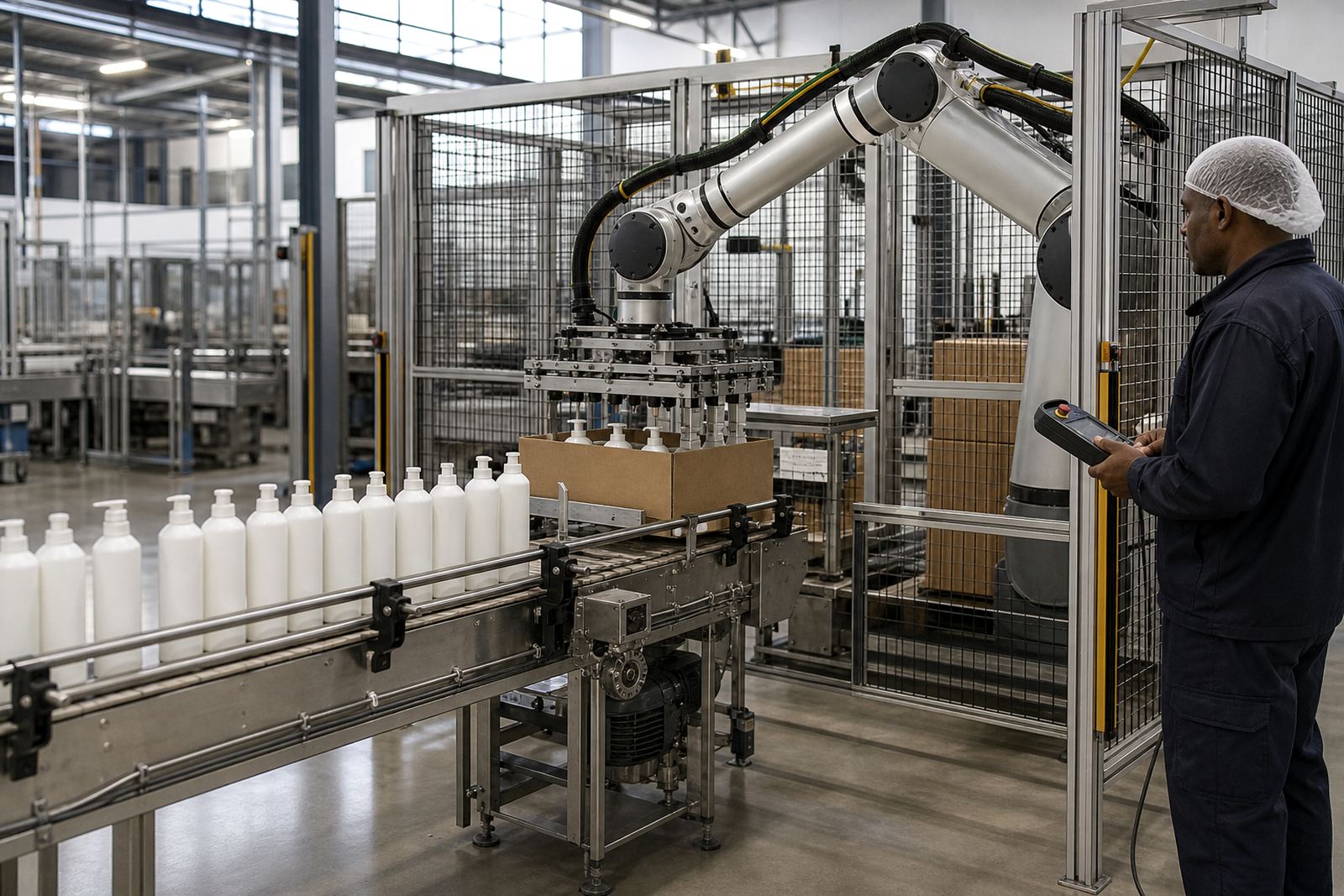
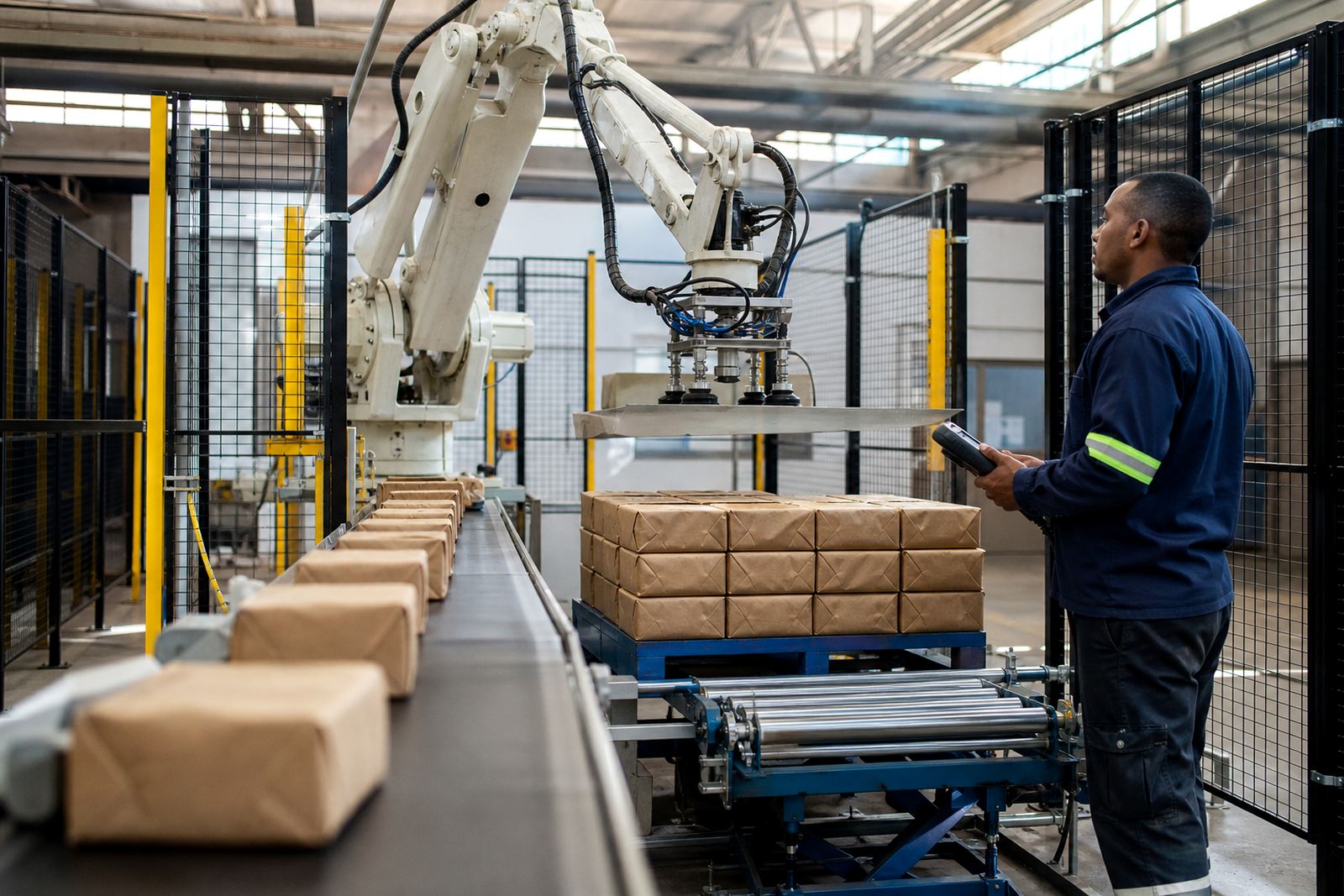
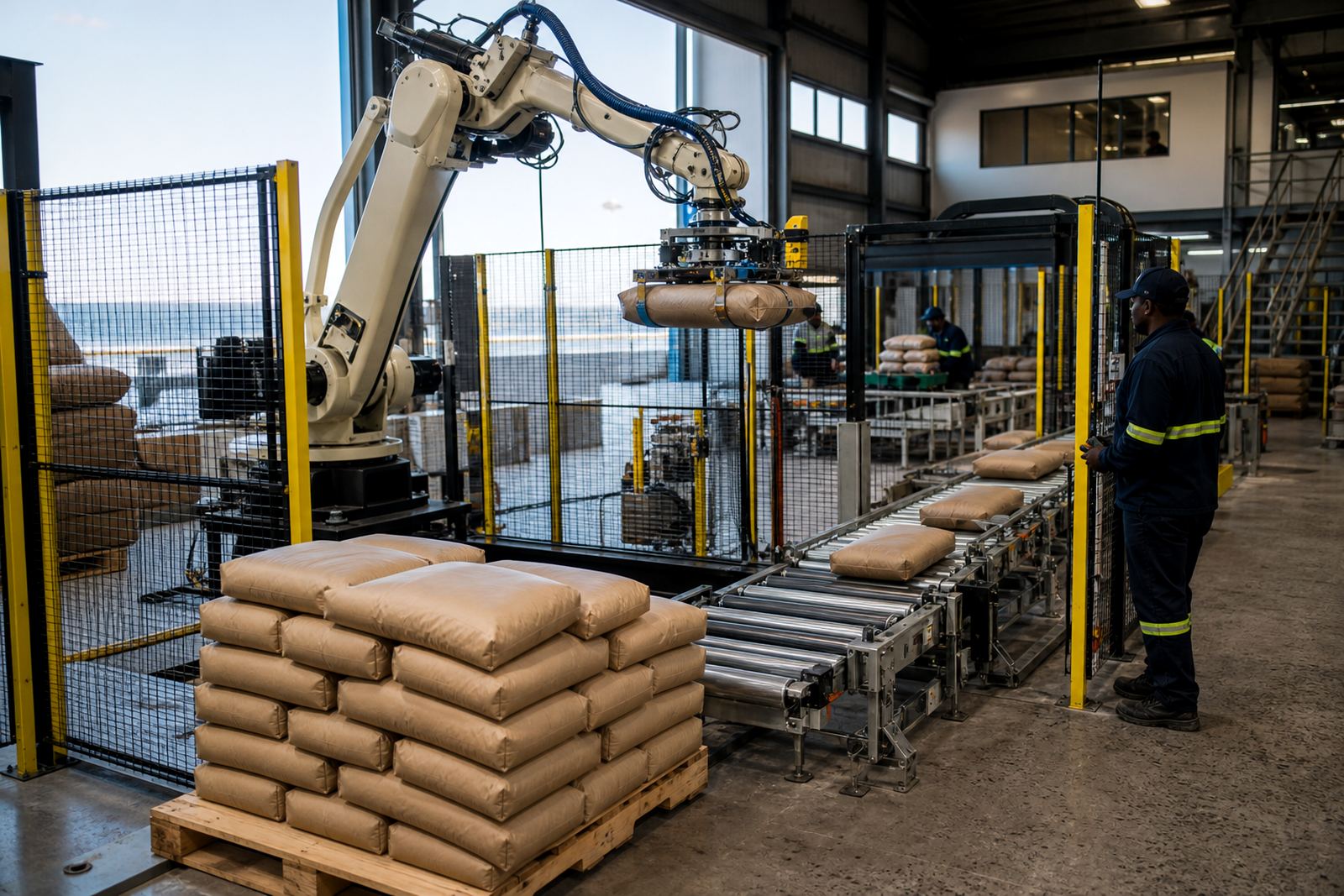
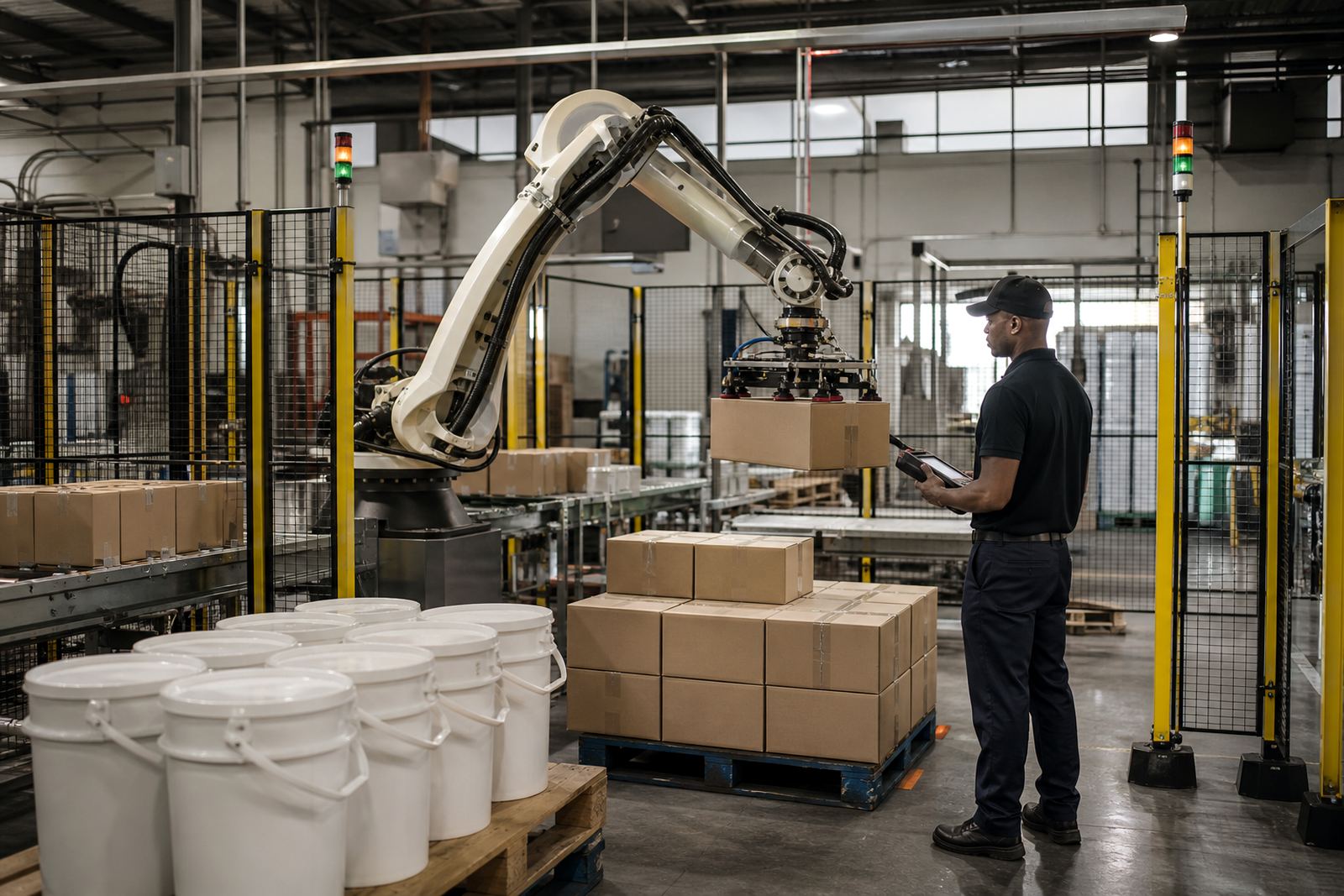
At this Rosslyn homecare site, we improved end-of-line flow by adding robotic case packing to the existing conveyor route. The project reduced manual handling at the pack-out area while keeping the plant layout, product mix and shift pattern practical for day-to-day production.
Rosslyn Site Brief And Operating Constraints
The client was a homecare manufacturer in Rosslyn, Pretoria, running a busy packing line with a fixed conveyor route and limited floor space at the end of line. The brief was straightforward: pack more consistently, reduce strain on operators, and keep the existing process moving without a full plant rebuild.
We started with a site line survey to understand product flow, case presentation, available floor space and the best place to drop in a robot cell without creating new bottlenecks. The existing conveyor path had to stay largely in place, so the retrofit needed to fit around what was already working rather than forcing a new layout. That meant careful measurements, attention to transfer heights and a practical approach to controls and guarding.
Site type: homecare packing and case-handling line
Location: Rosslyn, Pretoria
Main constraint: limited footprint at line end
Integration requirement: existing conveyor route to remain in service
What We Supplied For The Retrofit
We supplied a robotic case packing and palletising retrofit designed to work with the existing conveyor system. The solution included the robot cell layout, case transfer handling, conveyor integration, controls integration, safety guarding design and support through installation and commissioning. The robot was selected for repeatable handling, with the final end-of-line sequence set up to suit the size and weight range of the cartons on this line.
The retrofit also included practical items that are often overlooked until site work starts, such as access gates, guarding panels, interlocks, light curtain positioning where required, and safe operator access for clearing faults. We also planned for spares and maintenance access so the line could be serviced without unnecessary downtime. On a site like this, good packing automation is not just about speed, it is about giving the team a line they can run and maintain every day.
Robotic case packing integration
Conveyor infeed and discharge coordination
Safety guarding and access control
Control panel changes and signal handshaking
Operator training and maintenance handover
How The Existing Conveyor Route Was Integrated
The key challenge was connecting the robot to the current conveyor route without causing back-up or awkward transfers. We mapped the infeed, set the case presentation point, and matched the robot cycle to the line speed so the packer could take product at a steady rate. Because the line already had established movement paths, the new section had to fit the plant flow and not interfere with the rest of the operation.
Our automation work covered signal exchange between the conveyor controls and the robot cell, plus the logic required for start, stop, fault handling and jam recovery. We also looked at where operators would stand, where pallets would be removed, and how maintenance staff would reach equipment safely. Every retrofit is different, and that is why the control philosophy and layout are always built around the site rather than a generic template.
Conveyor handshaking for product transfer
Fault recovery and line-stop logic
Pallet discharge planning
Operator access and maintenance clearances
Safety Guarding And Risk Assessment Support
Robotic retrofits need proper safety thinking from the beginning. For this Rosslyn project we supported the site with a general risk assessment process and a guarding design that considered entry points, moving equipment, pinch points and the interaction between people and the machine. The final site risk assessment must always be done for the actual installation, because each plant has its own layout, access routes and operating conditions.
The guarding package was designed to separate people from the robot and conveyor movement zones while still allowing practical access for faults, cleaning and planned maintenance. We also allowed for clear stop points and controlled entry to the cell. In a production environment where shift changes and deliveries happen through the same area, the guarding has to be practical, not just compliant on paper.
General risk assessment support before installation
Guarding layout for robot and conveyor movement
Controlled access for maintenance and fault clearing
Site-specific final safety review required before handover
Installation, Commissioning And Training In Six Weeks
The project was completed over six weeks from final survey to commissioning support, with the site work planned around production requirements. The first phase covered survey confirmation and retrofit design. The second phase covered fabrication, controls prep and guarding planning. The final phase covered installation management, commissioning support and operator training on the new packing sequence.
During commissioning we checked the full sequence from product arrival on the conveyor to case handling and line discharge. We confirmed start-up routines, fault checks, safe stop behaviour and the practical steps operators needed for normal running. Training was kept focused and direct so the team could work with the line confidently from day one. There was also a small amount of tuning needed on the transfer points, which is normal on a live plant, and it was handled on site without disrupting the broader process.
Weeks 1 to 2: survey and retrofit design
Weeks 3 to 4: controls, guarding and installation prep
Weeks 5 to 6: installation management and commissioning support
End Of Line Results And What We Would Rework
The retrofit improved line-end efficiency by removing a large part of the manual case handling burden and by giving the site a more controlled packing flow. The conveyor and robot now work as one sequence, which helps reduce stoppages caused by inconsistent hand packing and makes the line easier to manage during normal shifts. For a homecare plant, that matters because the product mix and packaging formats can change, and the line still needs to keep moving.
For another homecare line retrofit like this Rosslyn installation, we would handle it in much the same way: start with a proper survey, keep the conveyor route in mind from the first sketch, and build the safety guarding around how the site actually runs. The best retrofit is the one that fits the plant, the people and the maintenance team. That is what makes it practical over the long term.
Less manual handling at the line end
More consistent case packing flow
Better use of the existing conveyor route
Safer, more organised end-of-line operation
Key facts
Project
Rosslyn Homecare Line
Location
Rosslyn, Pretoria
Scope
Robotic case packing retrofit with conveyor integration
Timeline
6 weeks
Site type
Homecare manufacturing line
Core deliverables
Site Line Survey, Retrofit Design, Conveyor Integration, Controls Integration, Safety Guarding Design, Risk Assessment Support, Installation Management, Commissioning Support, Operator Training
What our Robotic Automation customers say
Verified Google reviews
Retrofit questions
What was retrofitted on the Rosslyn homecare line?
We integrated a robotic case packing solution into the existing conveyor route and supported the end-of-line handoff to palletising.
Did the line need a full rebuild?
No. The aim was to work with the existing plant layout and conveyor route, so the retrofit could be installed with less disruption.
Does the safety setup use a standard one-size-fits-all approach?
No. The guarding and risk review must be based on the actual site layout, access points and operating conditions before handover.