Bellville site brief and production constraints
The brief was straightforward on paper and quite tight on the floor. A Bellville paper products plant wanted to replace repetitive manual palletising at the end of an existing packing line, while keeping the current conveyor layout in service and avoiding major civil work. The bundles were already wrapped and discharged on an outfeed conveyor, so the new cell had to pick from a fixed infeed height, handle consistent bundle orientation, and place onto mixed pallet patterns without disrupting upstream packing.
The site also had the usual practical limits that come with a working manufacturing floor in the Western Cape. There was limited floor space, live traffic around the line, and a need to keep access clear for forklift movement and pallet staging. Because the products were paper based, the team also had to manage dust, wrap residue, and the effects of coastal humidity on packaging materials and steelwork. The answer was not a full line replacement. It was a retrofit that worked with what was already there.
- Existing outfeed conveyor retained and tied into the new cell
- Wrapped bundles collected direct from the live product flow
- Space planned for pallet entry, exit and forklift access
- Guarding arranged around the robot envelope and load zone
What the client asked us to solve
The site needed reliable palletising with less manual lifting, more consistent stack quality, and better control over end-of-line bottlenecks.The line needed to keep running with minimal intervention once the new cell was in place.
We also had to work within general safety requirements and site rules. Any robotic retrofit needs a proper risk assessment for the actual layout, product behaviour and operator movement. Guarding, access gates, interlocks and emergency stops all had to be designed around the real space, not an ideal drawing. The site wanted a practical solution that could be maintained locally and supported without long delays when a sensor, drive or control component needed attention.
- Reduce manual palletising at the end of line
- Keep the existing conveyor route in use
- Allow for mixed stack patterns and pallet sizes
- Build in safe access for cleaning and maintenance
Retrofit scope and equipment integration
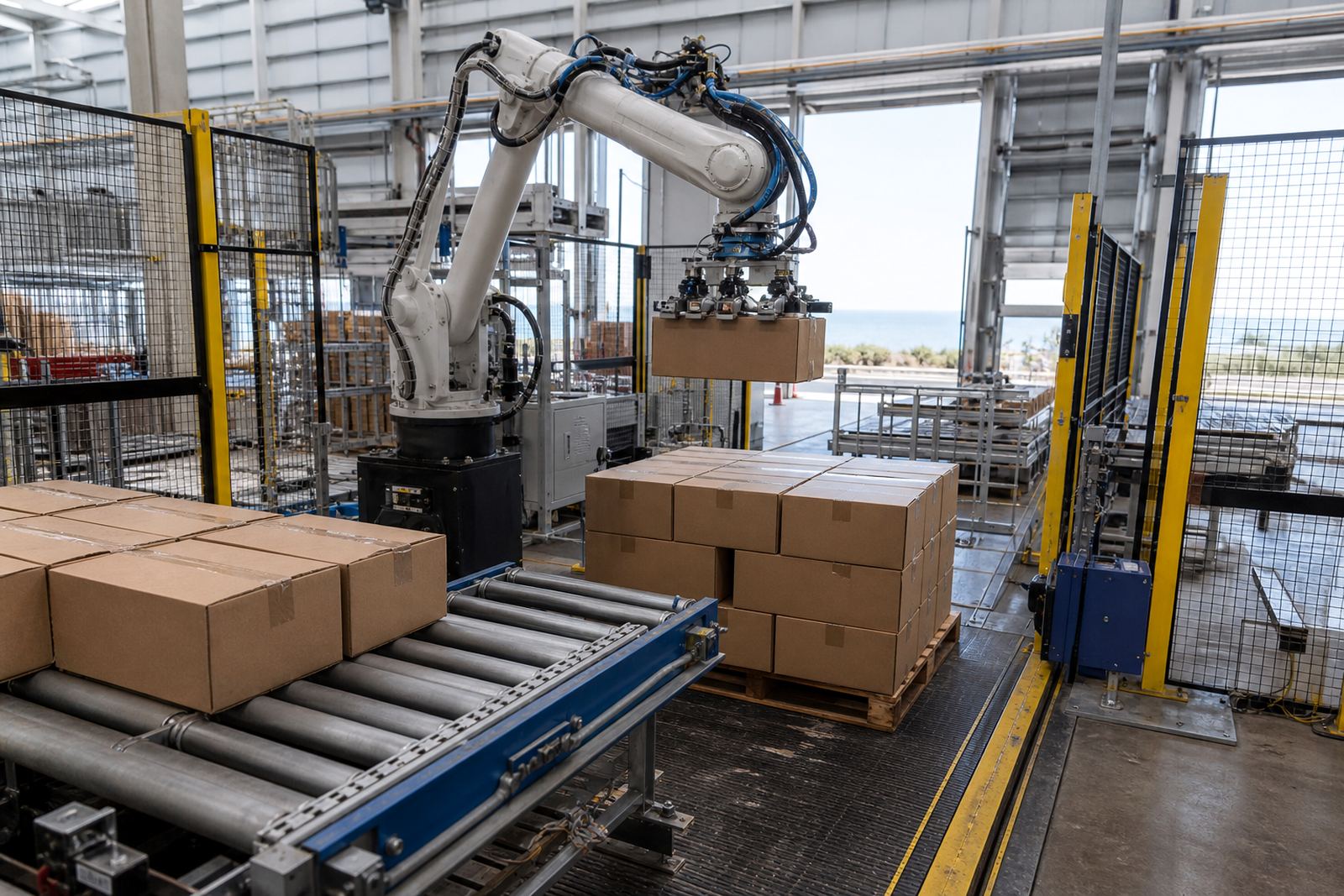
We supplied a robotic palletising retrofit centred on a compact robot cell, safety guarding, controls integration and line interface work. The robot was selected to suit the bundle weight, reach and cycle requirement, with end-of-arm tooling designed for the wrapped paper bundles rather than for loose product. We tied the cell into the existing conveyor so product arrival, detection and release could be managed from the upstream line without hand sorting at the pallet station.
Our scope covered site line surveys, layout checks, safety guard design, conveyor integration, controls integration, installation management and commissioning support. The line interface included product sensing, pallet presence checks, stack pattern control and fault handling so operators could see what was happening on the HMI and respond when needed. We also planned the pallet transfer position, pallet magazine area and wrap staging space to suit the Bellville floor plan.
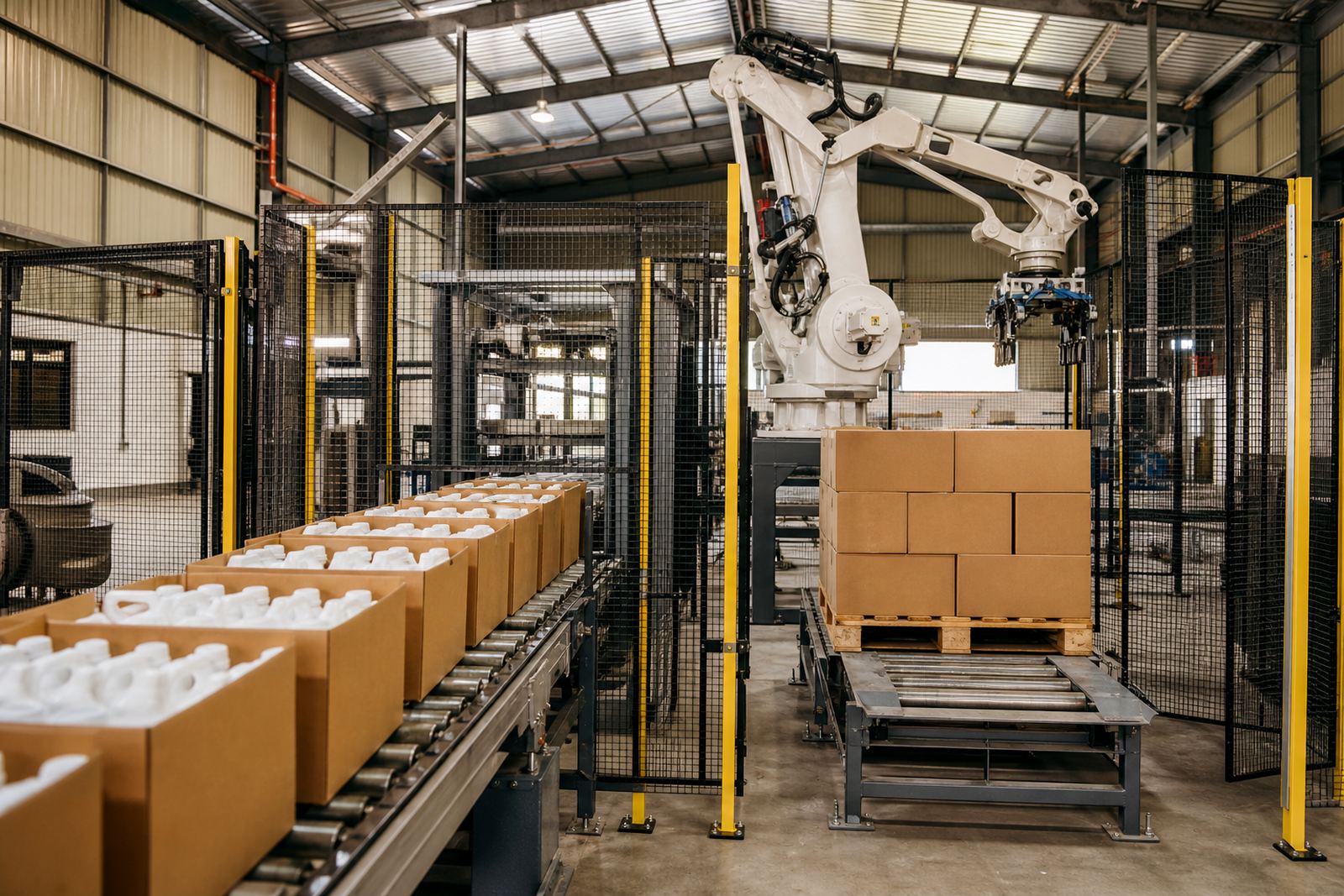
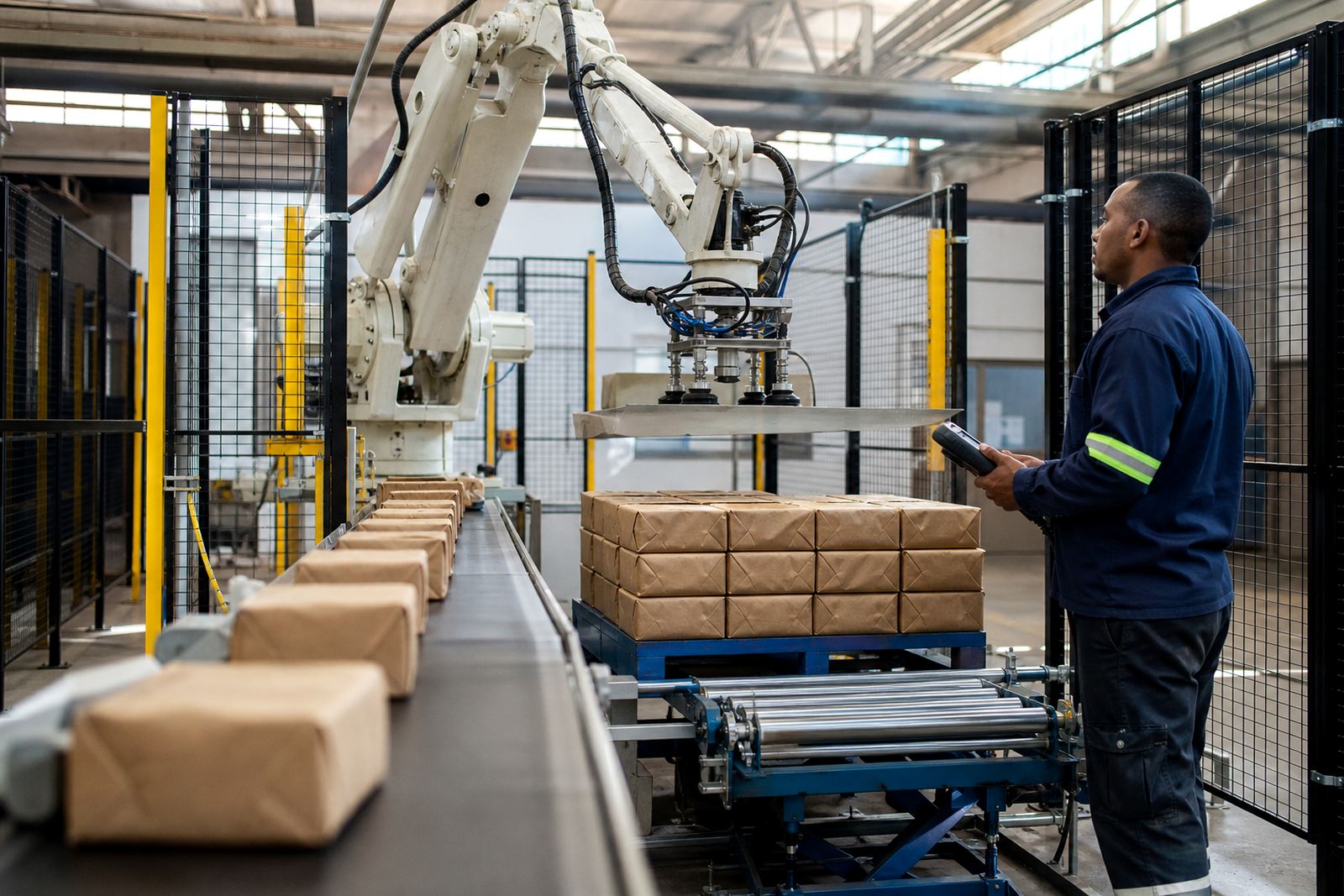
- Robot cell sized for wrapped bundles from an existing outfeed conveyor
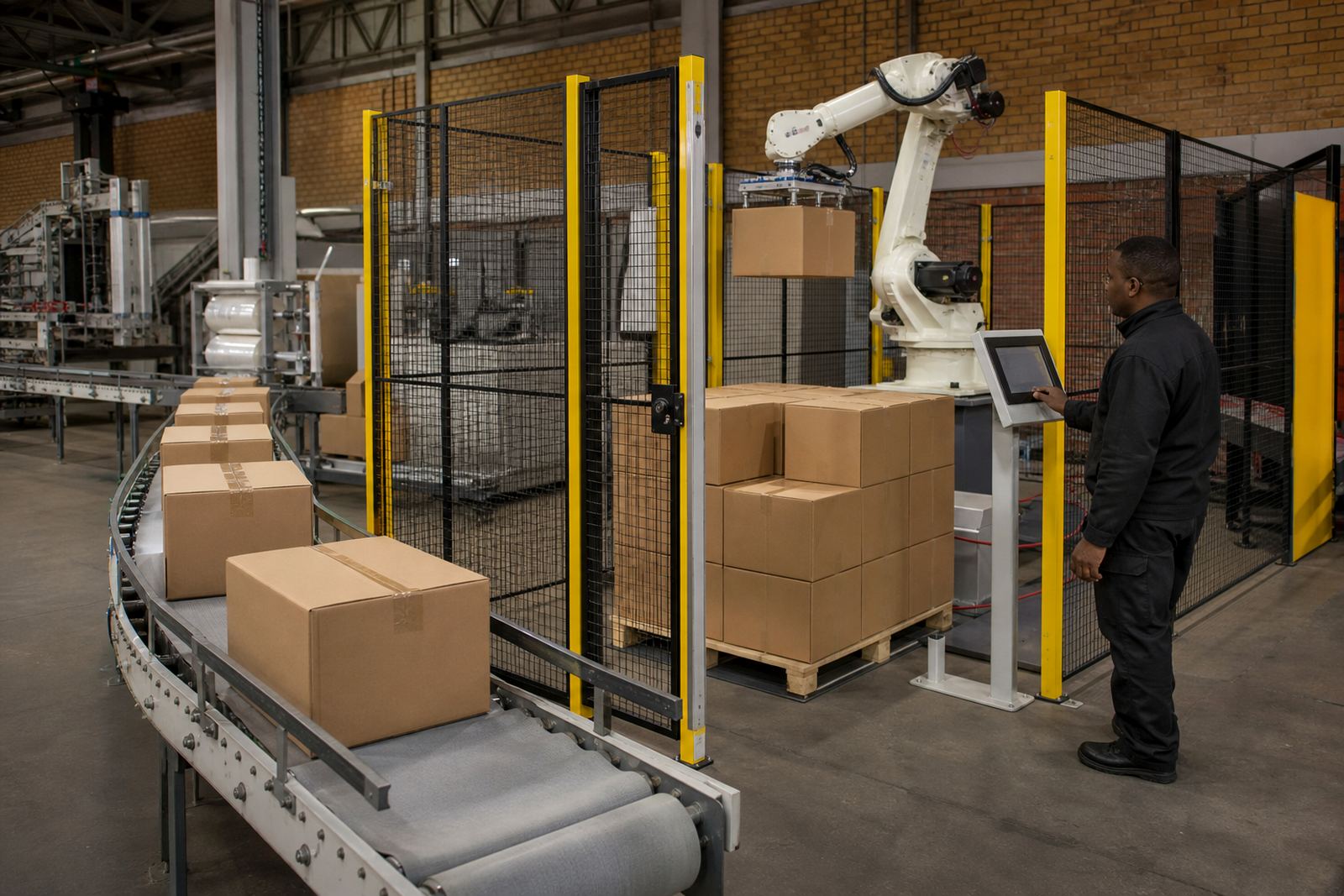
- Safety fencing and access gates arranged around the working envelope
- HMI-based controls for start, stop, fault reset and mode selection
- Pattern logic set up for stable pallet build and repeatable layer count
Safety guarding and risk assessment support
Because this was a live production site, the safety side mattered as much as the mechanical fit. We prepared risk assessment support around the actual operating method, including bundle transfer, pallet changeover, operator access, maintenance access and emergency stop placement. The guarding layout was designed to separate people from moving equipment while still allowing safe access for routine tasks such as film checks, sensor cleaning and pallet replenishment.
General safety rules were followed throughout, but every site needs its own final assessment based on machine type, access points and local operating practice. We do not assume one guarding arrangement suits another plant just because the product is similar. On this Bellville line, the focus was clear access control, visible status indication, and reliable interlocking so the cell could not be entered while the robot was active. That meant fewer manual interventions and a cleaner operating routine for the shift team.
- Site-specific risk assessment support
- Interlocked gates and emergency stop points
- Clear separation between operators and moving axes
- Access planned for maintenance without compromising safety
Installation and commissioning in weeks
The retrofit was completed over a measured programme that suited the production schedule. From survey and layout confirmation through to installation and commissioning, the work ran over six weeks in total. That included mechanical positioning, conveyor tie-in, electrical and controls work, safety checks, dry cycles and live product testing. The project was phased so the site could keep planning around the changeover instead of shutting down the whole packing area.
Commissioning focused on stable pick performance, accurate bundle placement and dependable handover from the conveyor. We fine tuned the timing between the infeed and the robot, checked pallet layer build quality, and tested alarms for common faults such as missed product detection and pallet availability. The operator training covered daily start-up, safe clearing of faults, basic checks and when to escalate to maintenance. Simple, practical training keeps a cell useful after handover and helps the line team stay confident.
- Survey and layout confirmation
- Mechanical install and conveyor tie-in
- Controls wiring and safety validation
- Dry runs, live testing and operator training
Results on the Bellville packing floor
Once in service, the new robotic cell gave the Bellville site a steadier palletising process and reduced the amount of manual handling at the end of the line. The bundles were taken directly from the outfeed conveyor, stacked in a consistent pattern and moved on with less stoppage between packs. That helped the site manage output more predictably, especially during busy periods when the packing line needed to recover quickly after interruptions.
The team also gained a cleaner end-of-line layout. With the robot handling the repetitive placement, the pallet area became easier to organise and the forklift movement around finished goods was simpler to manage. For paper product operations, that matters. When wrapped bundles arrive in a consistent position and the pallet build is repeatable, the whole line feels calmer. Less rework, fewer awkward lifts, and better use of floor space all make a difference.
- Less manual lifting at the pallet station
- More consistent pallet build quality
- Better control of end-of-line flow
- Cleaner use of floor space around the packing area
What we repeat on another paper line
If we were doing this type of project again, we would use the same approach: start with the live conveyor, confirm the product behaviour, map the available floor space, and build the retrofit around the site’s actual operating rhythm. Paper product lines can vary a lot by bundle size, wrap type and pallet pattern, so the best result comes from spending time on the survey and the risk assessment before any installation starts.
We also keep maintainability front and centre. A good retrofit should be easy to run, easy to clean and easy to support if a sensor fails or a pallet batch changes. That is why our work always includes controls integration, safety guarding design, commissioning support and spares planning. In Bellville, as in Johannesburg, Pretoria, Durban, Cape Town or Gqeberha, the objective is the same: fit the automation to the plant, not the other way round.
ReAutomated works from Spartan, Kempton Park and supports manufacturers across South Africa with robotic palletising retrofits, packing line integration, cobots, guarding, breakdown assistance and training. If your line is due for a retrofit, the starting point is a proper site survey and a clear brief.
Key facts
| Project type | Robotic palletising retrofit for a paper products line |
|---|---|
| Town | Bellville, Western Cape |
| Infeed | Existing outfeed conveyor with wrapped bundles |
| Timeline | 6 weeks from survey to commissioning |
| Scope | Survey, design, guarding, controls, installation and training |
| Site setup | Compact robot cell with interlocked safety guarding |