Pinetown carton line: the brief and the site conditions
The site was a carton manufacturer in Pinetown supplying high volumes into the KZN market and further afield. Their packing area was still relying on manual palletising at the end of line, which created uneven pallet quality, labour pressure on shift changes and slow recovery when orders changed. The brief was to automate the palletising stage without replacing the full packing line, and to make the system easier to run on mixed carton sizes.
The line sat in a busy production area with limited space, so the retrofit had to work around existing conveyors, access walkways and the building layout. Coastal humidity was also part of the picture, which meant we had to think carefully about guarding finishes, cable routing and the placement of equipment near washdown and cleaning activity. The client wanted a practical solution that would fit the current operation, not a full factory rebuild.
- Location: Pinetown, KwaZulu-Natal
- Application: carton line end-of-line palletising
- Upgrade focus: robotic palletising, recipe selection and safety guarding
- Constraint: minimal disruption to the existing packing process
What we supplied and how the retrofit was structured
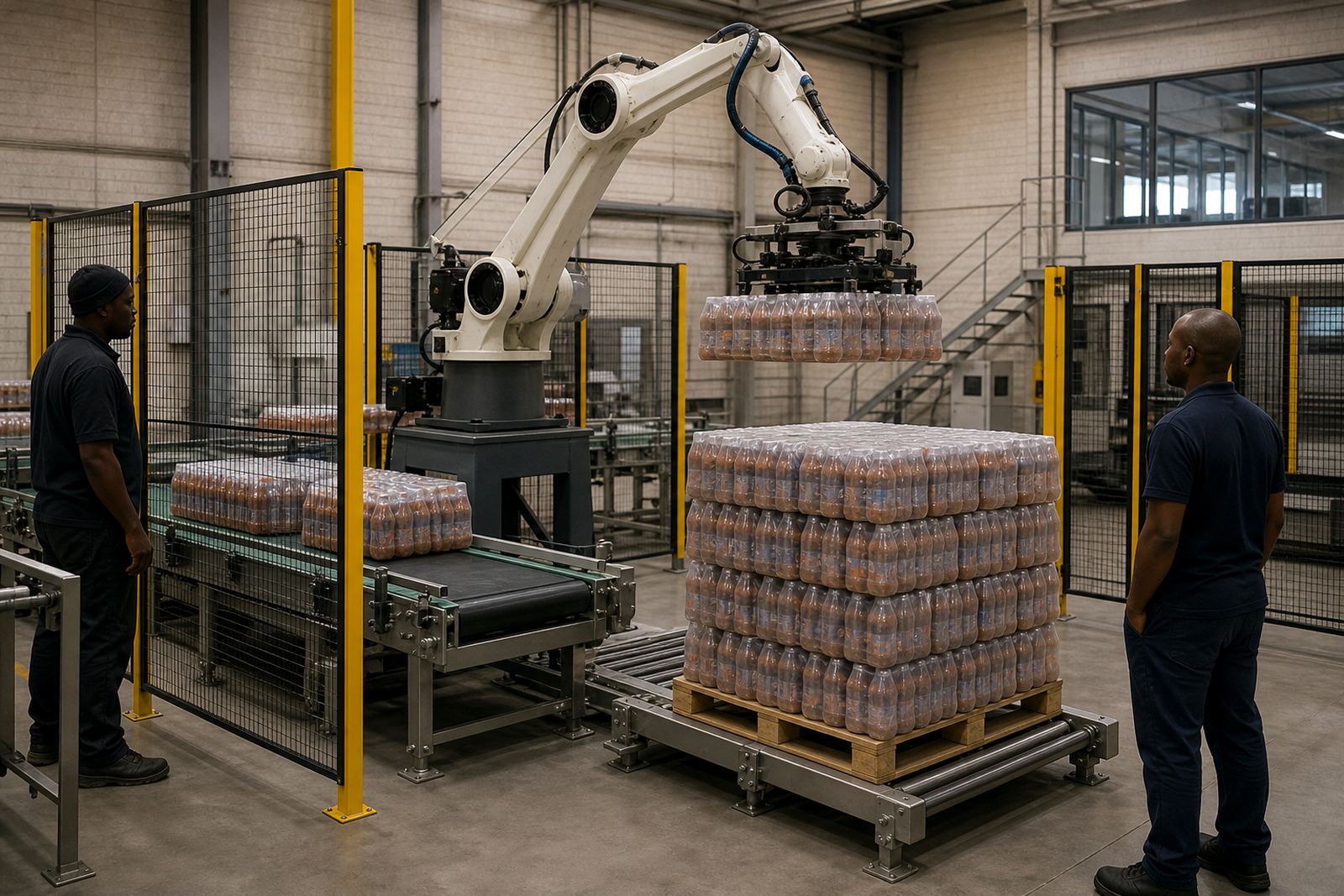
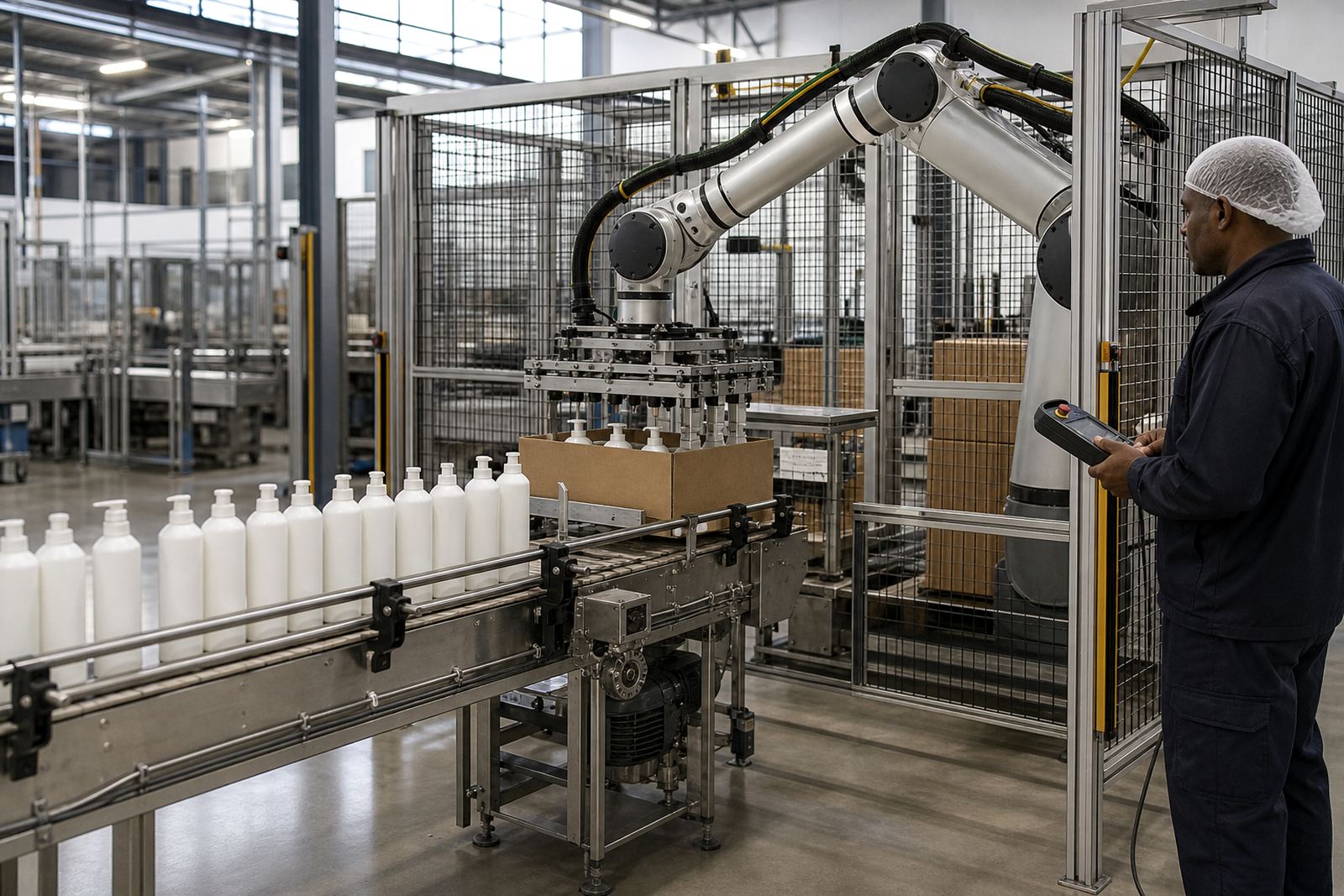
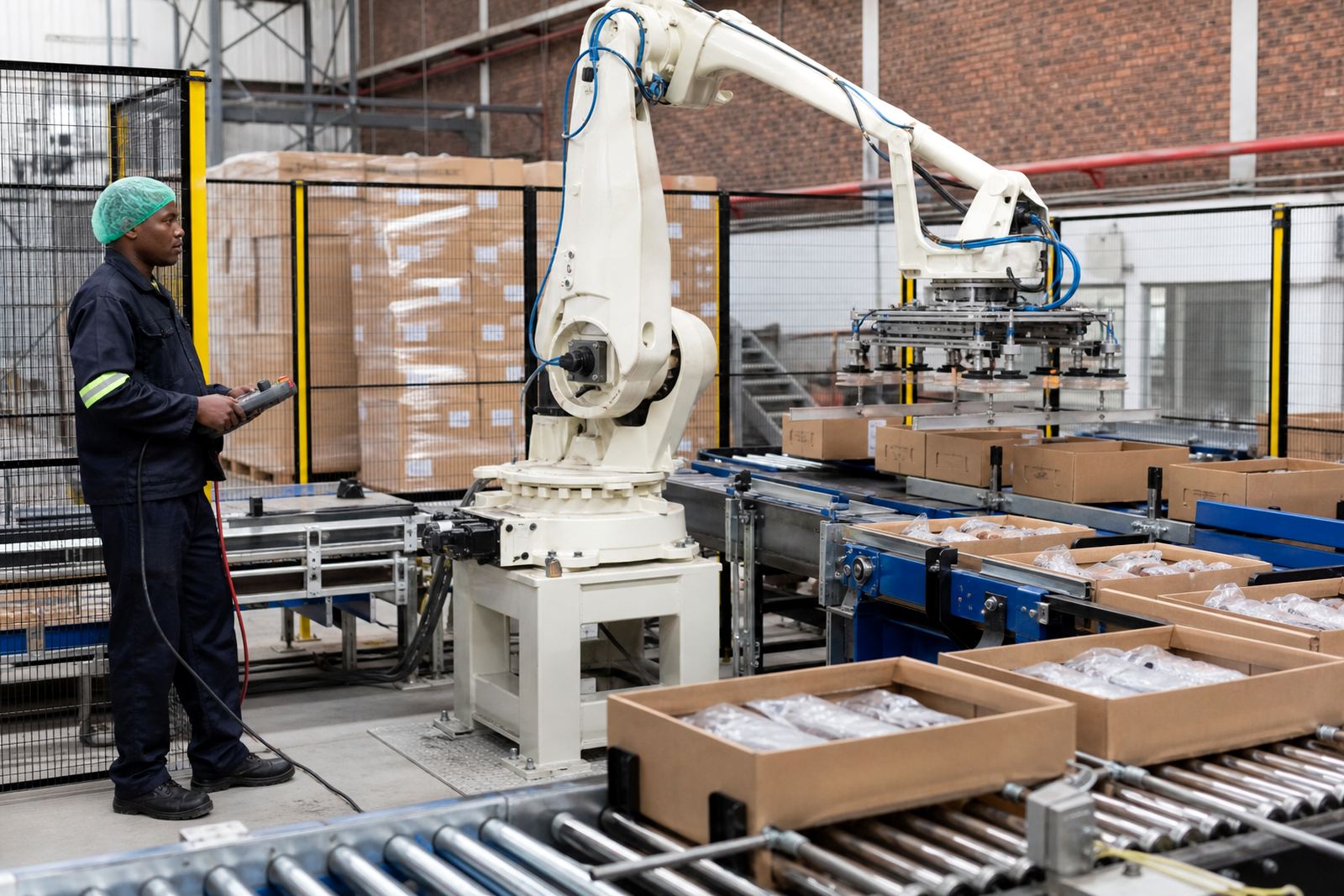
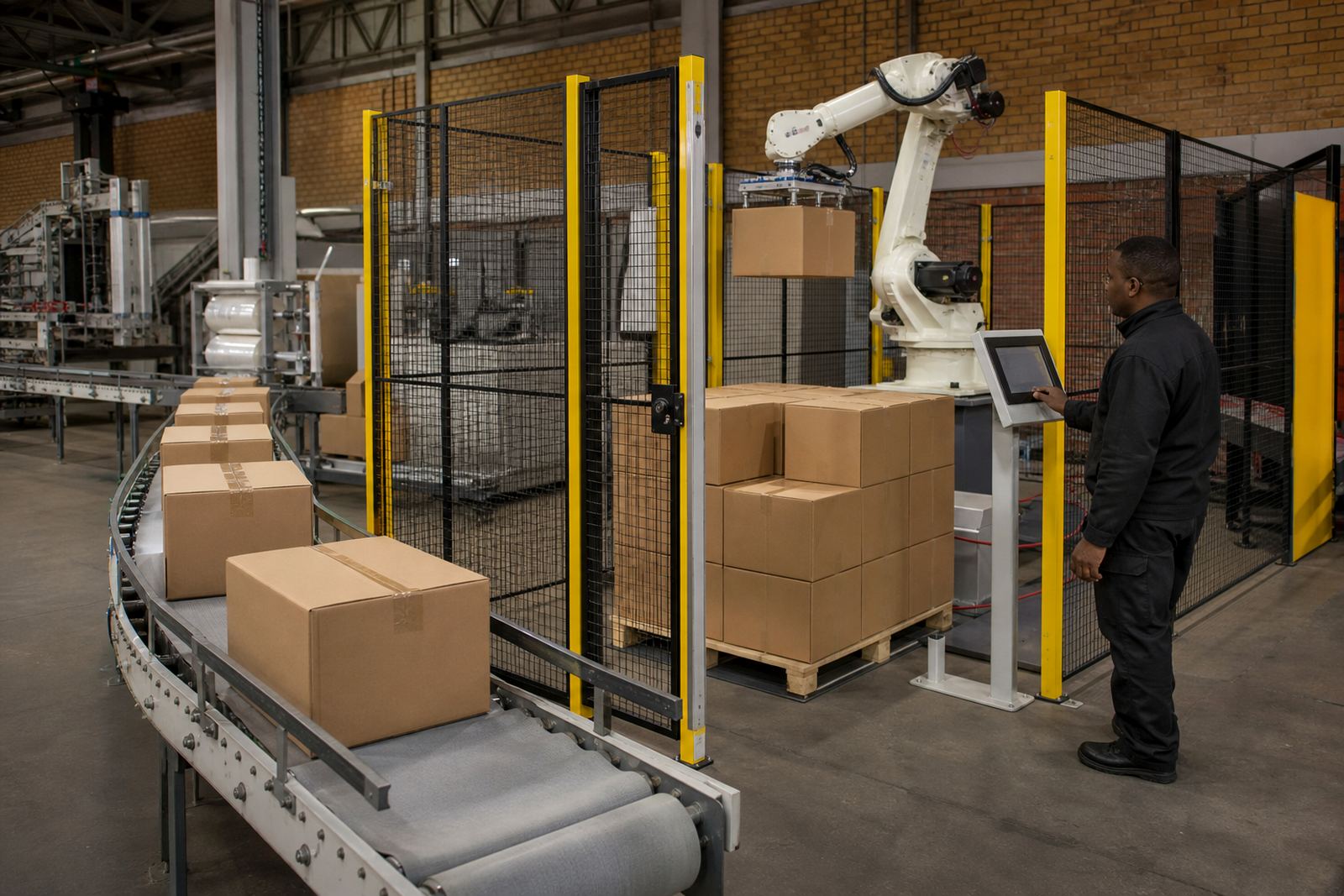
We supplied a robotic palletising retrofit built around the existing carton discharge conveyors and pallet staging area. The design included conveyor handover points, pallet infeed handling, product accumulation at the pick point and recipe selection so the operator could change stacking patterns for different carton formats without manual reprogramming on every run.
The system was set up to support regular production changes and to reduce the amount of manual handling at the end of line. We also included controls integration so the palletising cell could speak to the line controls, receive product signals and stop or start in the right sequence. Where required, the layout allowed for future expansion if the client later wanted to add more product patterns or a second pallet position.
- Existing conveyors retained and connected into the retrofit
- Recipe-based pallet patterns for different carton sizes
- Controls integration for line handshake and fault handling
- End-of-line pallet transfer and staging included in the layout
Safety guarding and risk assessment support
Because the line was moving cartons and pallets in the same production zone, guarding was not optional. We designed the safety guarding around the work area, access points and maintenance requirements, with clear separation between operators and moving equipment. The guarding had to allow for routine checks, safe loading of pallets and sensible access for cleaning and maintenance teams.
Risk assessment support formed part of the retrofit from the beginning. Each site needs its own assessment because conditions differ from one plant to the next, even when the machinery looks similar. We worked through access routes, emergency stop positions, gate interlocks and the safe interaction between the robot cell and the surrounding conveyors. That approach helped the client meet site safety expectations without making day to day operation difficult.
- Perimeter guarding around the palletising cell
- Access control for operators and maintenance staff
- Emergency stop and interlock layout reviewed for the site
- Risk assessment support based on the actual floor layout
Installation, commissioning and operator training
The project was completed over a six week programme. The first stage covered site survey work, line measurements and the detail design for conveyor integration and guarding. After that, the fabrication and assembly phase moved ahead while the site team prepared the line for changeover. The actual installation was planned to reduce downtime and to keep the packing department informed at every step.
Commissioning focused on product flow, pallet build quality and fault response. We tested the recipe selection, confirmed the carton entry timing and checked that the cell handled repeated starts and stops without upsetting the upstream line. Operator training was included so the shift team could run the system confidently, clear simple faults and carry out normal checks at the start of each shift.
- Project duration: 6 weeks from survey to handover
- Commissioning covered pallet patterns, timing and line signalling
- Training included normal operation, fault checks and basic recovery
- Handover supported the production and maintenance teams
Results on the production floor
The biggest change was the removal of repetitive manual palletising at the line end. Pallets were built more consistently, carton handling became more controlled and the packing team no longer had to absorb the physical load of stacking through every shift. The recipe selection made changeovers easier when the line moved between carton sizes, and the improved guarding gave the area a more defined operating structure.
The client also gained a neater end-of-line arrangement. With the robot handling palletising and the controls logic tied into the conveyor flow, the line became easier to manage during normal production and after short stoppages. It also helped reduce the risk of rushed manual stacking when orders changed late in the day, which is often when mistakes creep in.
For a carton line, that kind of retrofit is usually about keeping throughput steady while taking pressure off the team. This job did exactly that, without forcing the site to replace equipment that was still serviceable.
What We Would Rework On A Similar Carton Line
On a similar project we would again start with a full site line survey and a detailed look at the conveyor route, pallet access and available floor space. That early work saves time later because it shows where the cell can sit, how the cartons need to arrive and where maintenance access can be kept clear. On older plants, that step is often what separates a workable retrofit from a difficult one.
We would also keep the safety review tied closely to the mechanical layout and the actual operator routines. That matters on busy sites where people are moving between packing, staging and dispatch areas. For a carton line in a place like Pinetown, Durban or any other high-output plant, the best retrofit is the one that fits the building, the production rhythm and the team who will run it every day.
- Start with a proper survey, not assumptions
- Fit the cell to the site flow and access routes
- Keep recipe logic simple for the operators
- Plan guarding and maintenance access together
Key facts
| Project location | Pinetown, KwaZulu-Natal |
|---|---|
| Application | Carton line end-of-line robotic palletising retrofit |
| Scope | Recipe selection, conveyor integration, safety guarding and commissioning support |
| Timeline | 6 weeks |
| Site type | Manufacturing plant with existing packing conveyors |
| Service support | Site Line Surveys, Retrofit Design, Controls Integration, Risk Assessment Support, Operator Training |