Jet Park Beverage Line Brief
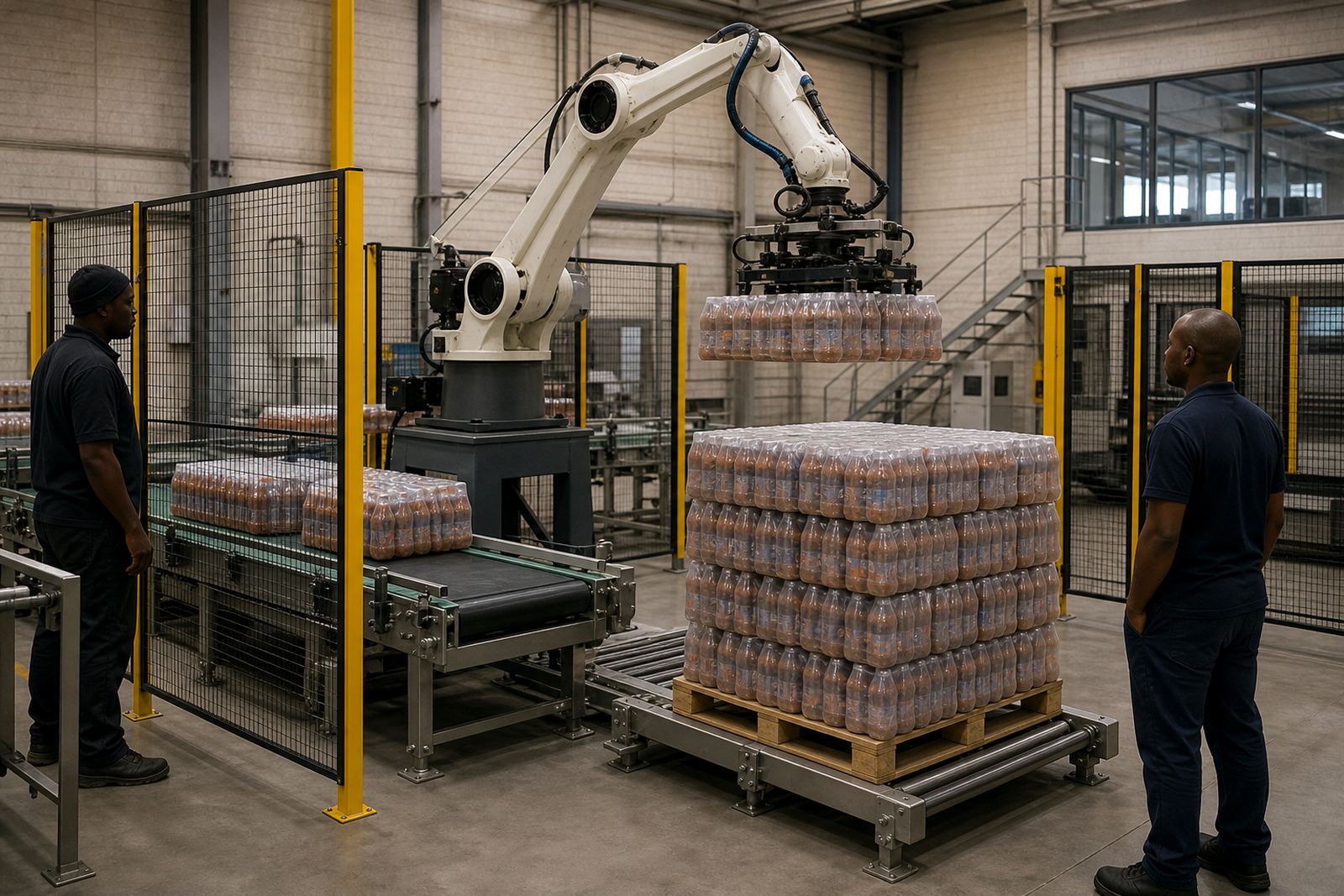
The site was a beverage packing operation in Jet Park, Kempton Park, handling bundled packs coming off a shrink line and moving them into end of line palletising. The brief was straightforward on paper but demanding on site: reduce manual handling, improve consistency, and fit a robotic solution into an existing line without ripping out conveyors that were still serviceable.
The product mix changed through the day, so the line needed a handling method that could manage different bundle counts and pack patterns without constant rework. The client also wanted the upgrade to support future growth, not just solve the immediate bottleneck. That meant the retrofit had to be practical, serviceable and easy for operators to learn.
Because this was a working beverage plant, the project had to respect hygiene practices, production windows and access around the shrink wrapper, conveyors and pallet staging area. Space was tight near the end of line, and there were existing pedestrian routes, forklift movement and emergency access points to keep clear. The solution had to fit the building not force the building to fit the robot.
Constraints On The Floor
The biggest constraints were physical space, existing conveyor heights and the need to keep production moving. In beverage plants, a few millimetres off in transfer height can turn into a lot of stoppages over a shift, so we spent time on the line survey and measured the whole run from shrink exit to pallet drop point. We also had to work around the plant’s shift pattern and schedule disruptive work for agreed shutdown windows.
The controls and restart sequence had to be arranged so the line could recover cleanly after power interruption and not leave product half transferred or a pallet in an unsafe position. Safety guarding had to suit the actual layout, with access points for maintenance and pallet changeover but no easy way for someone to reach into a moving zone. Each site needs its own risk assessment, and this one was no exception.
Coastal humidity was not the issue in Jet Park, but beverage sites across Gauteng and the coast often ask for the same thing: equipment that can tolerate dust, washdown routines and day to day wear without becoming fussy. The retrofit therefore needed clean cable routing, sensible enclosure placement and guarding that could be maintained without special tools.
What We Supplied And Integrated
We supplied the retrofit scope for the robotic handling section, including line survey support, retrofit design, conveyor integration, controls integration, safety guarding design and risk assessment support. The robot was integrated as part of the existing line, not treated as a separate island. That meant signal exchange with the conveyors, product presence detection, pallet handling sequence logic and operator controls all had to work together.
The handling concept was designed for bundled packs moving from the shrink line into a palletising routine. This included infeed timing, transfer logic, stack pattern control and a safe stop sequence. We also allowed for a cobot-style cell where appropriate, but the final guarding and operating method were based on the task and the risk assessment, not a standard approach.
Our team handled installation management and commissioning support, then stayed on site for operator training and handover checks. The controls specialist tuned the sequence so the line would restart cleanly after pauses and minor stoppages. The site supervisor coordinated the mechanical and electrical activities, while service support remained available after handover for teething issues and spares planning.
Timeline From Survey To Commissioning
The project ran over a planned period of six weeks from initial survey to commissioning support. Week one covered the site line survey and measurements. Week two was the retrofit design and layout review, including guarding positions and control philosophy. Weeks three and four focused on fabrication, prep work and control panel modifications. The physical installation and integration took place in week five, with commissioning and operator familiarisation in week six.
That timeline was realistic for a live production site with limited shutdown windows. It gave enough time to check conveyor levels, test the product flow and confirm that the pallet build sequence was stable before full handover. A rushed install might have looked quicker on paper, but it would have increased stoppages and troubleshooting once production resumed.
The handover stage also included maintenance notes, spare parts planning and a breakdown response process. In South African plants, support after commissioning matters as much as the first run, because shifts, utilities and production demand change fast. The site needed a clear route back to us if a sensor, interlock or conveyor signal behaved unexpectedly.
Results On Shift
Once the line was running in its new configuration, the main improvement was consistency. Bundled packs transferred more evenly from the shrink line and the pallet build became more predictable from shift to shift. That reduced manual intervention and made the end of line easier to manage, especially during peak production periods when the team had less time to handle exceptions.
The retrofit also improved safety around the palletising area by defining movement zones, access points and stop conditions more clearly. Operators had a better understanding of where to stand, when to intervene and how to reset the line. The plant could still do the work it needed to do, but with less heavy handling and less crowding around the transfer point. Small improvement, big difference over a full week.
Because the existing conveyors were kept in the system where possible, the client avoided unnecessary replacement cost and reduced the amount of mechanical work on the floor. That made future maintenance simpler too, since the team could still service familiar equipment while benefiting from the added automation layer.
What We Repeat On The Next Plant
If we were doing a similar beverage retrofit again, we would follow the same sequence: survey the line properly, measure the actual transfer points, and design around the building rather than fighting it. That is especially important in older plants where the conveyor heights, floor condition and aisle widths are already set. Good retrofit work starts with facts on the floor, not assumptions.
We would also repeat the early risk assessment process and bring the client’s operations team into the layout discussion before installation starts. That helps avoid late changes to guarding, access or product flow. On a line like this, the success of the automation depends just as much on the integration and safe operating method as it does on the robot itself. Get those right, and the rest tends to follow.
For beverage plants in Jet Park, Kempton Park, Johannesburg, Pretoria, Durban, Cape Town or Gqeberha, the same principles apply: fit the retrofit to the process, keep the controls straightforward and allow for maintenance, cleaning and power interruptions. That is how a robotic upgrade becomes part of the line instead of a problem on the line.
Key facts
| Project location | Jet Park, Kempton Park, Gauteng |
|---|---|
| Site type | Beverage packing and palletising |
| Scope | Robotic retrofit from shrink line to pallet build |
| Timeline | 6 weeks from survey to commissioning support |
| Integration | Existing conveyors, controls, interlocks and guarding |
| Service support | Training, maintenance support and breakdown assistance |