Project brief from the Isando packing floor
The site was a food production line in Isando, Gauteng with an existing case outfeed that was still being handled manually at the pallet build area. The brief was straightforward: keep the current packing and conveying equipment in place where possible, add robotic palletising, and make the end of line safer and easier to run on each shift. The client wanted a solution that would fit a busy plant with limited floor space, normal production pressure and the usual demands of food manufacturing hygiene and housekeeping.
The line had to keep moving during most of the upgrade, so the work had to be planned around production windows, cleaning cycles and site access. The main goal was to remove repetitive lifting from the pallet area, improve pallet consistency, and reduce strain on operators who were manually stacking cases and wrapping pallets before despatch.
Site constraints and operating conditions
This was not a greenfield installation, so the retrofit had to work with the existing conveyor heights, case flow and building layout. There was limited clearance around the outfeed area, and the pallet build zone had to remain clear for safe forklift movement and stock staging. The client also needed practical safety guarding that would suit a food plant, where cleaning access and visibility are both important.
Like many plants in Gauteng, the site also needed a dependable restart sequence after unplanned stops. Controls had to be arranged so the line could recover cleanly after stoppages, without confusing operators or creating unsafe starts. The solution had to fit the way the factory actually runs, not just how it looks on paper.
- Existing case outfeed kept in service where possible
- Space allowance made for pallet staging and forklift routes
- Guarding planned for access, visibility and cleaning
- Controls arranged for orderly restart after stoppages
What we supplied and integrated
We completed a site line survey, mapped the existing conveyor flow and worked out how the new palletising cell would connect to the current end of line. The retrofit included robotic palletising at the case outfeed, conveyor interface work, controls integration and safety guarding design. We also supported the risk assessment process so the final arrangement matched the actual site layout and operating method.
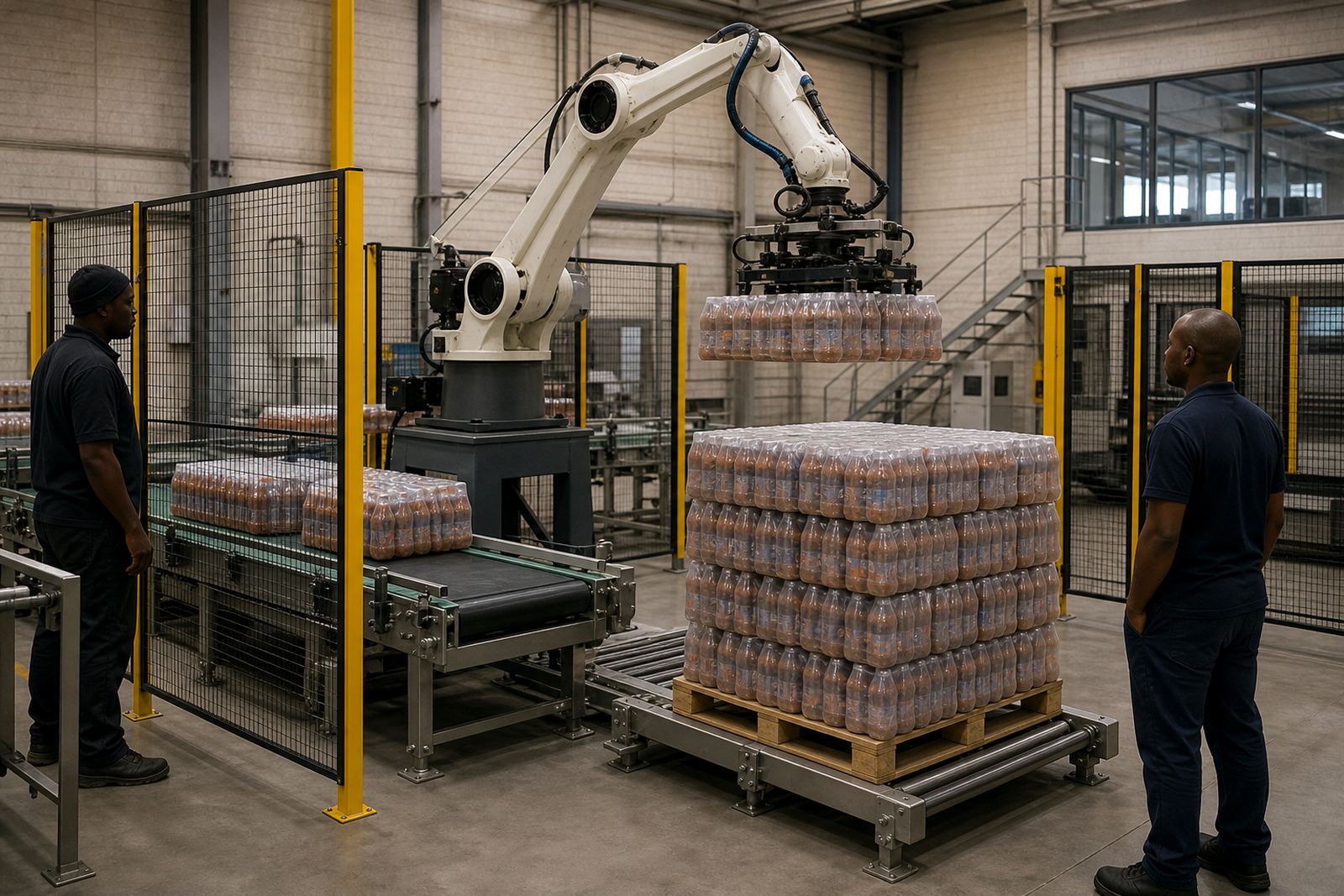
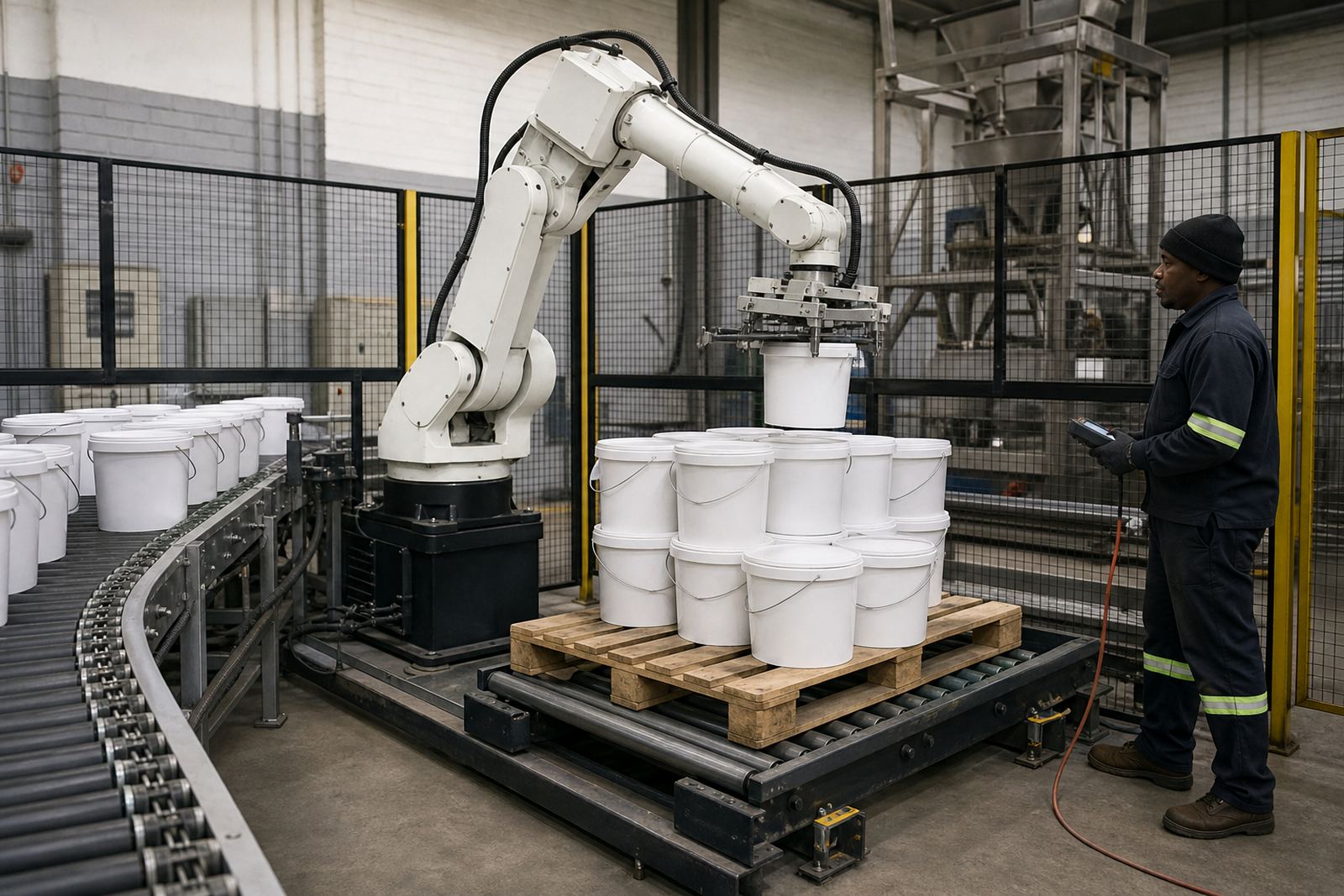
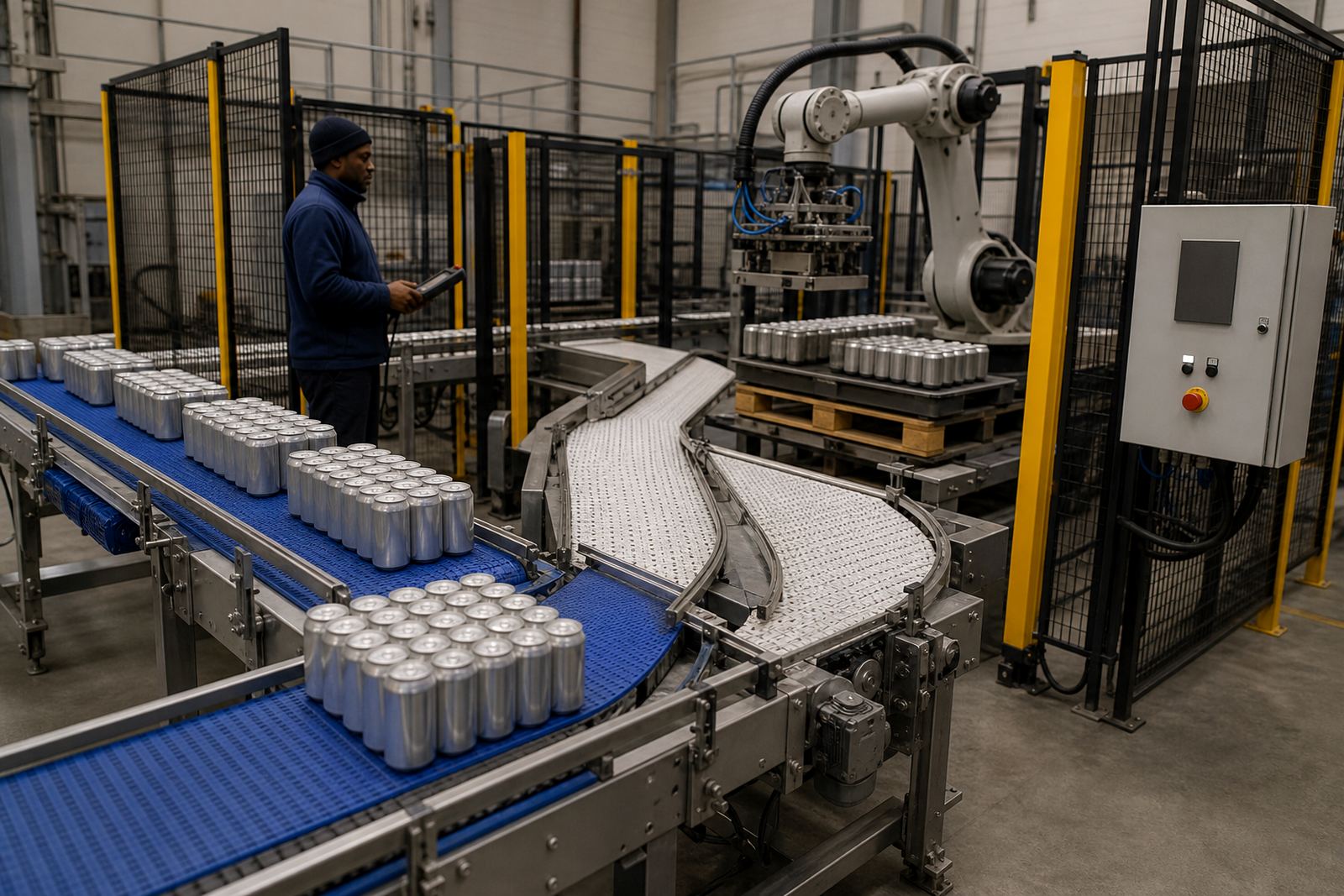
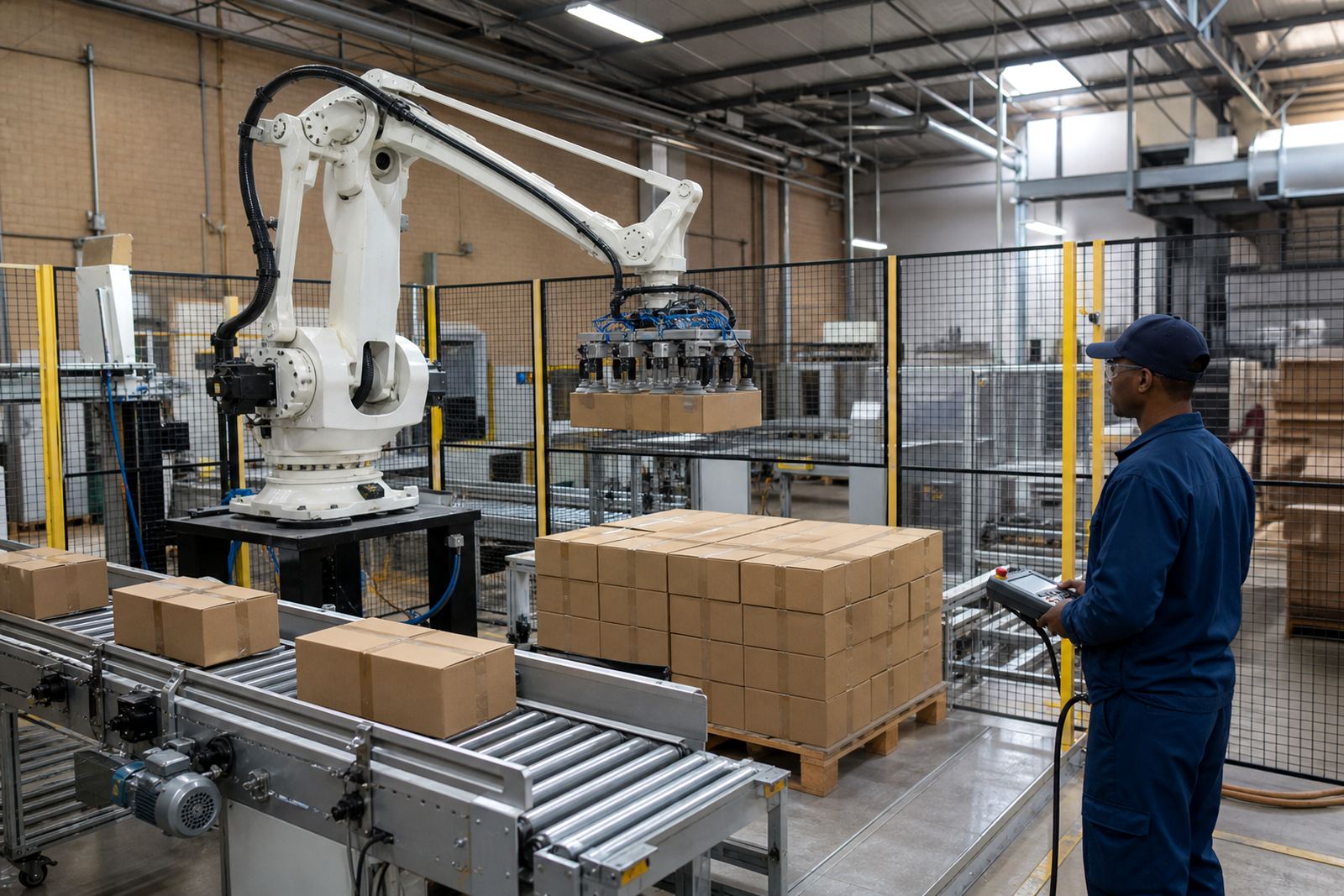
The robot cell was designed to take cases from the conveyor, form stable layers and place them on pallets in a repeatable pattern. Where required, the guarding was arranged to separate the operating zone from pedestrian movement and forklift handling. Operator access points, stop functions and maintenance access were considered from the start, because a retrofit only works well if it is easy to live with day to day.
- Robotic palletising tied into the existing case outfeed
- Conveyor interface and controls integration
- Safety guarding design around the pallet build area
- Risk assessment support for the final installation arrangement
Installation and commissioning over six weeks
The project ran over six weeks from detailed survey through to commissioning support. The first stage covered measurements, layout checks and final coordination with the client team. After that, the retrofit design was confirmed, guard positions were set out and the controls scope was matched to the existing line sequence. Mechanical installation and electrical tie-ins were managed so production disruption stayed within the agreed windows.
Commissioning focused on case tracking, pallet pattern stability and safe transfer between the conveyor and the robot cell. We also worked through start-up, stop, fault reset and normal operator routines with the people who would use the line every day. Small adjustments were made on site to suit actual case behaviour and the way the product moved on the conveyor, because that is where a retrofit proves itself.
- Week 1 and 2: survey, layout checks and retrofit design
- Week 3 and 4: guarding, conveyor works and controls integration
- Week 5: installation management and dry runs
- Week 6: commissioning support and operator training
Results on the palletising line
Once the system was running, the main change was consistency. Cases were transferred from the outfeed into a repeatable palletising cycle and the pallet build area became easier to manage. Manual lifting was reduced at the end of line, and the guarded layout gave the team a clearer working zone around the robot and conveyors.
The client also gained a neater handover point for despatch. With the palletising pattern controlled by the retrofit, the line produced more uniform pallet builds and fewer ad hoc interventions. Maintenance checks were simpler too, because the line had defined access points and the controls sequence was set up for practical use by site staff.
- Reduced manual handling at the case outfeed
- More even pallet builds and cleaner line handover
- Safer separation between people, conveyor flow and the robot cell
- Easier operator routines for start-up, stopping and fault recovery
What We Would Rework On A Similar Food Line
On a project like this, we would again start with the actual conveyor route and the real floor space available, not an assumed layout. That approach saves time later and helps avoid expensive changes once equipment arrives. We would also keep the safety review tied to the site conditions, because every packing line has its own movement patterns, cleaning needs and traffic paths.
For food manufacturers in Isando, Johannesburg or anywhere else in South Africa, the lesson is the same: a good retrofit has to support production first. If the guarding, controls and palletising flow are planned around the way the plant really works, the result is easier to operate and easier to maintain.
- Begin with an on-site survey and real measurements
- Design around cleaning access and forklift movement
- Match controls to the existing line sequence
- Use the site risk assessment to finalise guarding and access
Key facts
| Project location | Isando, Gauteng |
|---|---|
| Client type | Food manufacturer |
| Scope | Robot palletising retrofit for existing case outfeed |
| Integration | Existing conveyors, controls and safety guarding |
| Timeline | 6 weeks |
| Support | Survey, installation management, commissioning and operator training |