What the Benoni plant needed from the retrofit
The client was a beverage and packhouse operation in Benoni handling sleeved cans in grouped packs, with product moving from filling and secondary packing into palletising. The main challenge was that the line still relied too heavily on hand packing and manual clearing at the outfeed, which created bottlenecks during shift changes and peak runs. They needed a retrofit that would fit into the existing line, not a full rebuild.
The brief was simple in principle but careful in execution: improve packing consistency, reduce manual lifting, and keep the line moving at a steady rate without upsetting upstream or downstream equipment. Because the site had a live production schedule, the changeover had to be phased and planned around short shutdown windows. As with most retrofits, there were also practical constraints around floor space, guarding positions, access for cleaning, and the need to keep operators comfortable with the new process.
- Town: Benoni, Gauteng
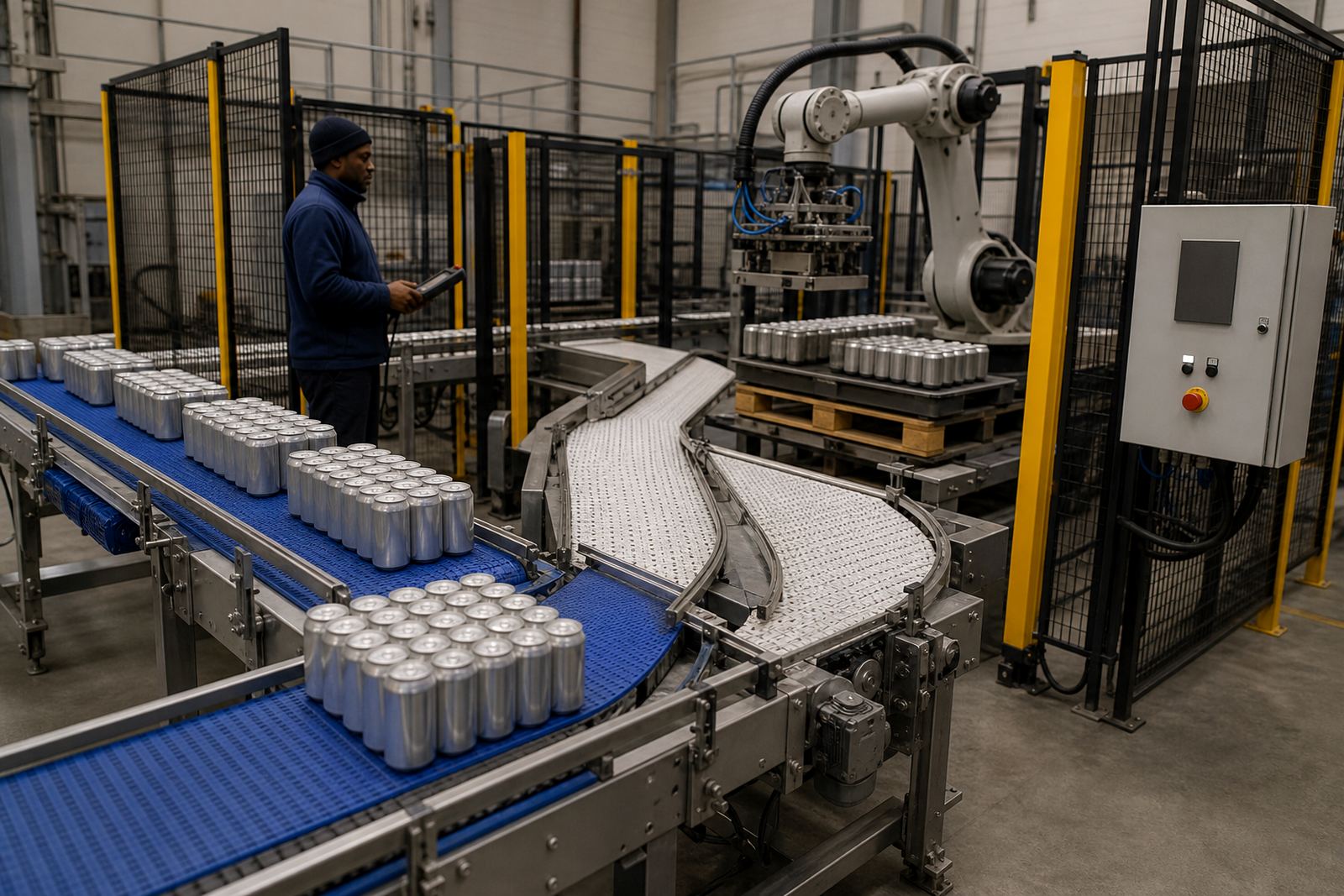
- Application: grouped cans, robotic packing, outfeed control before palletising
- Site type: existing production line with limited spare floor space
- Main goal: reduce manual handling and improve line flow
How we approached the line survey and design
We started with a site line survey to map the full product path from the infeed through to the palletising area. That included conveyor heights, transfer points, accumulation space, operator walkways and the positions where packs were being presented to the robot. The aim was to keep the retrofit practical and avoid creating pinch points or awkward access for maintenance teams.
From there, we developed a retrofit design around the existing conveyors and outfeed controls. The packing cell was laid out so grouped cans could arrive in a repeatable orientation, with clear presentation for the robot and predictable discharge to the palletising area. We also looked at the guarding line, access gates and emergency stops so the cell could be isolated safely for service and cleaning. Safety guarding and risk assessment support were treated as part of the design process, not as a final add-on.
- Existing conveyor interfaces measured and checked on site
- Pack presentation verified for repeatable robotic handling
- Guarding and access routes planned around operator movement
- Risk assessment support aligned to the final line layout
What we supplied and installed
The retrofit included a robotic packing cell for grouped cans, conveyor integration work, controls integration and safety guarding design. We also handled installation management so the fitment sequence stayed coordinated between mechanical work, electrical connections and final checks. The robot cell was tied into the existing line controls so product flow, stop signals and discharge timing could work together rather than as separate systems.
For this project, the packaging pattern had to stay stable because the cans were being moved in grouped packs before palletising. We set up the handling so the robot could manage repeatable pack placement, while the outfeed conveyor and accumulation section reduced clumping before the palletising stage. That mattered because inconsistent outfeed can slow everything down, even when the robot itself is working well.
- Robotic packing retrofit for grouped cans
- Controls integration with existing line equipment
- Conveyor transfer adjustments at the outfeed
- Safety guarding around the new working envelope
- Installation management through mechanical and electrical stages
Timeline, commissioning and operator handover
The project ran over six weeks from survey to commissioning support. Week one covered the site survey and layout confirmation. Weeks two and three were used for design, guarding detail and control logic preparation. The installation phase followed, with line fitment, wiring and conveyor adjustment completed during scheduled downtime. Commissioning support and operator training were then done on site so the team could work with the new sequence confidently.
We spent time with the operators and shift leads on practical use, including safe start-up, clearing procedures, basic fault checking and what to do when product feed changed during a run. Maintenance support notes were also handed over so the team had a sensible reference for daily checks and spares planning. The handover was paced to suit the site, because rushing an automation change on a live line usually causes more trouble than it saves.
- Duration: 6 weeks end to end
- Commissioning support carried out on site
- Operator training included start-up and fault response
- Maintenance guidance aligned to daily production needs
Results on the Benoni line
Once the retrofit was running, the line had a cleaner flow from packing to palletising, with less manual lifting at the outfeed and better control over grouped cans. The biggest practical improvement was consistency. Packs arrived more predictably, the robot could work to a steadier rhythm and the downstream section no longer had to absorb the same level of manual intervention.
The site also gained a safer working arrangement around the new cell, with guarding and stop functions positioned for normal operator use. Because the retrofit kept the existing conveyor system in play, the client did not have to change the full line architecture just to improve output. For a Benoni plant working under normal South African production pressures, that is often the difference between a sensible retrofit and a costly disruption.
- Better outfeed management before palletising
- Reduced manual handling around grouped cans
- More stable line rhythm during production runs
- Safer access and clearer working boundaries
What we repeat on a similar robotics project
If we were repeating this project at another can line in Gauteng, we would again start with a full line survey and keep the design tied to the existing conveyors, not the other way around. That approach makes it easier to keep downtime under control and avoids expensive structural changes. We would also keep the risk assessment site-specific, because each plant has its own traffic routes, cleaning routines and access points.
For clients in Johannesburg, Pretoria, Durban, Cape Town, Gqeberha or across the East Rand and Midvaal, the lesson is the same: the best retrofit is the one that fits the process you already have. We work on line surveys, retrofit design, conveyor integration, controls integration, safety guarding design, risk assessment support, installation management, commissioning support, operator training, maintenance support, breakdown assistance and spares planning. That way the upgrade is practical from day one, not just impressive on paper.
- Start with the live process and measure what is already there
- Keep the robot cell matched to the conveyor flow
- Plan guarding, access and stops before installation begins
- Train the people who will run the line every day
Key facts
| Project location | Benoni, Gauteng |
|---|---|
| Client type | Can packing and palletising operation |
| Scope | Robotic packing retrofit, outfeed management and controls integration |
| Timeline | 6 weeks |
| Key equipment | Robot cell, existing conveyors, safety guarding, line controls |
| Services used | Site Line Survey, Retrofit Design, Conveyor Integration, Safety Guarding Design, Risk Assessment Support, Commissioning Support |