What the Pretoria West site needed
The site was handling mixed packs of chemical products in cartons and pails, with manual palletising at the end of line. That meant repeated lifting, slow changeovers and a floor area that was always under pressure. The brief was clear: improve output, reduce manual handling and fit a palletising cell into an existing production line without disrupting the rest of the packing area.
The plant is in Pretoria West, where factories often have to work around older buildings, limited clearances and mixed traffic between forklifts, trolleys and people. In a chemical environment, the answer also has to account for safe access, product stability and the need to keep the line tidy and easy to clean. The client wanted a practical retrofit, not a full rework of the plant.
- Product types: cartons and pails
- Application: end-of-line palletising retrofit
- Site type: chemical products packing area
- Location: Pretoria West, Gauteng
Constraints on the packing floor
The line had to keep running through the retrofit, so the installation window was tight and had to be planned in stages. Existing conveyors were staying in place, which meant we had to work with the current infeed heights, discharge direction and pallet position. Space around the line was limited, and the guarding had to allow for operator access without leaving unsafe openings or awkward reach points.
We also had to consider dust, occasional spill control and general plant housekeeping. In a chemical site, access points must be simple to inspect and easy to lock off for maintenance. The client wanted a setup that would be dependable during normal production and still practical when the team had to change carton sizes or pail patterns. That meant proper controls integration and a clear operating sequence, not just equipment bolted down and left to sort itself out.
- Existing conveyors retained and tied into the new cell
- Guarding arranged for loading, maintenance and emergency stop access
- Layout adapted to a compact production footprint
- Controls planned for normal use and size changeovers
What we supplied and installed
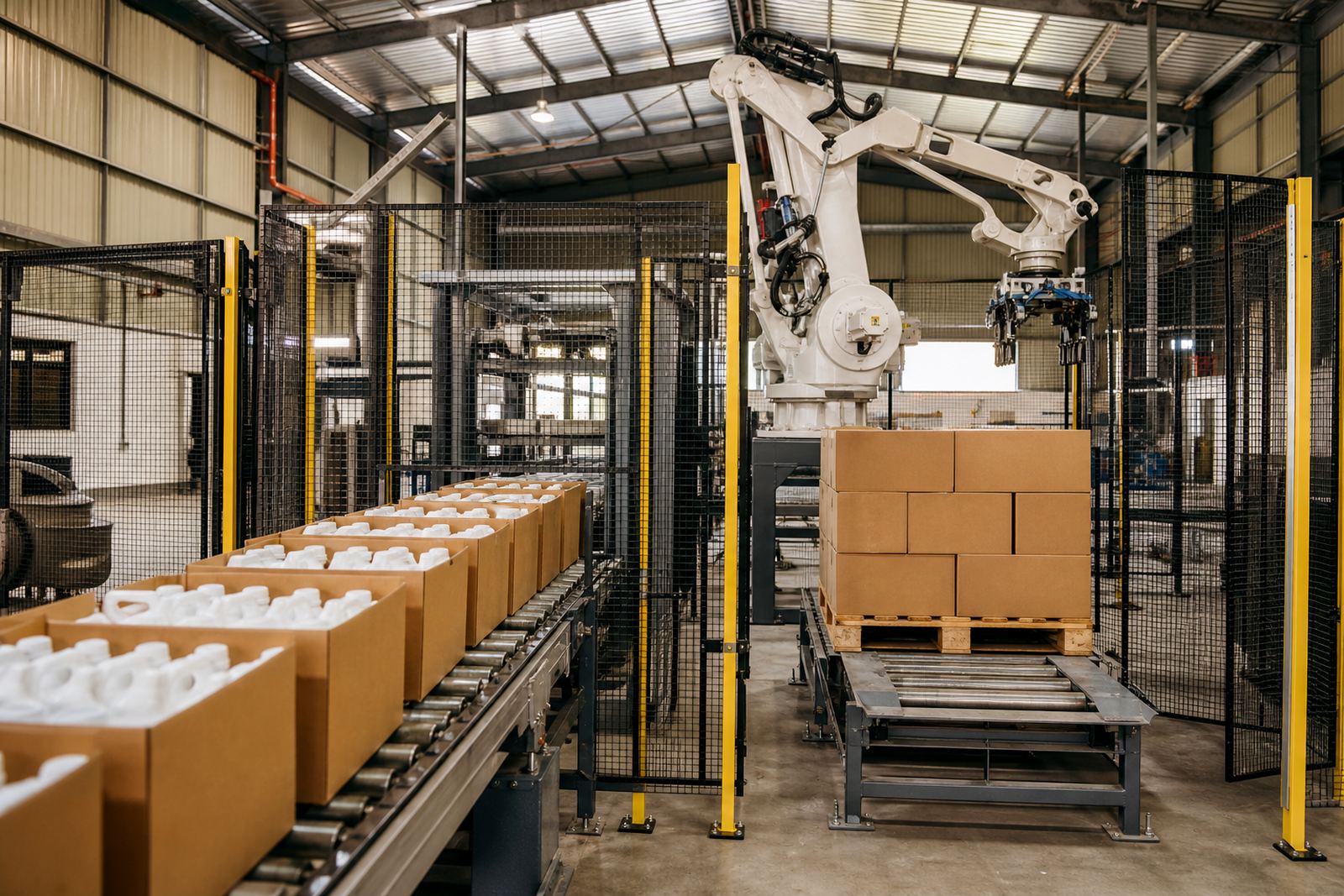
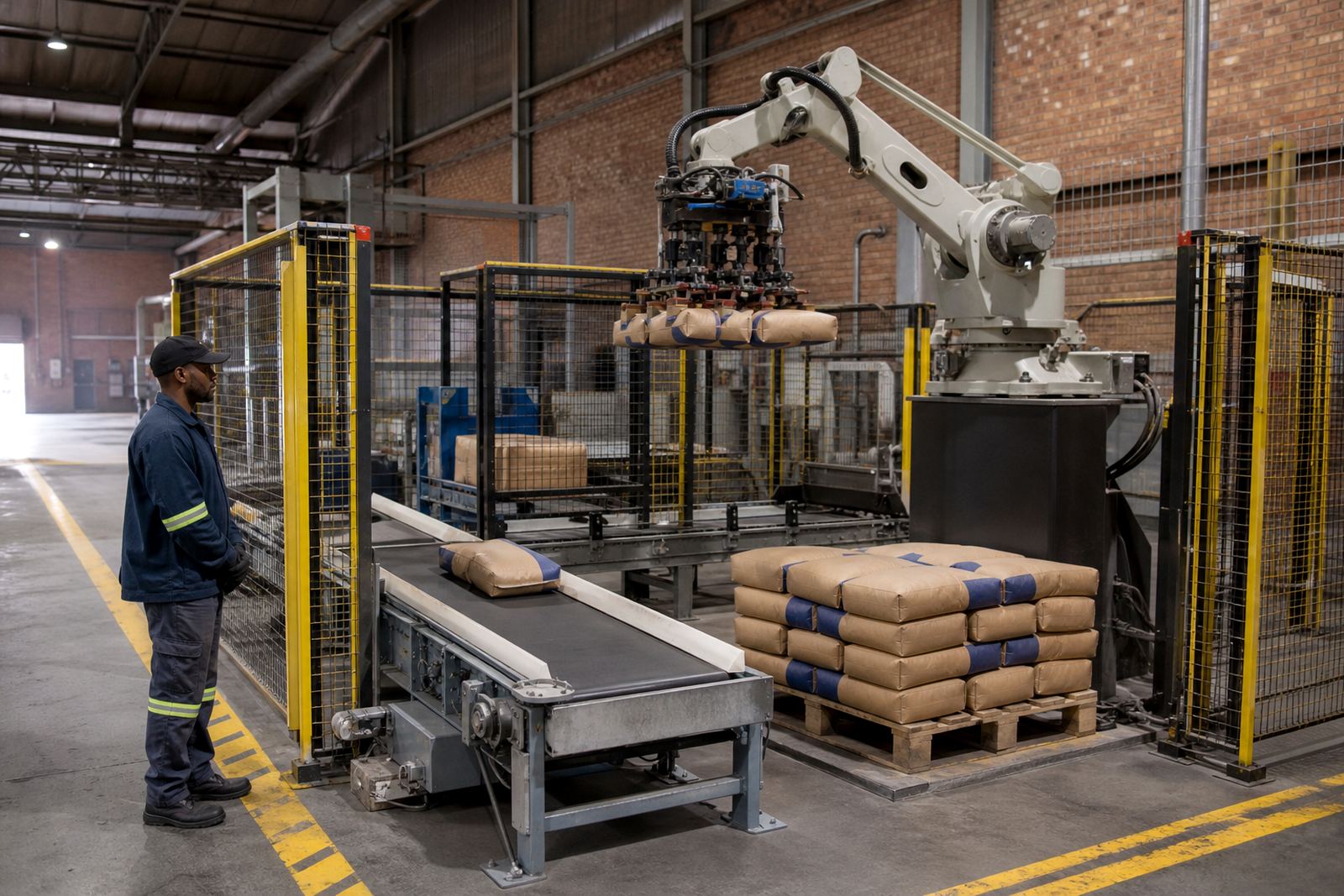
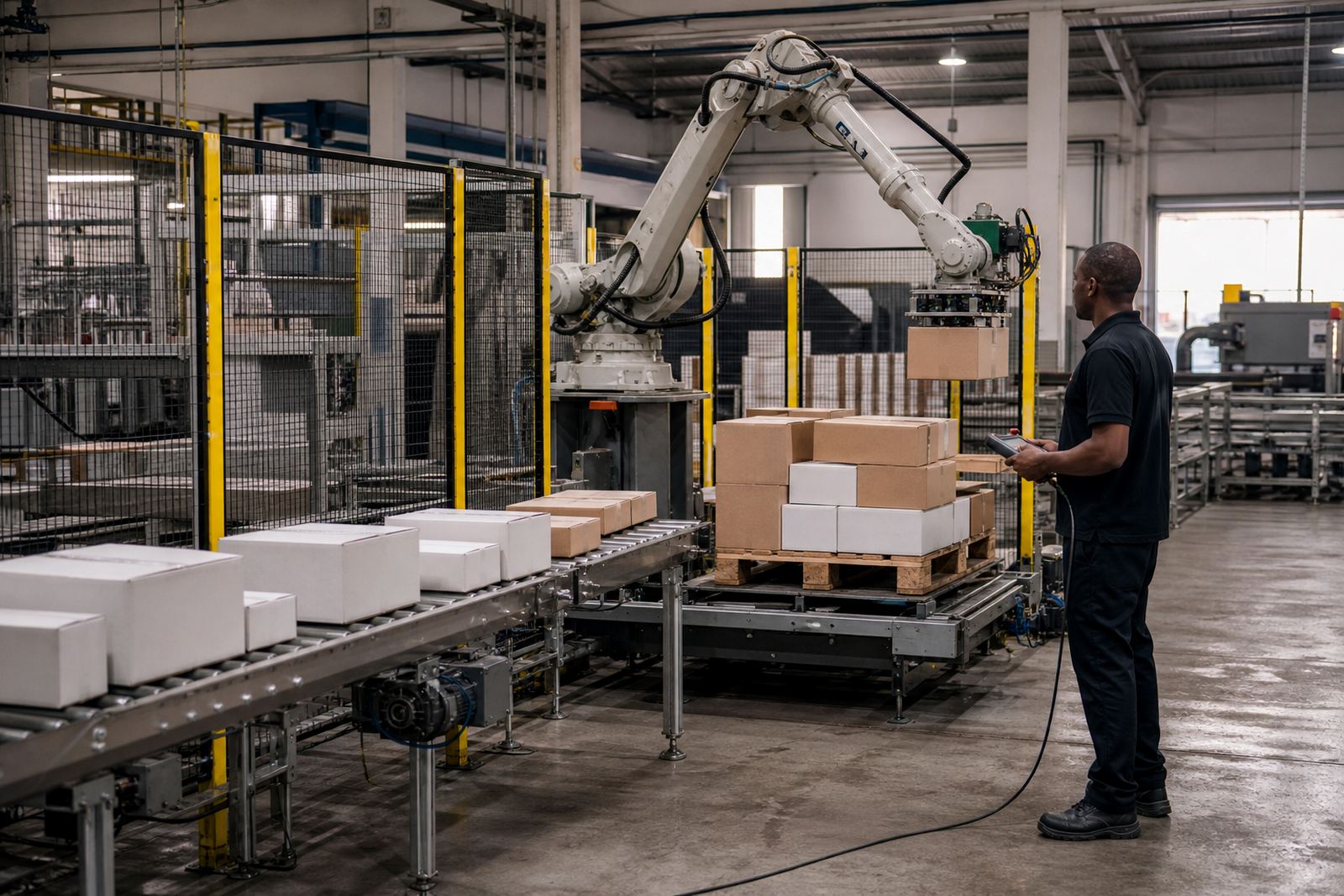
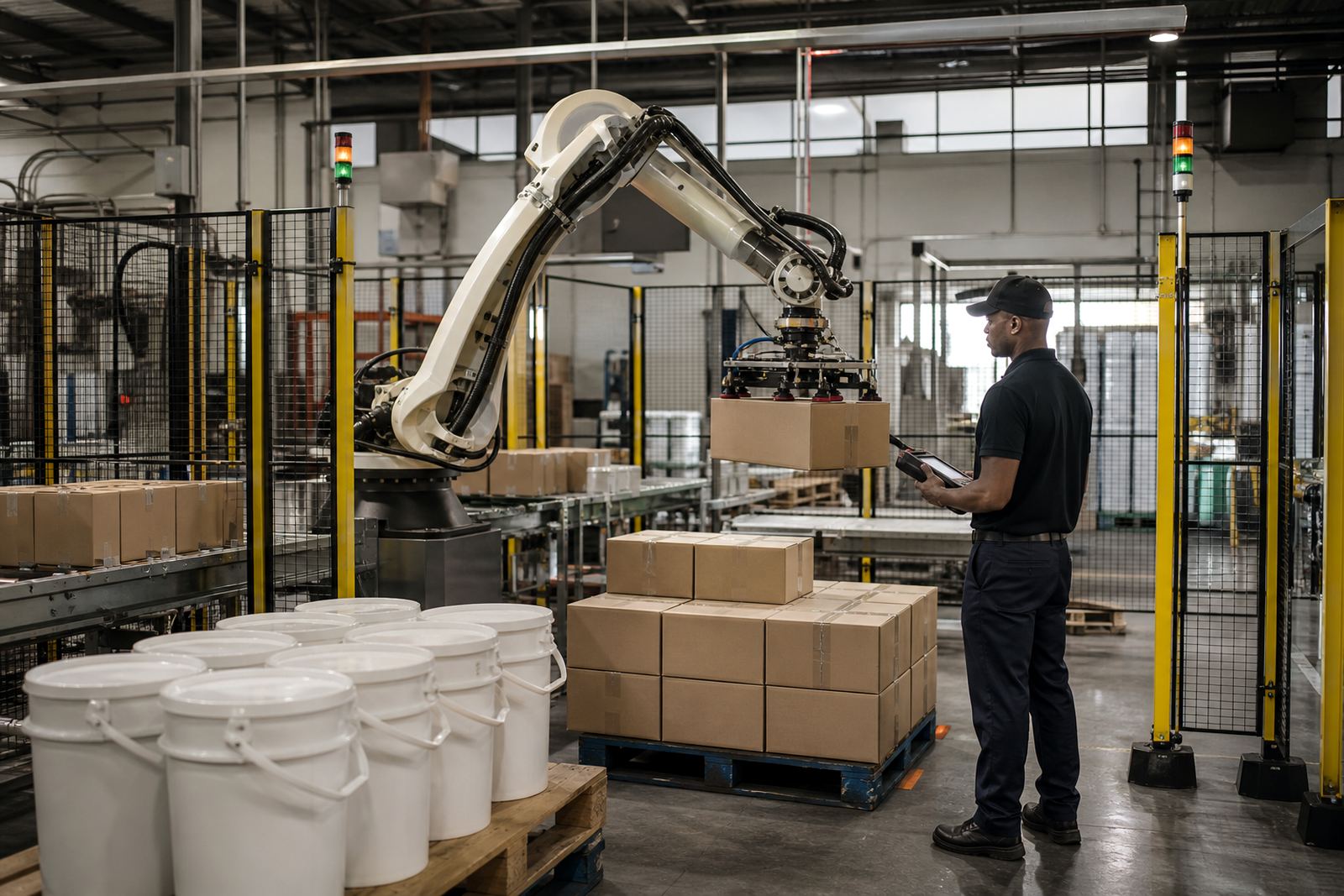
We supplied and managed a robotic palletising retrofit designed for the line's carton and pail formats. The scope included site line survey work, retrofit design, conveyor integration, safety guarding design, risk assessment support, installation management and commissioning support. The cell was arranged to take packs from the existing conveyor flow and place them in consistent pallet patterns, with the guarding set out to define the working envelope clearly.
The solution included a palletising robot, product transfer equipment, pallet presentation and a guarded access arrangement with interlocked gates. We also coordinated the controls work so that the line signals, stops and restart sequence matched the existing process. Where manual handling had previously taken most of the labour, the new cell took over the repetitive lift and place activity. A good retrofit should sit inside the plant, not fight it, and that was the approach here.
- Palletising cell for mixed cartons and pails
- Conveyor pick-up from the existing end of line
- Access guarding with interlocked entry points
- Controls integration with existing packing equipment
- Risk assessment support before commissioning
How the installation ran over four weeks
The work was carried out over four weeks from final site survey to commissioning support. Week one focused on measurements, flow review and final layout confirmation. Week two covered fabrication and control panel preparation. Week three was the installation phase, with guarding, conveyor tie-ins and cell placement on site. Week four was reserved for testing, operator familiarisation and final handover checks. It was a tight fit, so every step had to be sequenced properly.
We worked around the plant's normal production rhythm and coordinated the shutdown points carefully. On a site like this, the practical detail matters: where operators enter the cell, where pallets are staged, how the forklift route passes, and how the stop logic behaves when someone opens a gate. Those details are often what makes the difference between a line that looks good on paper and one that can be used every day without drama.
- Week 1: survey, layout and process review
- Week 2: fabrication and controls preparation
- Week 3: site installation and tie-ins
- Week 4: testing, training and commissioning support
Results on the line after commissioning
Once the cell was running, the packing team had a more consistent end-of-line flow and less manual lifting in the palletising area. The product handling became more repeatable, with cleaner pallet builds and fewer interruptions caused by tired operators stepping in and out of the process. The guarding also gave the site a clearer access boundary, which helps both safety and day-to-day discipline.
The client gained a setup that was easier to manage during normal production and easier to explain to new staff. In a chemical plant, that matters because turnover, shift changes and production pressure can quickly lead to shortcuts. With a defined automated cell in place, the team could keep the focus on feeding the line, monitoring the process and moving finished pallets away in an orderly way. That is where the real value sits, not in fancy talk but in a line that behaves the same way every shift.
- Less manual lifting at end of line
- More consistent pallet patterns
- Clearer access control around the cell
- Simpler operation for shift teams
What We Would Rework On Another Chemical Site
If we were asked to do a similar job at another chemical products plant, we would again start with a proper line survey and risk review before discussing hardware. Every site needs its own assessment because the packing layout, product weights, traffic flow and access requirements change from one factory to the next. The same applies to guarding, gate positions and restart logic. A safe retrofit is not generic, it has to suit the actual floor and the actual team using it.
We would also keep the installation approach practical: work with the existing conveyors where possible, preserve maintenance access and keep changeover steps simple. For Pretoria, Johannesburg, Durban or Cape Town, the same principle applies.This project showed that a compact palletising cell can fit neatly into an older production area when the design is based on the site rather than a catalogue idea.
- Start with a site-specific risk assessment
- Keep the existing conveyor route where it still works
- Design guarding around maintenance access as well as production
- Plan for changeovers, cleaning and shift handovers
Key facts
| Project type | Robotic palletising retrofit for cartons and pails |
|---|---|
| Site | Chemical products plant, Pretoria West |
| Scope | Site survey, retrofit design, conveyor integration, safety guarding, installation management and commissioning support |
| Protection | Access guarding with interlocked entry points |
| Timeline | 4 weeks from survey to commissioning support |
| Team involved | Sibusiso Hlongwane, Annelise Abrahams, Thabo Malherbe, Farah Khoza, Johan Booysen and Lerato Khanye |