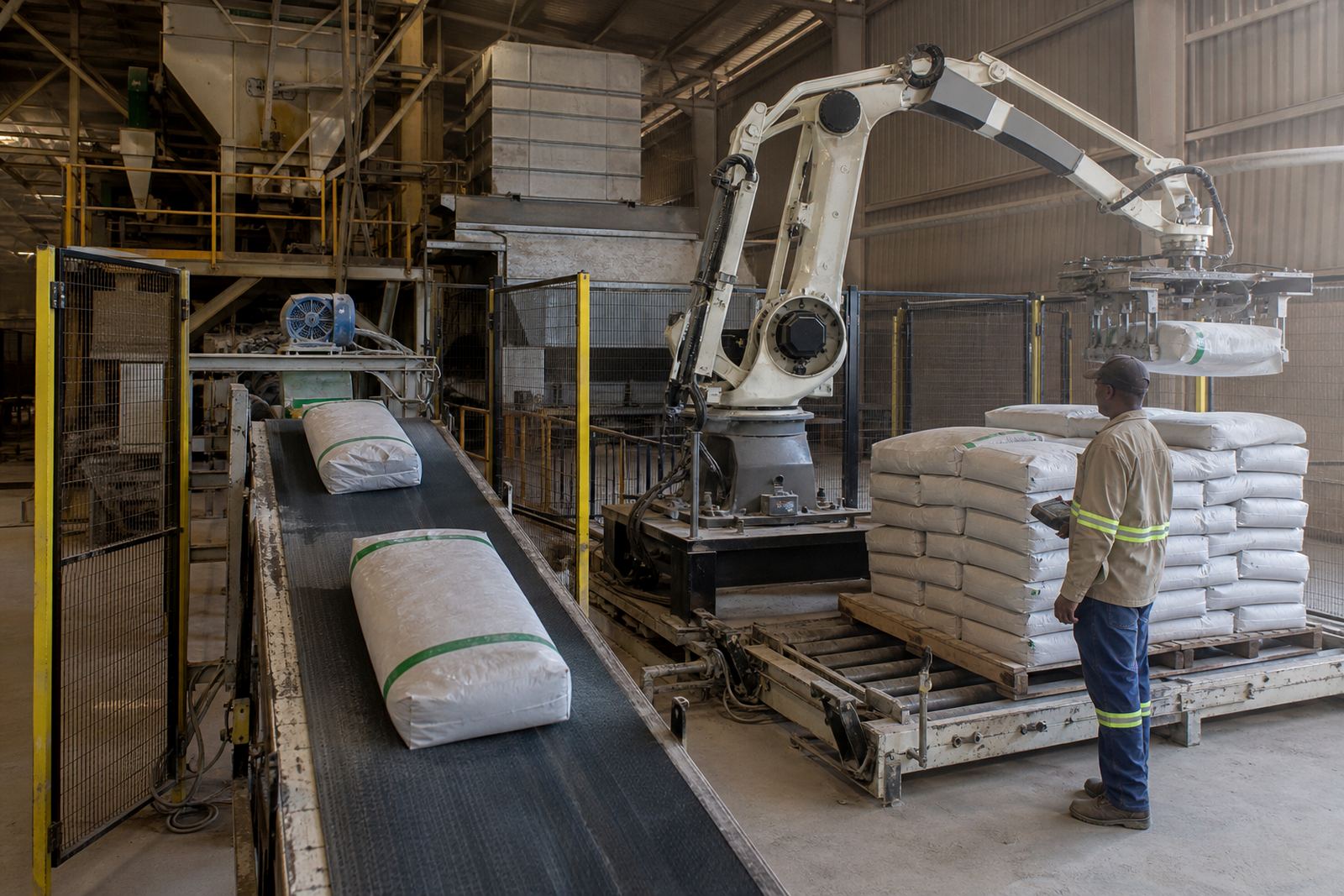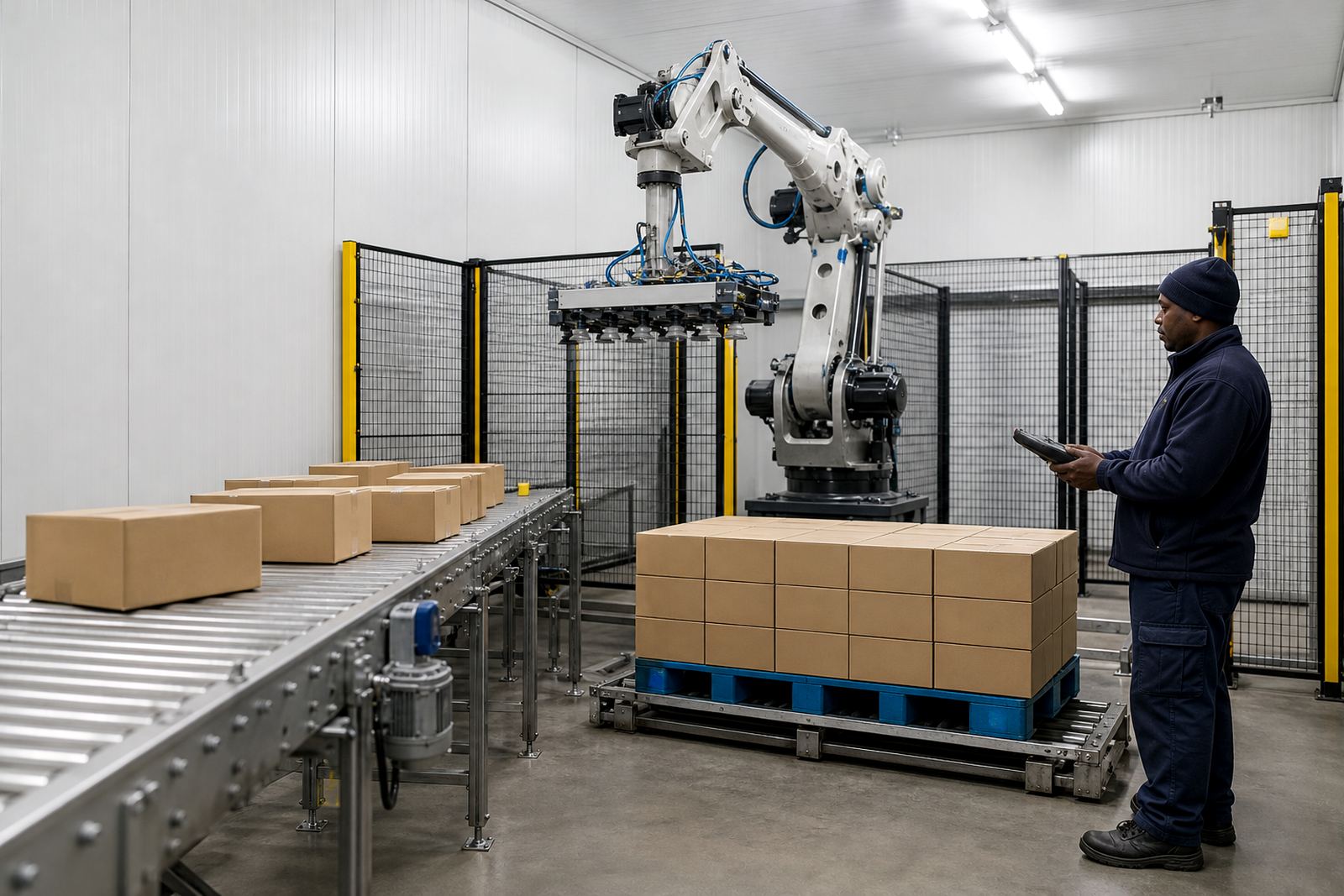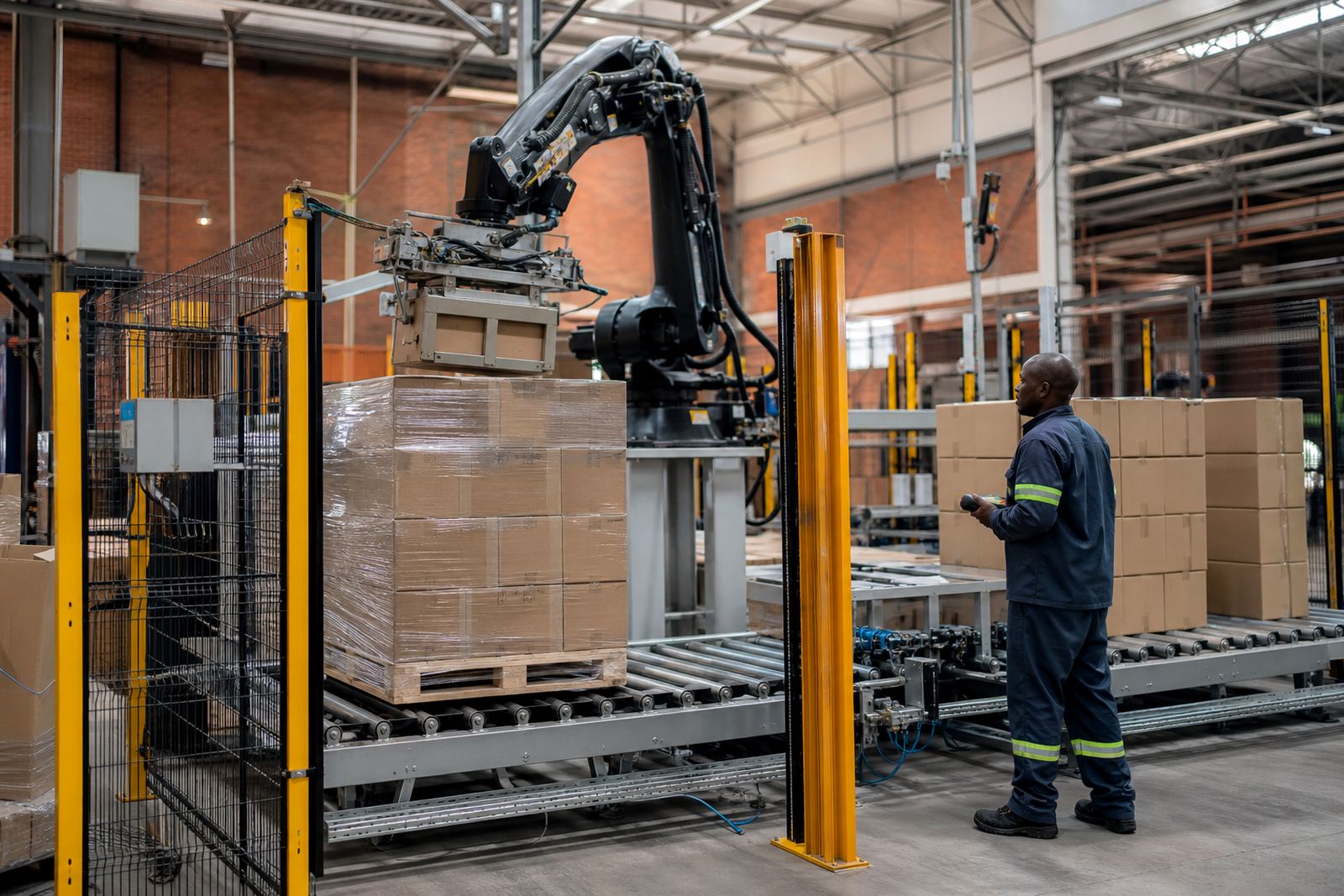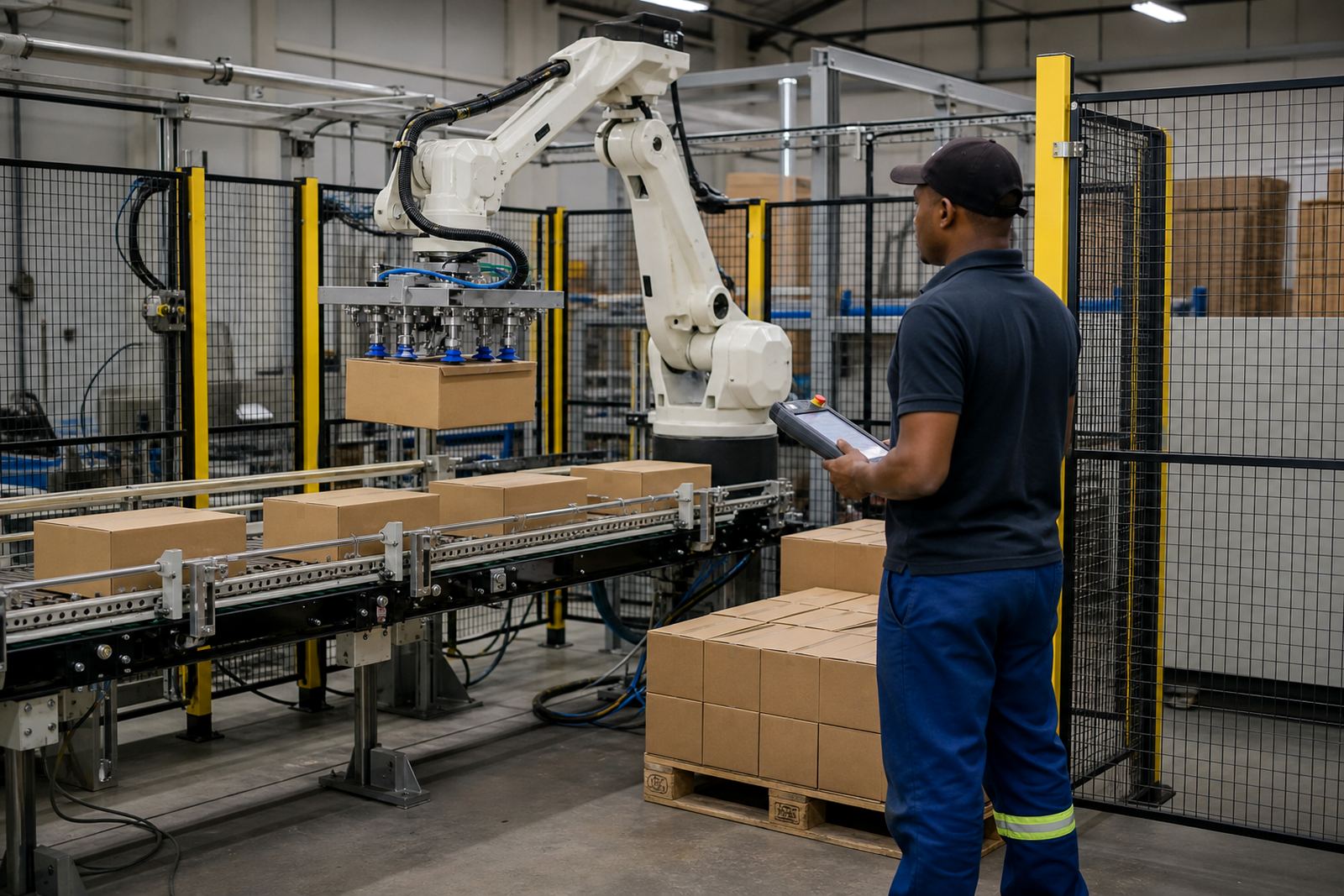
When a pharma support line needs a retrofit
Many regulated product sites in Kempton Park, Johannesburg, Pretoria, Durban, Cape Town and Gqeberha are running lines that still work well mechanically but struggle with labour intensity, repeated packing errors or slow end of line flow. That is where a retrofit can help. Instead of replacing a full line, the existing conveyor set-up is kept in service and robotics are added where the handover, case packing or palletising step is holding production back.
For pharma support lines, the main aim is repeatability. Bottles, cartons, sachets, tubs, trays and shipper cases need to move in a controlled way so that packing stays consistent through the shift. A retrofit can suit a smaller line feeding contract packing, a busy secondary packaging room or a distribution line that needs cleaner pallet formation and fewer manual lifts.
That planning matters because a support line cannot be designed on paper alone. It has to fit the floor, the utilities, the available space and the way staff already move around the area.
Typical equipment on a pharma packing retrofit
A support line retrofit normally brings together a few core elements rather than one single machine. The exact mix depends on the product format, pack size and available footprint. Common equipment includes:
- Robotic arm or cobot for pick and place, case packing or palletising
- Infeed and discharge conveyors matched to the existing line speed
- Carton forming, closing or indexing sections where needed
- Pick points, grippers or vacuum tooling suited to the pack type
- Safety guarding, fencing, light curtains or scanner controlled access
- Controls panel integration with existing machines and conveyors
- Stack light and fault indication for clear operator response
On pharma support lines, the tooling must handle cartons and cases gently and in a repeatable way. If a product shifts too much between the upstream packer and the robot pick point, the whole line becomes difficult to control. That is why conveyor timing and product presentation are just as important as the robot itself. In many cases, the retrofit also needs simple accumulation so a short upstream stop does not force the whole line to halt immediately.
Layout planning for clean, controlled flow
A good layout reduces travel, lifting and confusion. The robot or cobot should sit where it can reach the infeed point without overextending and where the operator can still load consumables, clear faults and inspect the line safely. In a tight packing room, every metre counts and a few poor decisions can create traffic around the palletising cell or block access to a fire exit.
For South African sites, practical planning also means thinking about floor condition, dust control, humidity and maintenance access. Coastal humidity in Durban or Cape Town can affect certain components and cable management, while warehouses in Gauteng may face more dust and temperature swings. If the line is in a pharmaceutical environment with strict housekeeping rules, the guarding and conveyor design should support easy cleaning and clear floor marking.
Useful planning checks include:
- Where finished cases accumulate before palletising
- How operators will feed labels, slip sheets or separators
- Whether forklifts and pallet jacks share the same aisle
- How the line recovers after a stop or jam
- What happens when utility supply is interrupted
Safety guarding and risk assessment for regulated sites
Every site needs its own risk assessment. That is not a box-ticking exercise, because the risks change with product type, line speed, operator access and the actual floor layout. A retrofit on a packing line in Midvaal is not the same as a high-throughput palletising area in the East Rand or a compact contract packing room in Pretoria.
Safety guarding design normally considers access points, emergency stops, safe reach distances and the way operators interact with the conveyor. In some layouts, a cobot may suit a smaller cell where close human interaction is part of the process. In other cases, a fully fenced cell is more practical. The right choice depends on the task, not on a general rule.
We usually support clients with the following during planning and installation:
- Site specific risk assessment support
- Guarding concept design for operators and maintenance staff
- Access control for cleaning, clearing and changeover
- Commissioning checks before the line goes live
- Operator training on faults, stops and safe restart steps
On a regulated product line, housekeeping around the cell is also important. Loose film, split cartons and pallet debris can create slip hazards and delay cleaning. If the room uses wet washdown or frequent sanitising, that must be allowed for in the choice of fittings and cable routes.
Common mistakes on pharma support line retrofits
The biggest mistakes are usually practical ones. The first is trying to force a robot into a line without fixing the conveyor flow. If cases are not square, if infeed spacing varies too much or if the discharge point is awkward, the robot becomes a problem instead of a help. The second is ignoring maintenance access. A cell that looks neat on day one can become difficult to service if panels, sensors and belts are boxed in too tightly.
Another common error is underestimating the amount of training needed. Operators, setters and maintenance staff all need to know what normal running looks like, what a fault means and how to recover safely after a stop. On a busy line, if one person knows the procedure and the rest are unsure, the benefit of the retrofit is lost very quickly.
Other mistakes to avoid include:
- Choosing too little buffer between machines
- Leaving no space for pallet removal or case replenishment
- Ignoring future product size changes
- Skipping the restart sequence after an unplanned stop
- Skipping spares planning for wear parts and sensors
Budget ranges in Rand for a retrofit project
Budget depends on the line condition, the amount of conveyor work, the level of safety guarding and whether the project is a packing station, a case packing cell or a full palletising retrofit. For a smaller support line, a practical project may start in the low hundreds of thousands of Rand. A more complete integration with conveyors, guarding and controls work can move into the upper hundreds of thousands. Larger multi-stage lines, or projects with several product formats and complex changeover requirements, can move beyond that.
The better way to plan spend is to separate the project into clear parts: site survey, retrofit design, conveyor integration, controls integration, safety guarding design, installation management, commissioning support and training. That helps a manufacturer compare options honestly and avoid paying for features that do not improve line output. It also makes it easier to phase the work if the site needs to stay operational during installation.
Support costs should also be planned. Maintenance support, breakdown assistance and spares planning are often more valuable than people expect, especially where the line runs long shifts or has limited technical staff on site. A well planned retrofit should reduce manual labour and improve consistency, but it still needs proper care to keep performing.
Working with ReAutomated on a pharma support line
ReAutomated is based in Spartan, Kempton Park and supports manufacturers across Johannesburg, Pretoria, Durban, Cape Town, Gqeberha, the East Rand and Midvaal. The team is led by Sibusiso Hlongwane and includes Annelise Abrahams, Thabo Malherbe, Farah Khoza, Johan Booysen and Lerato Khanye. That mix of planning, controls, site supervision and service coordination is useful on retrofit work because packing lines rarely stop for the convenience of the project.
Clients usually start with an enquiry through the contact page, followed by a discussion about the existing conveyor layout, line speed, product format and site constraints. From there, the aim is to define a retrofit that fits the building, supports the production schedule and allows the site to keep working with as little disruption as possible.
If your pharma support line needs more controlled packing, steadier palletising or better conveyor handover, the first step is usually a site line survey and a straightforward plan for what can be improved, what must stay in place and what needs to be guarded properly from the start.