What export packing lines need to do every shift
When product is going out for export, the packing line has to do more than simply move cartons to a pallet. The load must be consistent, stable and easy to wrap, store and transport. That matters whether the freight is going by road from Kempton Park to Durban harbour or moving through a local warehouse in Johannesburg before export release. Small variations in carton placement can lead to shifting loads, damaged corners and avoidable rework.
Many South African plants already have conveyors, pack benches and older palletising equipment in place. A retrofit approach allows those systems to keep working while a robot, cobot or semi automated palletising cell handles the repetitive end of line work. That is often the sensible route when space is tight, the plant cannot shut down for long and the existing layout still has useful life in it.
Typical retrofit equipment used on export lines
Every site is different, but export packing lines often benefit from a combination of the following equipment:
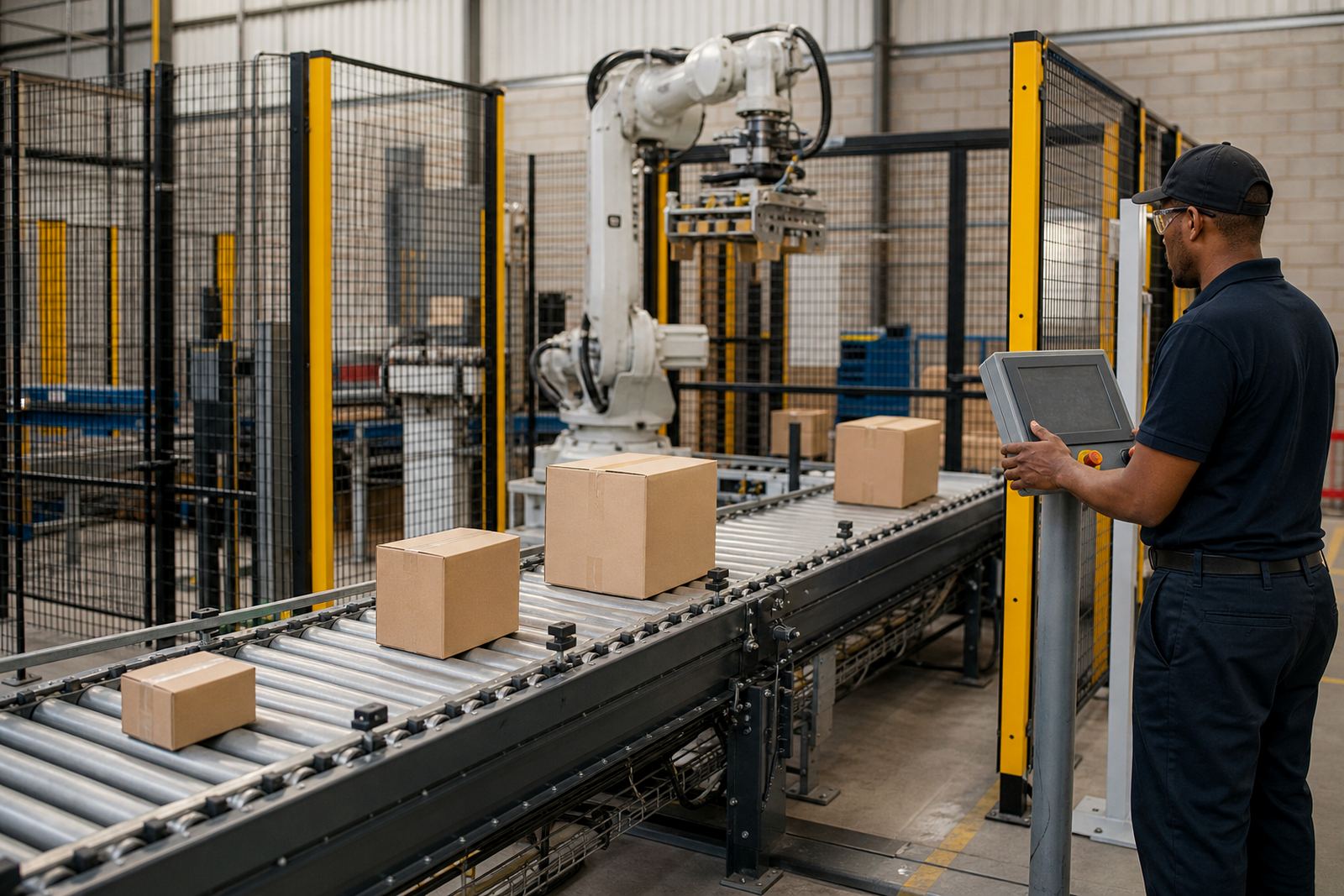
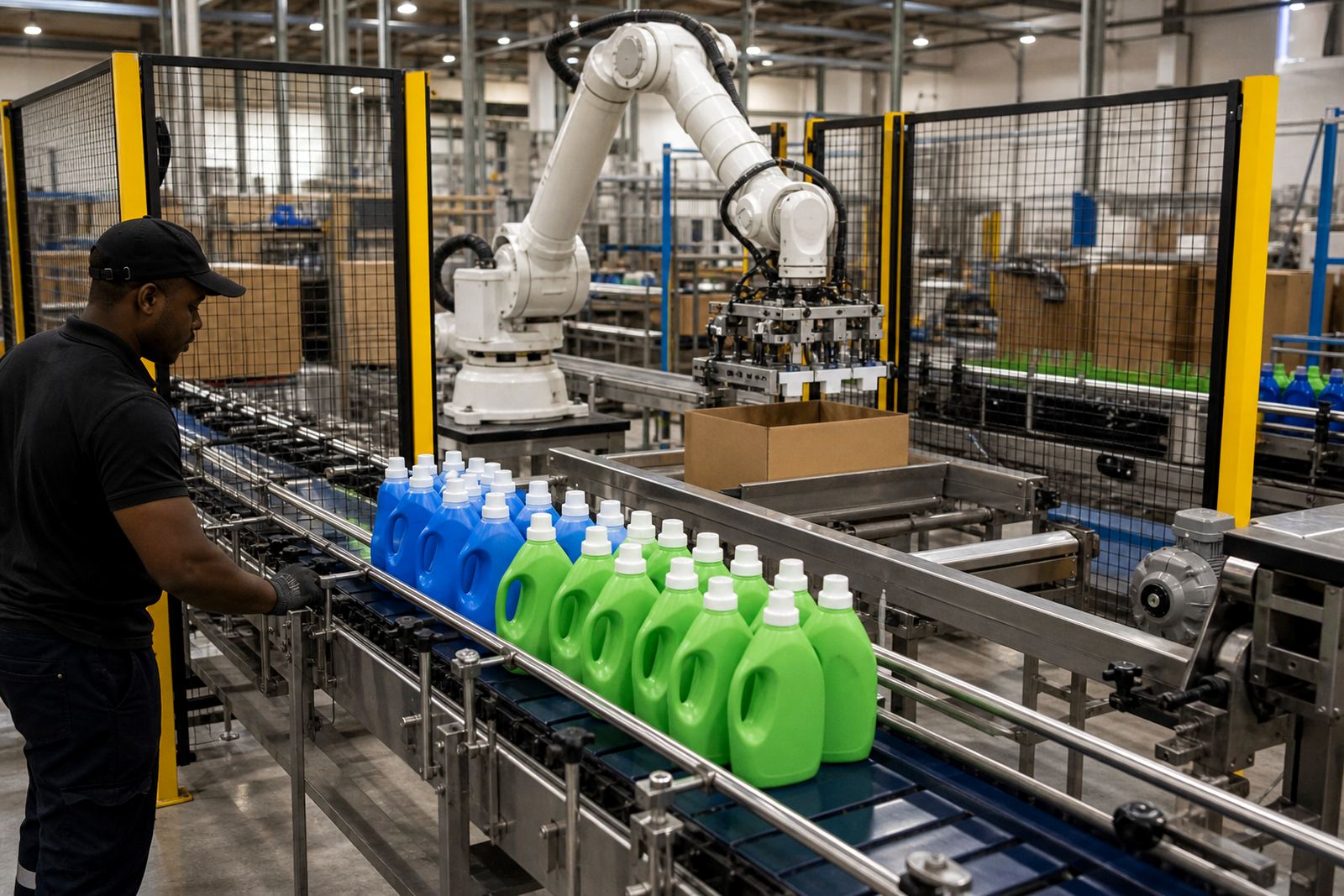
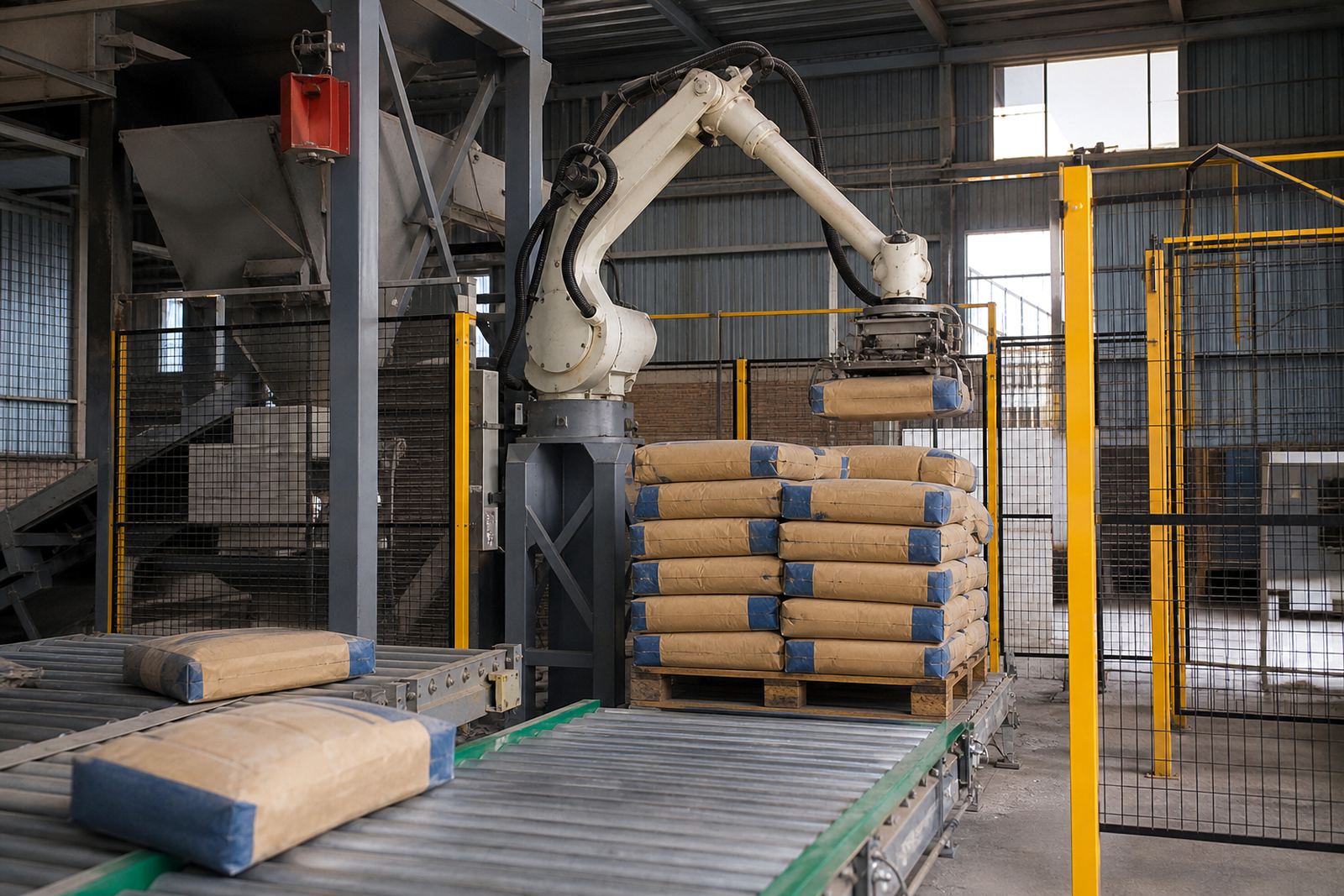
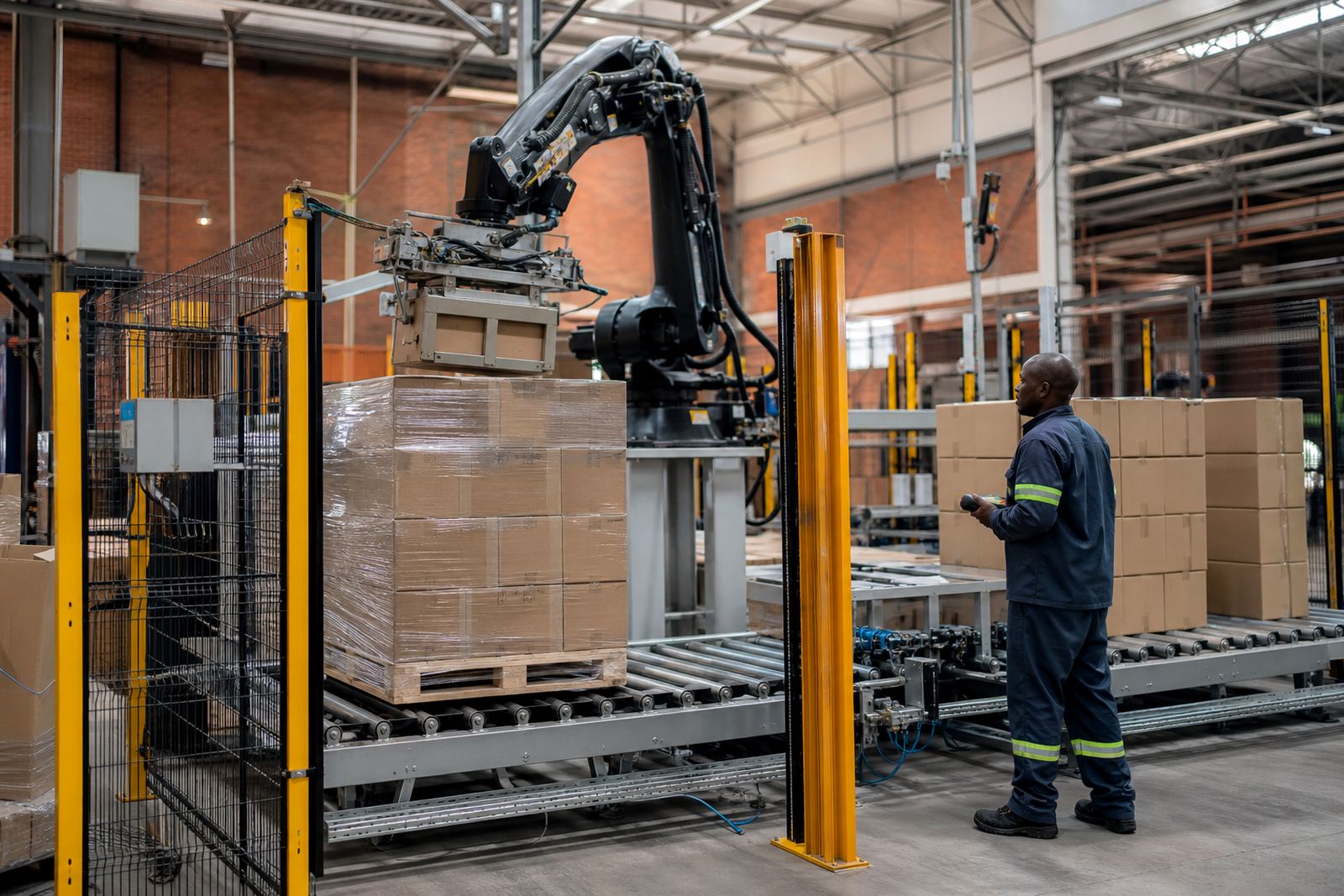
- Robot or cobot palletising arm for case handling and layer building
- Infeed conveyors to present cartons in a controlled flow
- Accumulation sections to manage line surges and short stops
- Layer forming tables or guides for neat pallet patterns
- Slip sheet handling or pallet top sheet support where required
- Safety fencing, interlocked access gates and light curtain protection
- Simple operator interface panels for selection of pack patterns and line status
- Scales or verification points where export packs need extra control
We look at the existing conveyor height, carton size, pallet dimensions and the direction of flow before any final layout is fixed. A good retrofit should work with the plant you have, not force the whole packing area to be rebuilt. In some cases a cobot suits lighter loads and lower volumes. In others a fully fenced robotic cell is a better fit for speed, reach and duty cycle.
Layout planning that keeps export loads tidy
Good layout planning starts with the finished pallet, not the robot. The question is how the product must leave the site and how it is handled after packing. If pallets will be stacked in a cold room, a dispatch lane or a container, the pattern must suit that route. If the cartons are weak at the corners or the product shifts easily, the line needs a calmer handover and more careful layer control.
On many export lines the best improvement comes from reducing unnecessary lifts, turns and manual touch points. Conveyor widths should match the carton footprint, and transfer points must be set to avoid jams. Guarding also needs to leave enough access for cleaning and maintenance without making operators squeeze past moving parts. In coastal areas such as Durban or Gqeberha, extra thought may go into corrosion control and enclosure placement because humidity can affect frames, fixings and electrical cabinets over time.
We normally support clients with site line surveys, retrofit design, controls integration and installation management. That helps identify where the line is losing time, where product damage starts and which pieces of equipment can stay in service. A well planned retrofit should also take future growth into account, so a plant can add another line or alter pack sizes later without starting from scratch.
Common mistakes on export packing projects
Many packing projects run into trouble because the line is treated as a machine only, when in fact it is a process. The robot may be capable, but if the cartons arrive skewed, the conveyor timing is unstable or the pallets are not consistent, the whole system will struggle. One of the biggest mistakes is choosing equipment before confirming the actual product mix and pallet pattern.
- Allowing product to enter the cell without proper spacing or squaring
- Ignoring changeovers between carton sizes, SKUs or pallet patterns
- Using guarding that blocks maintenance access or slows cleaning
- Overloading a robot with a duty cycle that does not suit the shift pattern
- Skipping risk assessment support until the end of the project
- Forgetting about spares, wear parts and simple breakdown response
If a line loses power mid cycle, the restart sequence must be safe and predictable. That is why controls integration and commissioning support matter just as much as the mechanical installation. A neat pallet pattern means little if the line is awkward to recover after a stop.
Safety guarding and risk assessment support for each site
Robot safety needs a risk assessment for each plant, based on the product, line speed, level of human interaction and available space. Export packing lines often have operators loading cartons, removing rejects and checking labels near moving equipment, so the guarding design must suit actual working conditions, not only the layout drawing.
Depending on the site, that can include perimeter fencing, gate interlocks, emergency stops, safety mats, light curtains or zone based access control. The aim is to keep people out of the hazard area while still allowing sensible access for set up and cleaning. Where a cobot is used, the application still needs a proper assessment. Shared workspaces are not automatically safe just because the robot is smaller. The load, speed and reach all need to be checked.
We also look at the effect of the retrofit on the rest of the plant. If the palletiser is faster than the upstream pack line, the product flow needs buffering. If the downstream wrap station is too slow, the new system will bottleneck there. Safety and throughput have to be planned together, not as separate tasks. That is usually where a site saves the most time during commissioning.
Budget ranges for export packing line retrofits
Budget depends on the number of infeed lines, the pallet pattern complexity, the amount of conveyor work and the level of guarding and controls required. A smaller semi automated retrofit for a modest export line may start from around R750 000 to R1,5 million, while a more involved robotic palletising retrofit with conveyor changes, guarding and full commissioning support can move into the R2 million to R5 million range or higher.
Those ranges are only for planning. The actual cost depends on the site survey, product dimensions, pallet size, shift requirements and whether existing equipment can be retained. A good retrofit should also consider maintenance support, breakdown assistance and spare parts planning from the start, because export schedules do not leave much room for unplanned downtime. In many cases the right budget decision is not the cheapest one, but the one that keeps the line stable and serviceable over the long term.
For manufacturers in Kempton Park, Midvaal, Pretoria, Durban, Cape Town and Gqeberha, we help shape a practical scope before equipment is ordered. That includes the conveyor path, control logic, guarding layout and operator training. The result should be a line that loads pallets neatly, runs predictably and fits the space you already have, not a complicated setup that is hard to live with.