When a Personal Care Line Needs a Retrofit
Shampoos, lotions, soaps, creams and wipes often move through the same factory with different pack formats, carton sizes and case counts. That makes manual end-of-line packing slow and hard to keep consistent, especially when a line is already running on older conveyors or mixed equipment. A retrofit lets you keep the line structure that works while adding robot handling where it saves the most labour.
At ReAutomated, we look at how product comes off the filler, how cases are formed, and where the flow starts to back up. In personal care plants around Kempton Park, Johannesburg, Pretoria and Durban, the usual pressure points are changeovers, product orientation, and pallet stability on the final stack. The aim is not to replace every machine, only to add the right automation at the right point.
Based in Spartan, Kempton Park, our team works with manufacturers that need practical changes on live production lines, not a full factory rebuild. That usually means careful tie-in work, clear guarding, and close coordination with existing conveyors so the upgrade suits the plant layout and the shift pattern, not the other way round.
Typical Equipment Set for Packing and Palletising
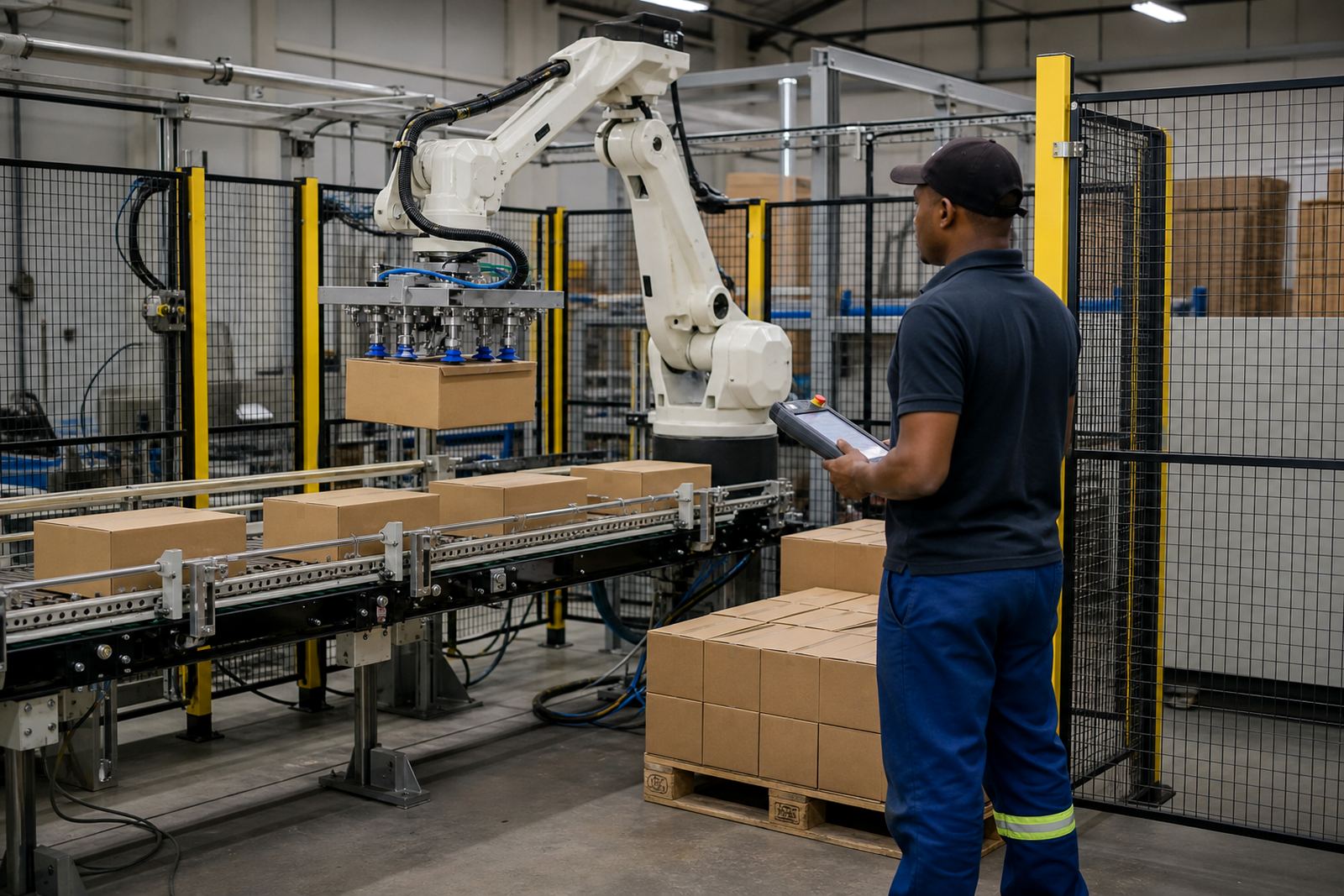
Personal care products can be light, slippery, wrapped in film or packed in glossy cartons that need gentle handling. The usual retrofit package depends on line speed, case format and floor space, but many projects include a mix of the following:
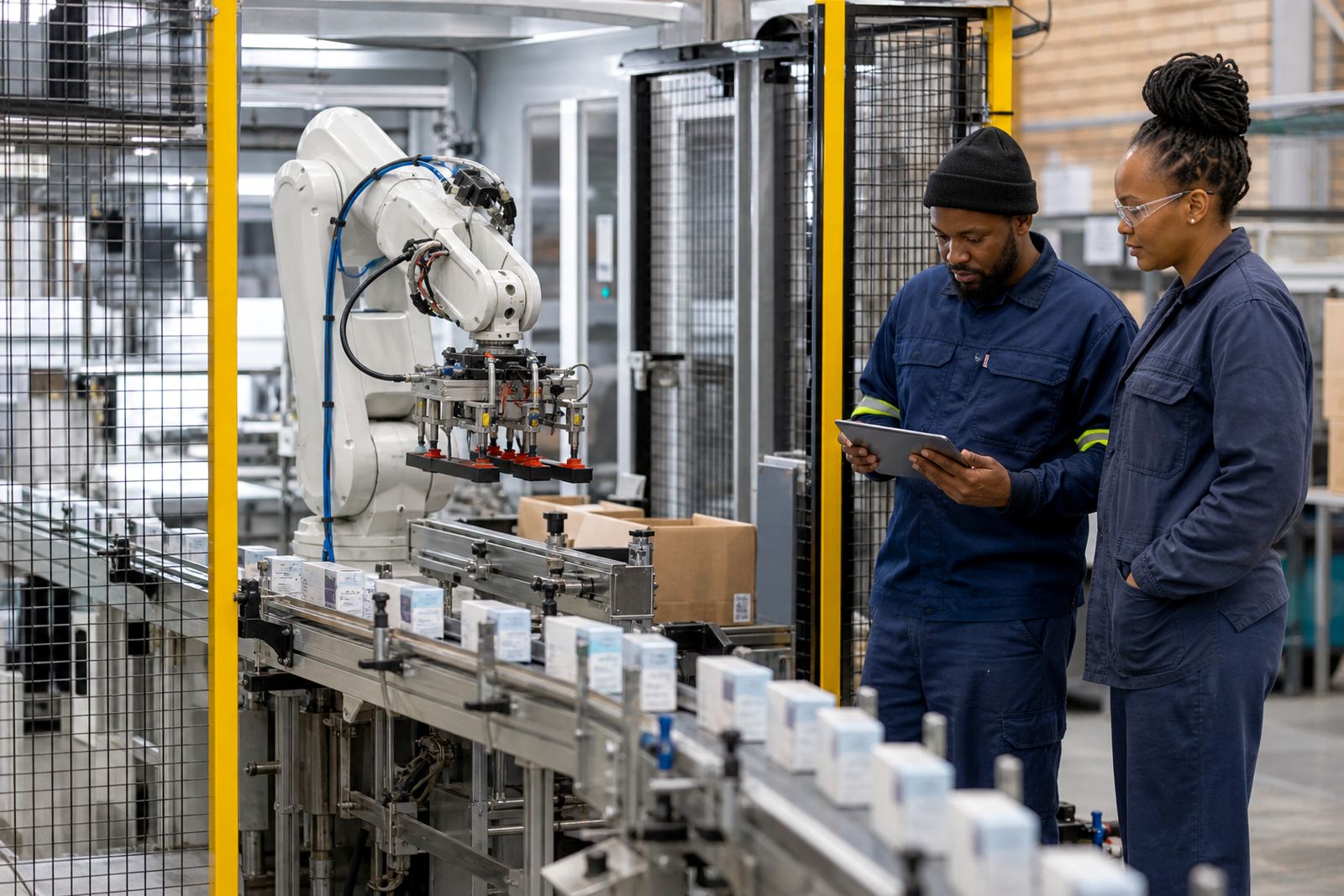
- Robotic packing for collating sachets, bottles, tubes or cartons into cases
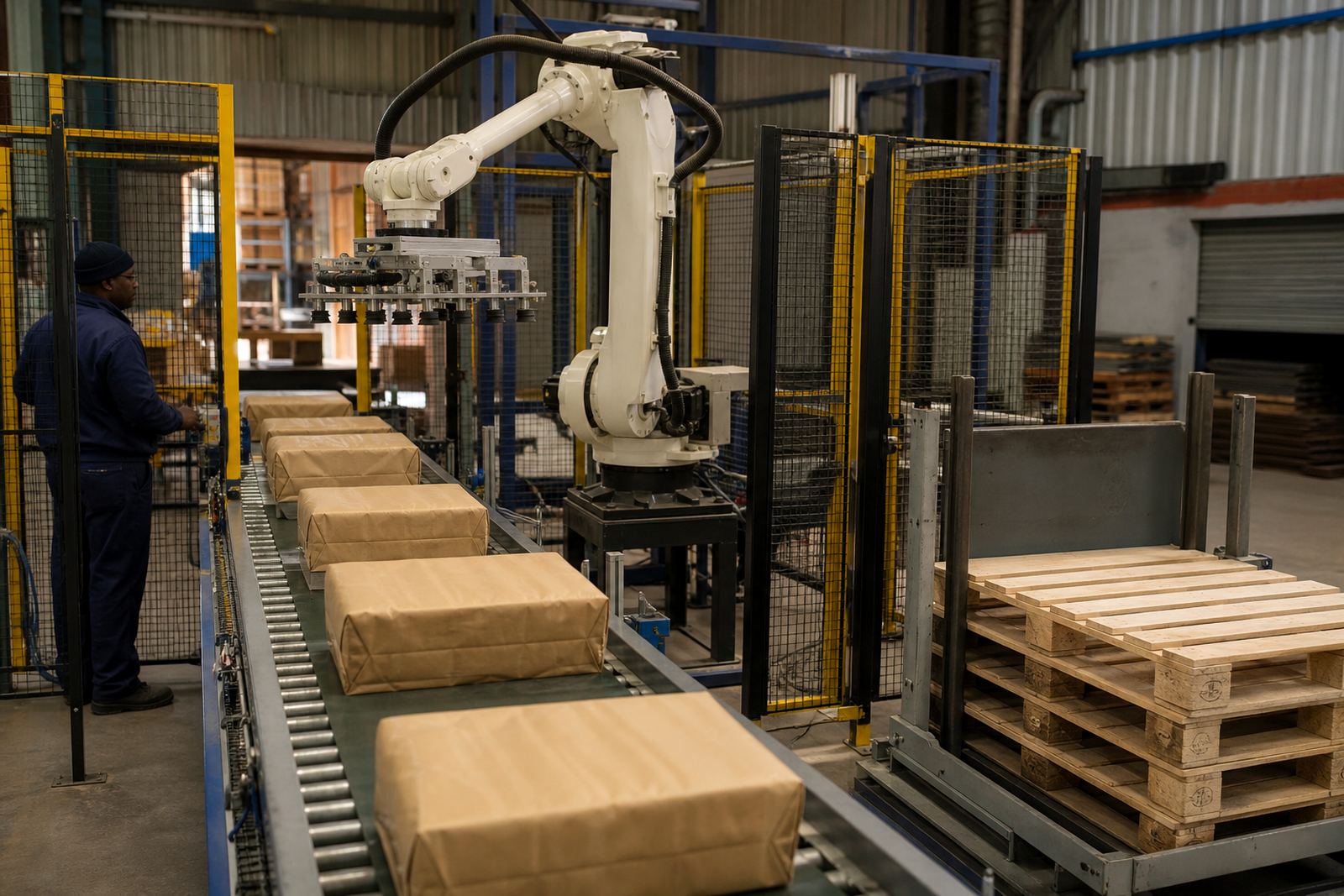
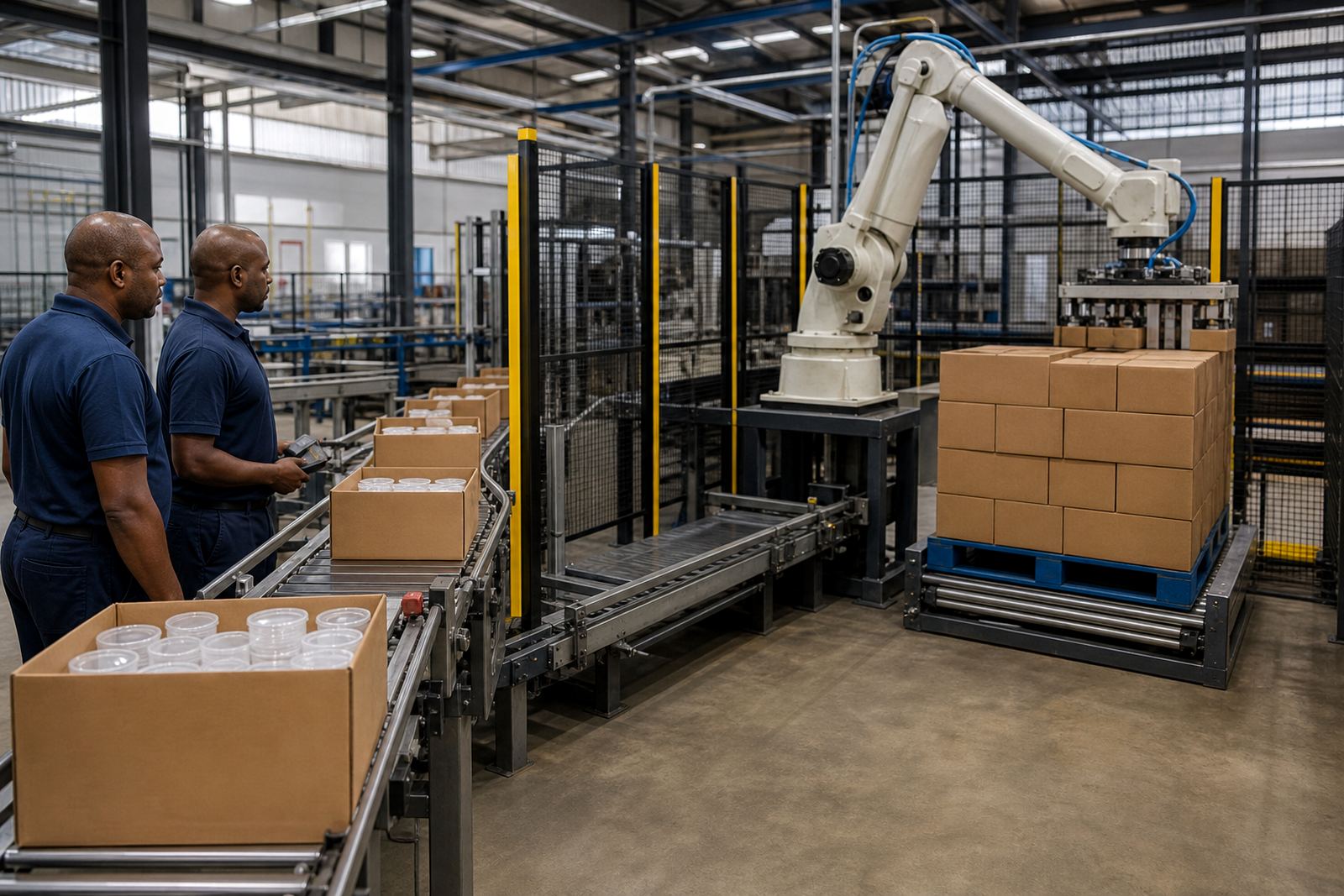
- Robotic palletising for full cases, shrink wrapped bundles or trays
- Side loading or top loading transfer points where product orientation matters
- Existing conveyor tie-ins with diverts, accumulation and case discharge control
- Cobot stations for lower speed lines where people and machines work in nearby zones
- Safety guarding, light barriers or fenced access depending on the risk profile
- Control panels, sensors and interlocks matched to the current line controls
We also help with spares planning and maintenance access so the retrofit does not become awkward to service. On some lines, the best answer is a compact palletising cell. On others, a robot is added only at the final case packing point, with the pallet load built by a separate station. There is no single arrangement that suits every pack format, and a proper line survey shows the difference early.
Planning the Layout Around Existing Conveyors
Most personal care plants do not have empty floor space waiting for a new cell. That is why retrofit planning starts with the existing conveyor path, available clearances, operator walkways and where pallets are removed. In many cases, the robot cell has to fit into a space that was originally used for manual packing, which means every metre matters.
Electrical and control integration must be suited to local conditions, with neat cable routing and clear isolation points. If the line runs in multiple shifts, the layout should allow quick access for cleaning and daily checks without creating extra stoppages.
- Keep infeed and outfeed levels consistent to avoid product toppling
- Allow enough room for carton accumulation before the robot zone
- Place pallet infeed and take-off points so forklifts do not cross live traffic unnecessarily
- Leave access for maintenance panels, sensors and gripper changes
- Plan for future pack size changes if the product range is likely to grow
Where a line is already tight, a smaller footprint cell or cobot arrangement may be more practical than a large fenced system. The right answer depends on throughput, stack height, product fragility and how much manual handling remains at the line ends.
Safety Guarding and Risk Assessment Support
Any robot retrofit must be matched to the actual hazards on that site. Personal care lines often have slip risks from product spills, sharp carton edges, moving conveyors and forklift traffic near the palletising area. Safety guarding is not a standard one size solution. Each site needs its own risk assessment, and that should cover access, emergency stops, maintenance entry and the way operators move around the line.
We support the safety design process by looking at where people need to intervene, where guards should be fixed or interlocked, and how to keep routine tasks practical. In some plants, a cobot can reduce guarding complexity if the application fits the speed and reach limits. In others, full perimeter guarding is the better option because the pallet stack or infeed pattern demands more separation.
General safety rules still apply across every project, but the final decision must follow the plant layout and the actual process risk, not guesswork. That is especially important where a line was built in stages over many years and the controls are a mix of old and new equipment.
Common Mistakes on Personal Care Retrofits
One of the biggest mistakes is choosing automation before the product data is clear. Bottle shapes, case weights, film wrap, tray strength and label position all affect how the robot grips and places the load. Another common problem is underestimating how often personal care lines change format. If changeovers are frequent, the system must be quick to adjust or the time savings disappear.
- Ignoring carton quality and then finding cases collapse at the palletising stage
- Placing the robot too far from the infeed and losing line balance
- Not allowing enough space for pallet wrap, label checks or finished pallet removal
- Assuming one gripper suits every SKU, which usually causes trouble later
- Skipping operator training and then seeing avoidable stoppages during shift handover
We also see plants leave out maintenance access, which becomes a problem once the line has to run through busy seasons. A retrofit should make the plant easier to run, not harder. That means thinking about routine cleaning, spare parts, service intervals and how the controls are reset after a stop. Small oversights here can turn into regular downtime.
Budget Ranges for South African Manufacturers
Budget depends on line speed, the number of pack formats, whether the work includes both packing and palletising, and how much existing equipment can be reused. For a smaller personal care retrofit with limited changes to the line, costs can start in the lower hundreds of thousands of Rand. A more complete packing and palletising retrofit with controls integration, guarding, conveyor changes and commissioning support can move into the higher hundreds of thousands or above, depending on scope.
It is usually better to plan the budget by work package rather than by guessing one lump sum. That means separating the robot cell, mechanical integration, electrical work, guarding, training and any line stoppage planning. Sites in the East Rand, Midvaal and the major metro areas often have different constraints around floor space, truck access and municipal requirements, so the final layout can affect cost as much as the machine choice.
Our Site Line Surveys and Retrofit Design work help define a realistic scope before equipment is ordered. From there, Installation Management, Commissioning Support and Maintenance Support keep the changeover controlled. For many manufacturers, the most practical route is staged implementation: first the packing point, then the palletising cell once the line is stable.
How ReAutomated Supports the Project
ReAutomated works with manufacturers across Johannesburg, Pretoria, Durban, Cape Town, Gqeberha, Kempton Park and the wider South African market to retrofit robots onto existing packing and palletising lines. Our service covers the practical parts that keep a project moving: surveys, design, conveyor integration, controls integration, safety guarding design, risk assessment support, installation management, commissioning support, operator training, maintenance support, breakdown assistance and spares planning.
The team includes Sibusiso Hlongwane, Annelise Abrahams, Thabo Malherbe, Farah Khoza, Johan Booysen and Lerato Khanye, each focused on a different stage of the work. That matters on personal care lines, where product handling, clean presentation and stable pallet build quality all need to hold up on day-to-day production. If you are planning a retrofit in Spartan, the East Rand or further afield, start with a site survey and a clear scope before you commit to equipment.
For enquiries, clients can use the form on our contact page and we will take it from there.