Where paper lines usually need the most help
Paper product plants often start with a line that still works, but the final pack and pallet area becomes the pressure point. Wrapped bundles of tissue, carton cases, reams and multipacks can all arrive at the end of line in a steady stream, then one missed lift or a tired crew member creates delays. In Gauteng, coastal areas and inland sites alike, the challenge is usually not the product alone, it is the pace, the floor space and the mix of SKUs.
A retrofit makes sense when manual palletising is slowing dispatch, when repacking causes congestion, or when the conveyor is already in place and the plant needs a better end of line flow. For many paper lines, the right answer is not a full rebuild. It is a robot cell added to the existing layout, with the infeed, outfeed and pallet movement organised properly from the start.
- Wrapped bundles that shift on the conveyor
- Cartons that need consistent layer building
- Tissue-style multipacks with light but bulky profiles
- Mixed pallet patterns for stores, depots or export orders
Typical retrofit equipment on a paper line
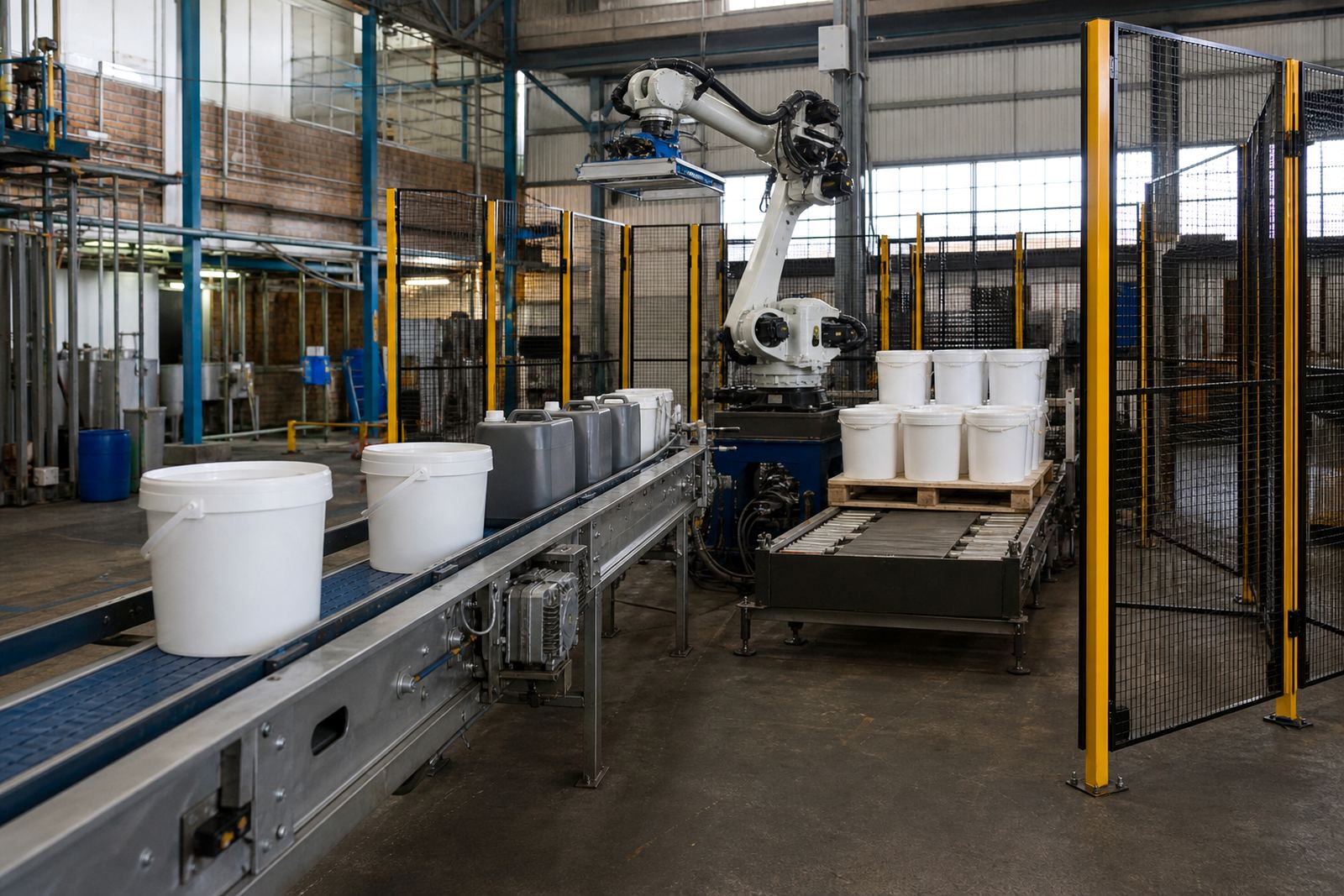
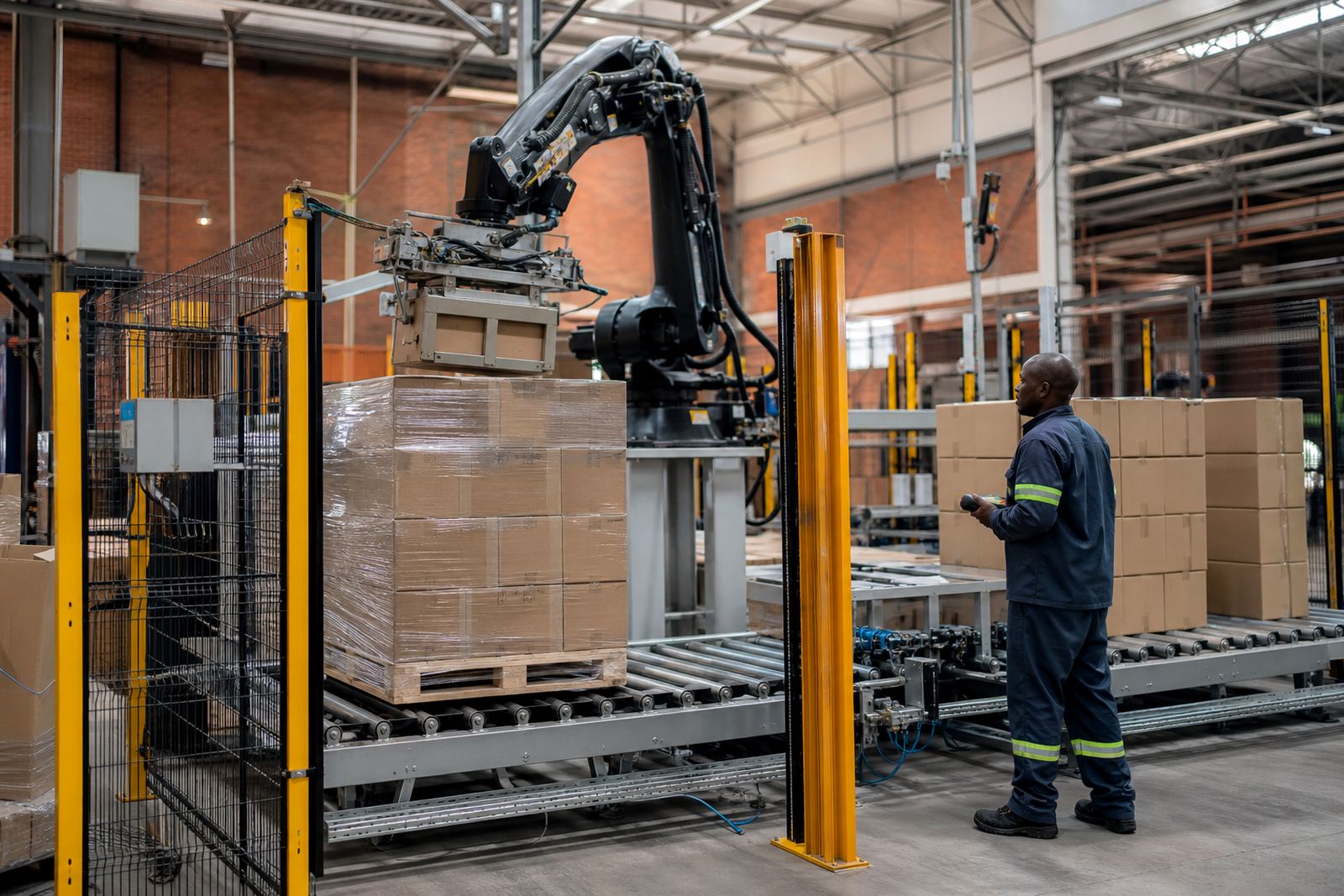
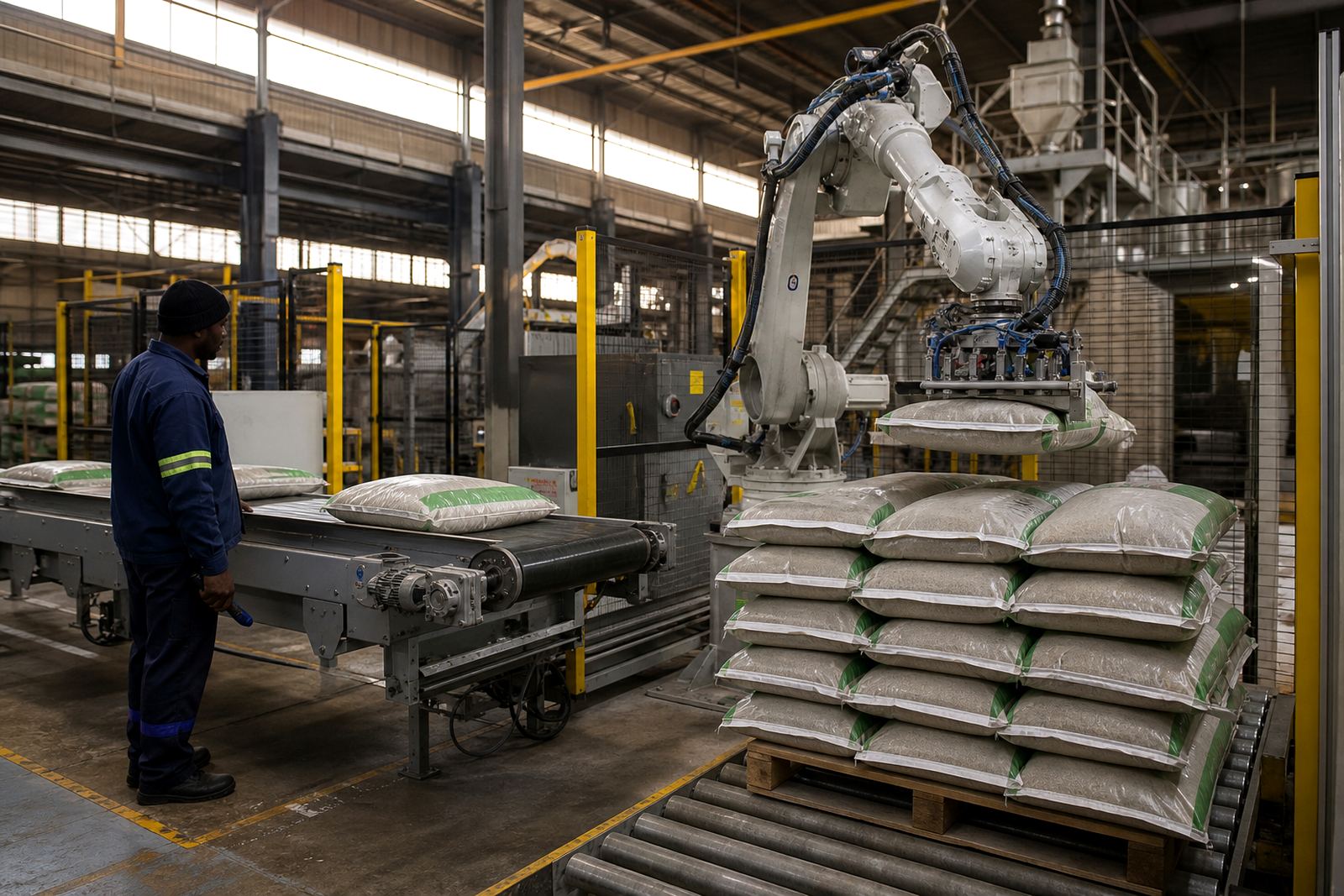
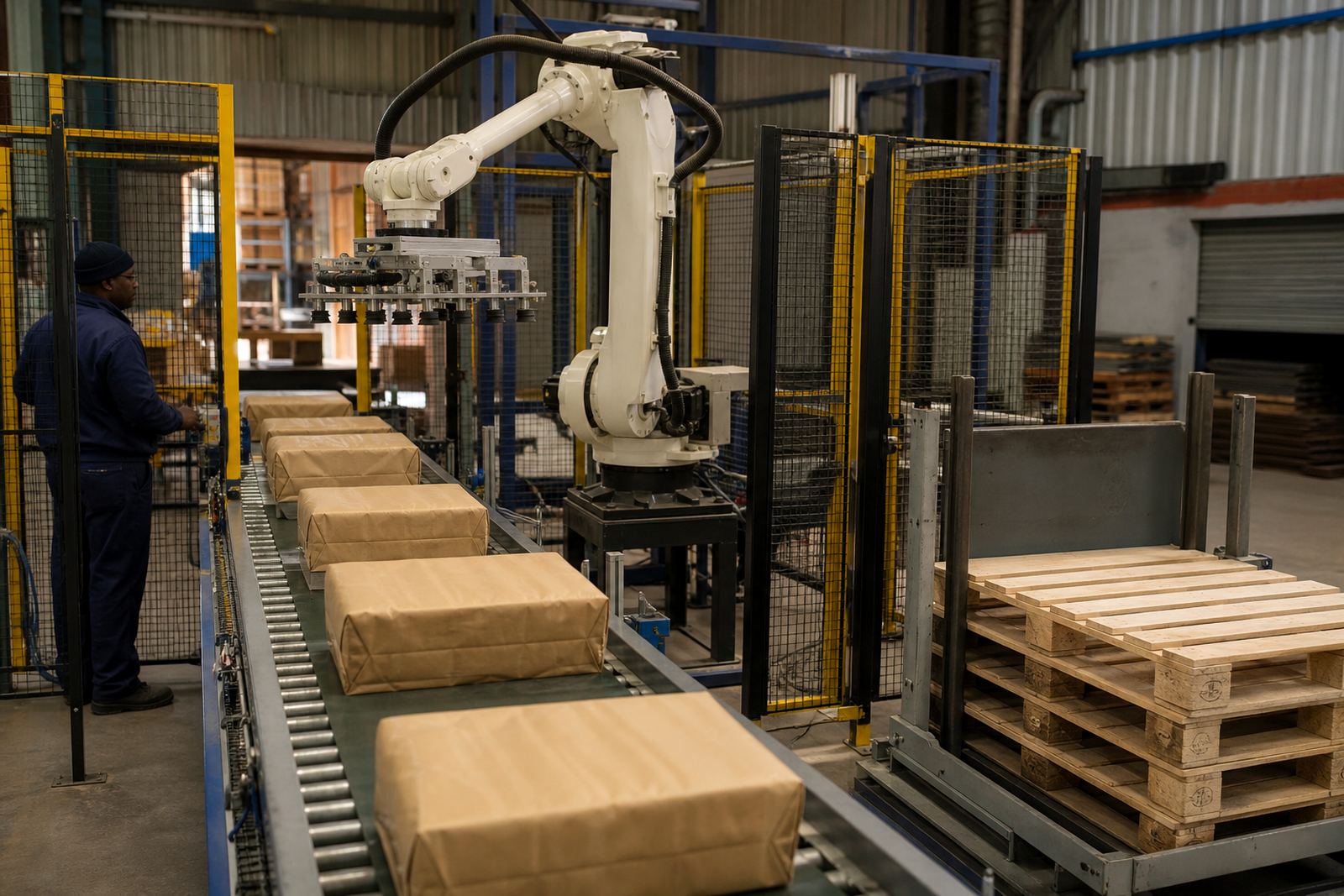
A paper line retrofit normally uses a robot, a gripper suited to the pack type, and conveyors that present products in a repeatable way. The cell may include pallet magazine equipment, interlayer sheet handling, check sensors, reject points and safety guarding around the working envelope. If the plant already has conveyors, the main job is to make sure product arrives in the right position and timing, so the robot is not waiting or fighting a poor feed.
For heavier cartons, a mechanical gripper or vacuum assisted end effector may be suitable. For lighter multipacks, the gripping method has to suit the wrap quality and the pack surface. The controls side matters just as much. If the line signals are not clean, the robot can start late, stop too often or place product off pattern, which wastes time and can damage the packs.
- Robot arm for pick and place or palletising
- Conveyor modifications for spacing and orientation
- Safety fencing, interlocks and access gates
- PLC and controls integration with existing equipment
- Layer pads, pallet handling and pallet staging where needed
Planning the layout before the first bolt is fitted
Paper plants often have narrow spaces between wrapping, bundling and dispatch, so layout planning has to be practical. The best retrofit usually starts with a site line survey, then a drawing that shows how product moves from the packaging machine to the pallet point. That includes pallet feed direction, maintenance access, operator walkways and any overhead services already in place. At some sites in Pretoria or Durban, the real constraint is not the robot itself, it is forklift movement and pallet storage nearby.
Good planning also considers future pack sizes. A line that runs one format today may need a second pattern next month. If the gripper, conveyor spacing and software are planned properly, changeover becomes quicker and less stressful for the team. It is also worth checking floor condition, dust control and humidity, especially in coastal environments where paper products and packaging materials can be sensitive.
- Allow clear access for maintenance and cleaning
- Keep forklift routes separate from the robot cell
- Check ceiling height, power points and control cabinet space
- Plan for product variation and changeovers before installation
Safety, guarding and risk work for each site
Robotic palletising on a paper line must be matched with proper guarding and a site specific risk assessment. General rules are not enough because every plant has different traffic, different conveyors and different operator routines. Some sites need full perimeter guarding, some need access gates with interlocks, and some need a combination of physical barriers and controlled access points for set-up and cleaning.
Risk assessment support should cover pinch points, moving conveyors, pallet drop areas, manual intervention points and emergency stopping. If the line includes cobots or shared work zones, that does not remove the need for careful assessment. A collaborative robot still needs the right task limits, layout and controls.
- Guarding around robot reach and pallet build area
- Interlocked gates for supervised access
- Emergency stops placed where operators can reach them quickly
- Risk review for manual clearing, cleaning and jam removal
Common mistakes we see on paper palletising projects
One common mistake is trying to force the robot to fix an unstable pack. If cartons or bundles are badly formed before they reach the end of line, the robot inherits the problem. Another mistake is underestimating conveyor timing. Paper products may look simple, but if the spacing is inconsistent, the robot cannot build a neat pallet every time. Sites sometimes also forget the effect of dust, loose wrap tails or slippery packaging film. Those small issues can become a daily nuisance.
Another problem is choosing a layout that leaves no room for pallets, stretch wrapping or downstream dispatch. Then the line works in theory but not on shift. A good retrofit should leave enough space for the operator, the maintenance person and the forklift driver. It should also be serviceable without stopping the whole plant for every minor adjustment.
- Installing automation before fixing pack quality
- Ignoring pallet staging and dispatch space
- Leaving no room for cleaning and maintenance
- Using poor conveyor spacing and then blaming the robot
Budget ranges for paper line retrofits in Rand
Budget depends on the line size, the number of infeed points, the product mix and how much existing equipment can be reused. A smaller retrofit for one palletising point may sit in a lower range than a multi-line installation with conveyor changes, guarding and controls integration. If the site needs major structural work, extra sensors, pallet magazines or complex sequencing, the budget will move up accordingly.
For planning purposes, many paper line projects fall into three broad bands. A simpler retrofit can start from around R650 000 to R1,2 million. A more involved system with conveyor changes, guarding and commissioning support may land between R1,2 million and R3 million. Larger multi-line or multi-shift installations can exceed that, depending on the plant layout and the amount of integration needed. These are planning ranges only, not quotations, and each site needs its own survey and scope.
When the line is down too often, the real cost is not only labour. It is missed dispatch, overtime, rework and the pressure on supervisors. A well planned retrofit should make the end of line easier to run, not harder.