When food packing lines need a retrofit
Food plants often contact us when manual palletising begins to slow the shift, product damage starts to rise, or one line must handle more pack sizes than it was originally set up for. In many cases the line is still sound, but the last stage of the process has become the bottleneck. A retrofit lets you keep the conveyors, fillers, checkweighers and case packing equipment already in place, while adding a robot or cobot cell where it will do the most work.
A retrofit has to fit around washing routines, cold-room conditions where relevant, and the route products take from pack-off to wrap and dispatch. That means the line cannot be treated as a single machine. It has to be mapped from product infeed to finished pallet, with every transfer point checked for flow, access and cleaning.
- High-mix packing lines with frequent changeovers
- Manual end-of-line palletising that causes strain or inconsistency
- Existing conveyors that can be reused with minor changes
- Sites that need better handling of cartons, bags, trays or cases
Typical equipment in a food line retrofit
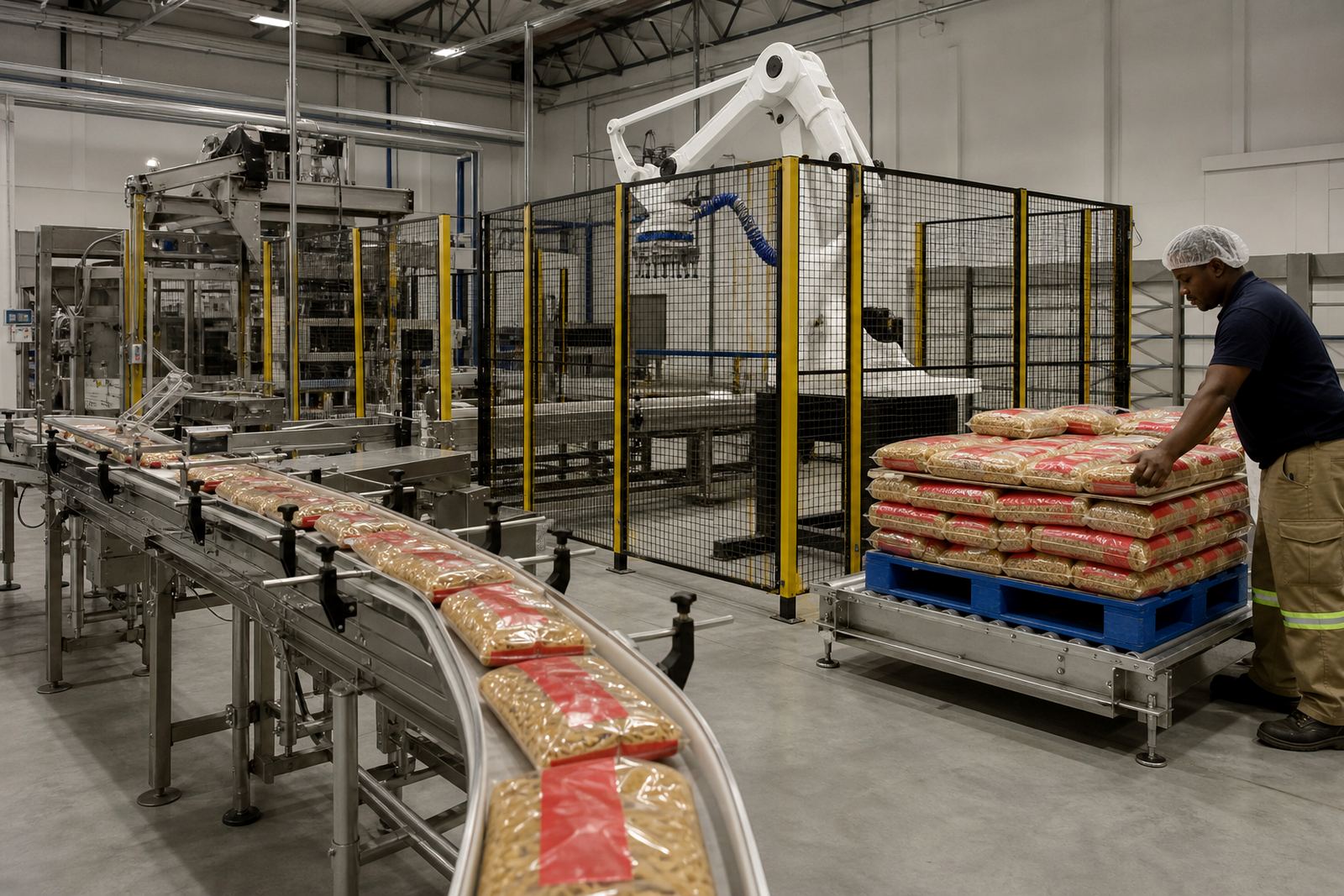
Food packing retrofits are usually built around what is already on site. We look at the conveyor layout, product presentation, case packing point, palletising position and any wrapping or strapping equipment downstream. A well planned retrofit keeps product movement simple, with fewer stops and less handling. If the line is crowded, the answer is often not more machinery but a cleaner sequence and a better footprint.
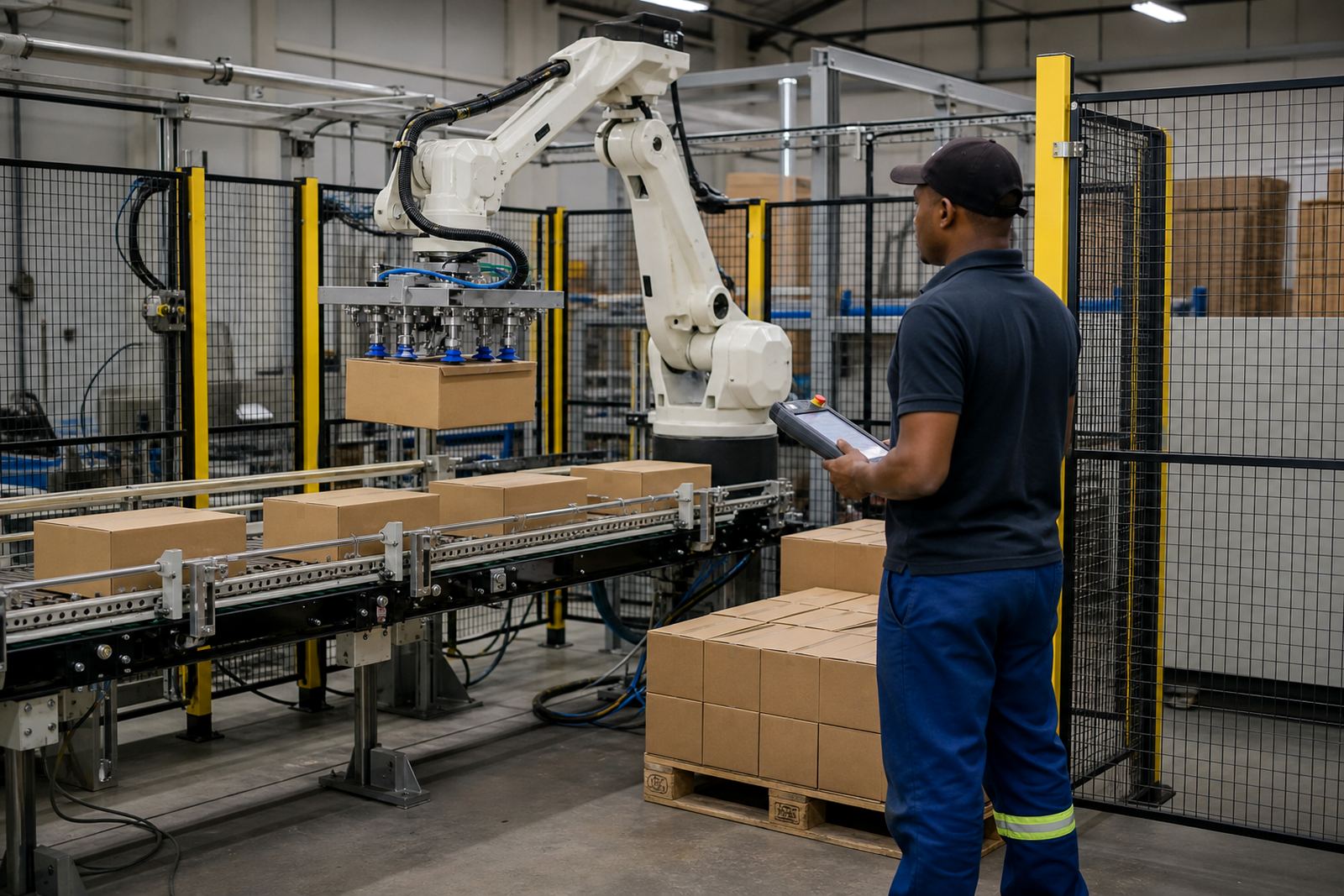
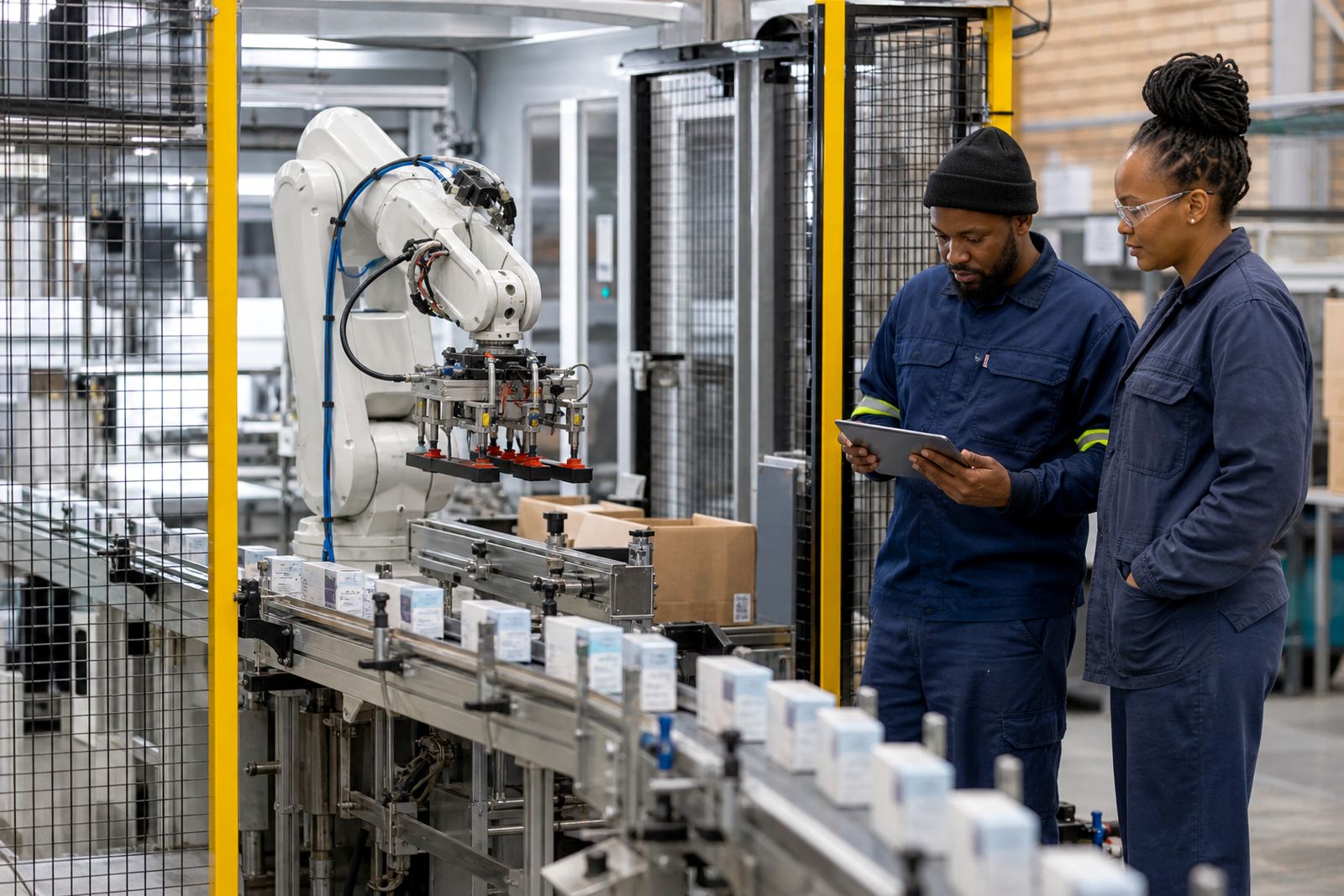
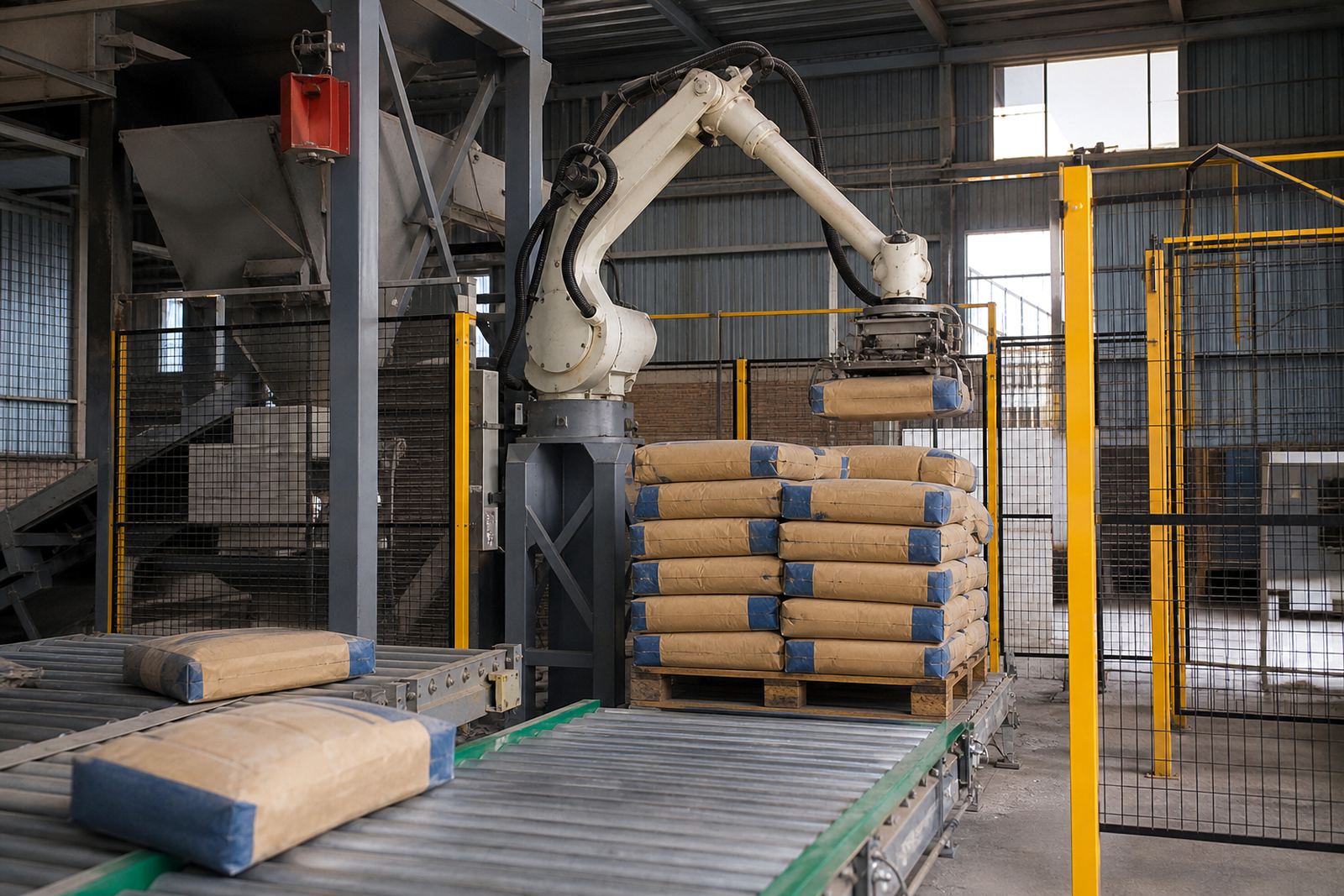
For food applications the equipment set often includes a robot arm or cobot, infeed and discharge conveyors, case indexing, pallet infeed, and safety guarding with proper access gates. Depending on the line, we may also integrate sensors, stack height controls, interlocks and control panel changes so the existing equipment speaks to the new system. For hygienic areas, the layout must also allow cleaning access and reduce dirt traps around frames and supports.
- Robotic palletising or packing cell
- Existing conveyors with modified transfer points
- Case orienting or singulation where needed
- Safety fences, interlocked gates and light protection where appropriate
- Control system integration with the current line controls
Planning a hygienic layout without wasting floor space
Food plants do not usually have extra floor space sitting around. That is why the first step is a site line survey. We measure the available footprint, check ceiling height, confirm access for pallets and maintenance, and note how the line must run during a shutdown window. In some plants the retrofit can be done beside the existing line and tied in over a weekend, while in others the work has to be phased so production can continue on part of the line.
Layout planning also matters for hygiene. You want smooth surfaces where possible, sensible cable routing and enough clearance to clean under and around equipment. If product is exposed to dust, moisture or temperature changes, the retrofit needs to account for that too. On coastal sites in Durban or Gqeberha, corrosion resistance and enclosure choice matter more than many buyers first expect. In inland sites, dust control and heat are often the bigger issue.
- Keep robot reach and pallet stack height within the available ceiling height
- Separate clean product zones from pallet and wrap areas
- Allow for wash-down, mop-down or dry-clean procedures as required
- Leave access for maintenance, fault finding and safe pallet removal
Safety guarding and risk assessment for food plants
Every food retrofit needs its own risk assessment. The hazards on one site can be very different from the next, even if the product is similar. A palletising cell may need full perimeter guarding, an interlocked gate, stop circuits and clearly marked access points. A cobot application may allow closer operator access, but it still needs its own assessment, tested stop functions and a safe work method for teaching, cleaning and fault recovery.
Guarding must suit the line, not create new problems. If operators need to clear jams, remove damaged cases or change pack formats several times a shift, the access points have to be practical. Poor guarding slows production and encourages workarounds. Good guarding lets people do their jobs safely while the robot handles repeat lifting and stacking. We also look at emergency stops, trapped product risks, start-up warnings and the sequence for restarting after a stop.
- Site specific risk assessment before installation
- Guarding design matched to operator access needs
- Interlocks and stop functions checked during commissioning
- Training for cleaning, fault recovery and reset procedures
Common mistakes in food packing retrofits
The biggest mistake is trying to force a robot into a layout without checking the rest of the line. If the infeed is inconsistent, the palletiser cannot compensate forever. If the cases are badly formed, the robot will only repeat the problem faster. If the conveyor heights do not line up, operators end up lifting or nudging product by hand, which defeats the point of the retrofit.
Another common problem is underestimating utilities and controls. A retrofit may need power upgrades, compressed air checks, clearer cable runs and proper control integration with the existing line.If that is ignored, production time is lost and the team ends up resetting the system by hand more often than they should.
- Skipping a proper line survey before choosing the robot position
- Ignoring conveyor speed matching and product spacing
- Using guarding that blocks cleaning or maintenance
- Leaving no room for future pack size changes
- Not planning restart steps after power interruptions
Budget ranges for food line retrofits
Budgets vary widely because no two food lines are exactly the same. A smaller retrofit for a single packing or palletising point may start from the lower hundreds of thousands of Rand, while a more involved line with conveyor changes, guarding, controls work and commissioning can move into the higher hundreds of thousands or beyond. The final figure depends on reach, payload, line speed, layout complexity, the amount of existing equipment that can be reused and how much installation time the site can give us.
For planning, it helps to work in stages. Survey and concept work comes first. Then detailed retrofit design follows, then fabrication, integration and commissioning support. Some businesses choose to phase the project so they solve the most pressing bottleneck first, then add more automation later. That can make sense on food lines with seasonal demand, multiple shift patterns, or product ranges that change through the year. We do not quote fixed prices without seeing the line, because the right answer depends on the actual site conditions.
- Survey and planning for the existing line layout
- Robot or cobot selection based on reach and product type
- Conveyor and controls integration work
- Safety guarding, testing and operator training
- Maintenance support and spares planning after handover
Support for food manufacturers across South Africa
ReAutomated works from Spartan, Kempton Park and supports food manufacturers in Johannesburg, Pretoria, Durban, Cape Town, Gqeberha, East Rand and Midvaal. Whether the site is a bakery, dry goods packhouse, sauce filler, frozen food plant or carton packing operation, the retrofit approach stays practical: survey the line, protect the product, reduce manual lifting and make sure the system fits the way the plant already works.
Our team handles site line surveys, retrofit design, conveyor integration, controls integration, safety guarding design, risk assessment support, installation management, commissioning support, operator training, maintenance support, breakdown assistance and spares planning. Food lines need care, cleanliness and dependable timing, and that is exactly where a well planned retrofit earns its place.
If you are looking at a food packing or palletising line that needs to do more with the space and equipment you already have, start with the enquiry form on our contact page. The right answer usually begins with a proper look at the line as it stands.