What our breakdown assistance covers
Our breakdown assistance is for manufacturers running packing and palletising lines with robots, cobots, conveyors, lift tables, product stops, sensors and panel-based controls. We assist with fault finding on the full line, from the point where product leaves the process line through to case packing, pallet build, interlocks and end-of-line transfer. If the fault sits in the robot cell, the conveyor logic, the safety circuit or the interface between them, we work through it in a practical order.
We support sites in Kempton Park, Johannesburg, Pretoria, Durban, Cape Town, Gqeberha, the East Rand and Midvaal.We do not guess at faults. We inspect signals, sequence logic, field devices, mechanical conditions and operator settings, then confirm the cause before work starts.
- Robot cell fault finding and restart support
- Conveyor and transfer point diagnosis
- Safety circuit and interlock checks
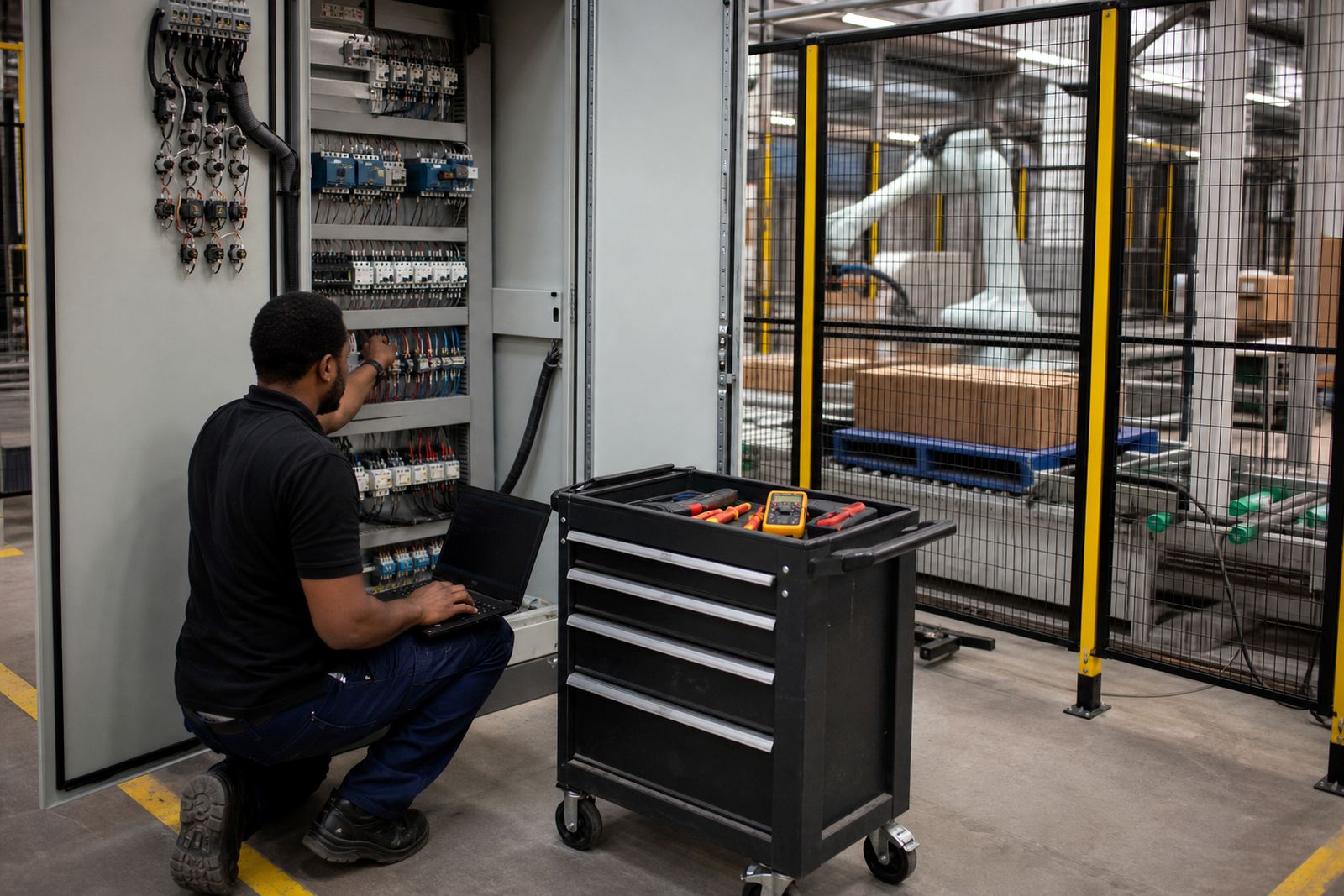
- Controller, I/O and HMI interface review
- Mechanical alignment checks on grippers, stops and guides
- Operator and maintenance handover notes after the callout
How we respond when a line goes down
Most breakdowns need orderly diagnostics. We start by speaking to the on-site team to gather the fault history, alarm text and any recent changes to the line. Then we work through the cell in layers, beginning with safety status, power availability, compressed air if used, communication health and visible mechanical issues. This helps avoid repeated resets that only mask the real fault.
Where the issue is linked to an existing retrofit, we check the interface points we know are most sensitive: pallet presence sensors, carton stop timing, conveyor accumulation logic, robot handshakes, safety gates and restart permissions. On some lines a simple sensor drift or loose terminal is the cause, on others the problem sits in a sequence step that only appears when the line is under full production load. We keep the fault trace practical and site specific.
- Initial callout and fault triage
- Safety status check before any access is opened
- Signal, sequence and device inspection
- On-site repair or temporary recovery action
- Verification run and restart confirmation
What is included on site
Breakdown assistance is not a blanket service. What we do on site depends on the fault, the access available and the plant rules in place. Typical support includes tracing input and output signals, checking the robot and conveyor handshake, reviewing alarms, testing sensors, checking cable terminations, examining pneumatic devices where fitted, and confirming that guarding and safety functions are operating correctly. If a component has failed, we identify the part and the likely replacement path.
We also help the maintenance team understand what happened and what should be watched during the next shift. That matters on lines running at speed, especially when one fault can create a chain reaction across a packing lane or a palletiser. If a temporary run-around or manual recovery is possible, we discuss it only where it can be done safely and within the site rules.
- Fault trace on robot, conveyor and control interface
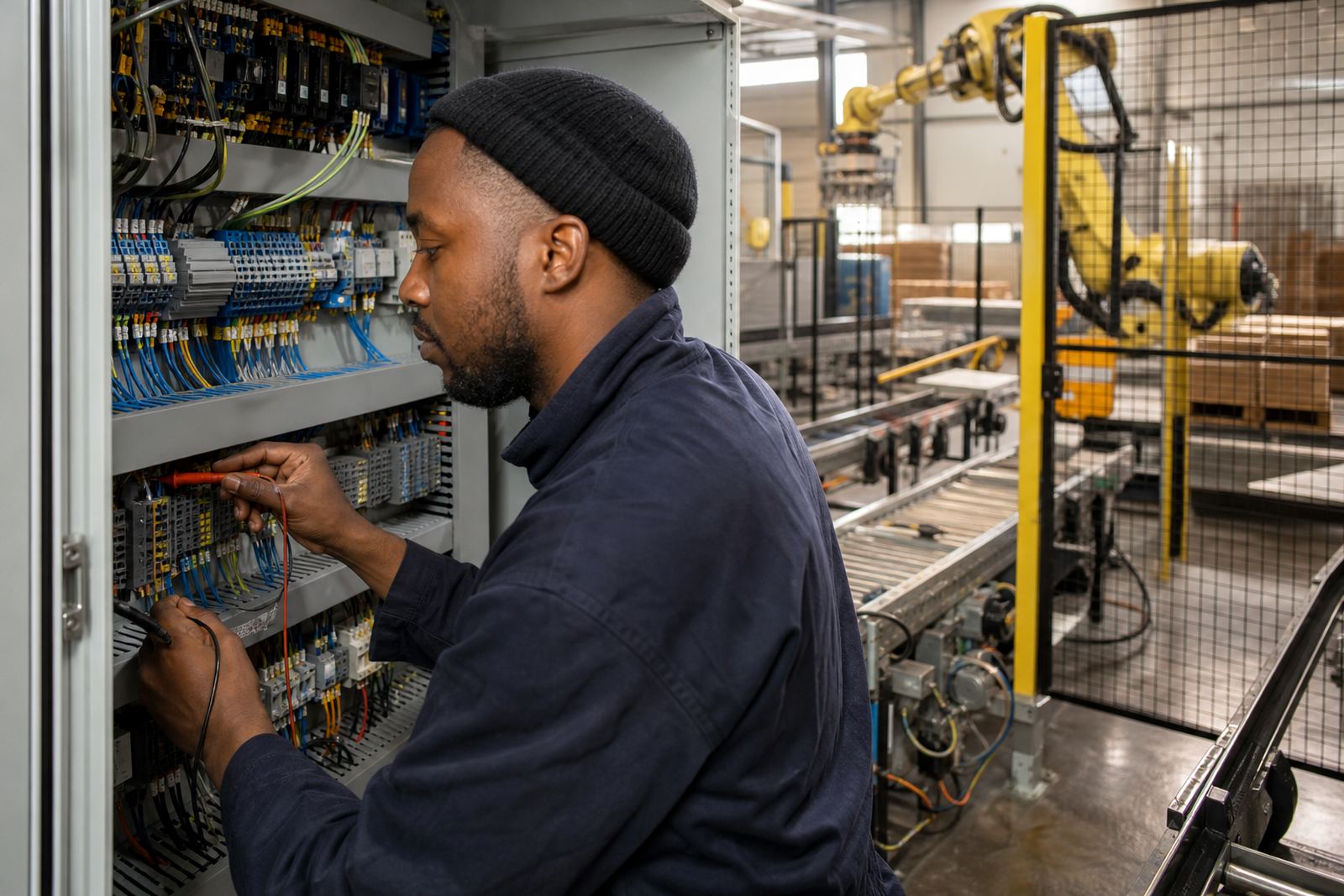
- Basic electrical and controls checks
- Mechanical inspection of moving parts and guides
- Safety device verification and restart support
- Site notes for the next maintenance shift
Safety, guarding and site rules
Every breakdown call has to respect the site risk controls already in place. If access into a cell is needed, the line must be made safe first, with lockout, isolation and the plant’s own permit process where required. For sites with guarding, light curtains, safety mats, interlocked gates or a cobot cell, we check that those devices are part of the fault response and not bypassed to push production back too soon. Each site needs its own risk assessment, because no two lines are arranged the same way.
That means we also check for low air pressure, voltage recovery issues, moisture in cabinets, loose terminals and encoder or sensor problems after power returns. Good breakdown work is not only about getting the line moving again, it is about making sure it restarts without creating a new hazard.
- Lockout and isolation before entry
- Site permit and access rules followed on every callout
- Guarding, interlocks and emergency stops checked before restart
- General risk assessment support for the work area
- Recovery action only after the line is safe
Turnaround and attendance across major metros
Turnaround depends on the location, the time of day and the fault reported. For Gauteng sites in Kempton Park, Johannesburg, Pretoria, the East Rand and Midvaal, we can often move quickly when the call comes in during operating hours. For Durban, Cape Town and Gqeberha, we plan attendance around travel, site access and the urgency of the stoppage. Remote pre-checks help us arrive prepared, with the right tools and likely spares in mind.
We aim to shorten the time from report to diagnosis by asking for the alarm text, photos of the fault area, the last known good condition and any recent maintenance work. That gives the team a head start before we get to site. If the fault is intermittent, we may request a controlled run test so we can capture the failure as it happens rather than after the fact.
- Remote fault pre-check before attendance where practical
- Support availability depends on location and workload
- Weekend and after-hours attendance can be arranged for urgent stoppages
- Clear handover once the line is stable again
Pricing approach and service checks
We price breakdown assistance according to the time spent, the type of line, the location of the site and whether the fault needs specialist controls or mechanical work. Some callouts are short and straightforward, others need a longer fault trace and repeat testing. We keep the pricing approach clear before work continues, and where a repair needs parts or extra labour, we discuss the next step first so there are no surprises.
For sites running packing and palletising lines every day, service checks matter just as much as the repair itself. We normally recommend regular checks on sensors, cable terminations, guarding devices, conveyor tracking, air systems and control cabinet condition, with the timing based on duty cycle and site environment. Plants near the coast may need closer cabinet and connector checks because humidity can affect contacts. A planned service check often prevents the kind of fault that shuts a line for half a shift.
- Callout pricing based on fault type, travel and time on site
- Parts quoted separately where replacement is required
- Planned service checks set per line and operating conditions
- Repeat-fault review available after the breakdown is cleared
Key facts
| Service type | Breakdown assistance for robotic packing and palletising lines |
|---|---|
| Systems supported | Robotic cells, cobots, conveyors, safety circuits and control interfaces |
| Regions covered | Kempton Park, Johannesburg, Pretoria, Durban, Cape Town, Gqeberha, East Rand, Midvaal |
| Typical fault areas | Sensors, handshakes, interlocks, I/O, cabling, pneumatic devices and mechanical alignment |
| Attendance basis | Planned callout, emergency attendance or remote pre-check where practical |
| Site requirement | Each site needs its own risk assessment before access or restart |