The right fit starts with the line, not the robot
At Spartan in Kempton Park, we often see sites that want automation but do not want to rebuild the whole packing area. That is usually where a retrofit makes sense. An industrial robot can be a good fit when the line already has a steady product flow, a defined pallet pattern and enough space for safe movement around the cell. If the conveyor height, infeed timing and pallet staging are already controlled, the robot can slot into the process with less disruption than a full line change.
For heavier cartons, unstable bags, multipack trays or mixed pallet patterns, conventional industrial robots are often chosen because they can handle larger loads, wider reach or faster palletising cycles than a lightweight collaborative unit. That does not mean a cobot has no place. It means the task must match the machine. If the payload is modest and the operator must work close to the process, a cobot may suit the job better. If the line needs speed and reach across a full pallet footprint, an industrial arm may be the better option.
Retrofits work best when the conveyor already does part of the job
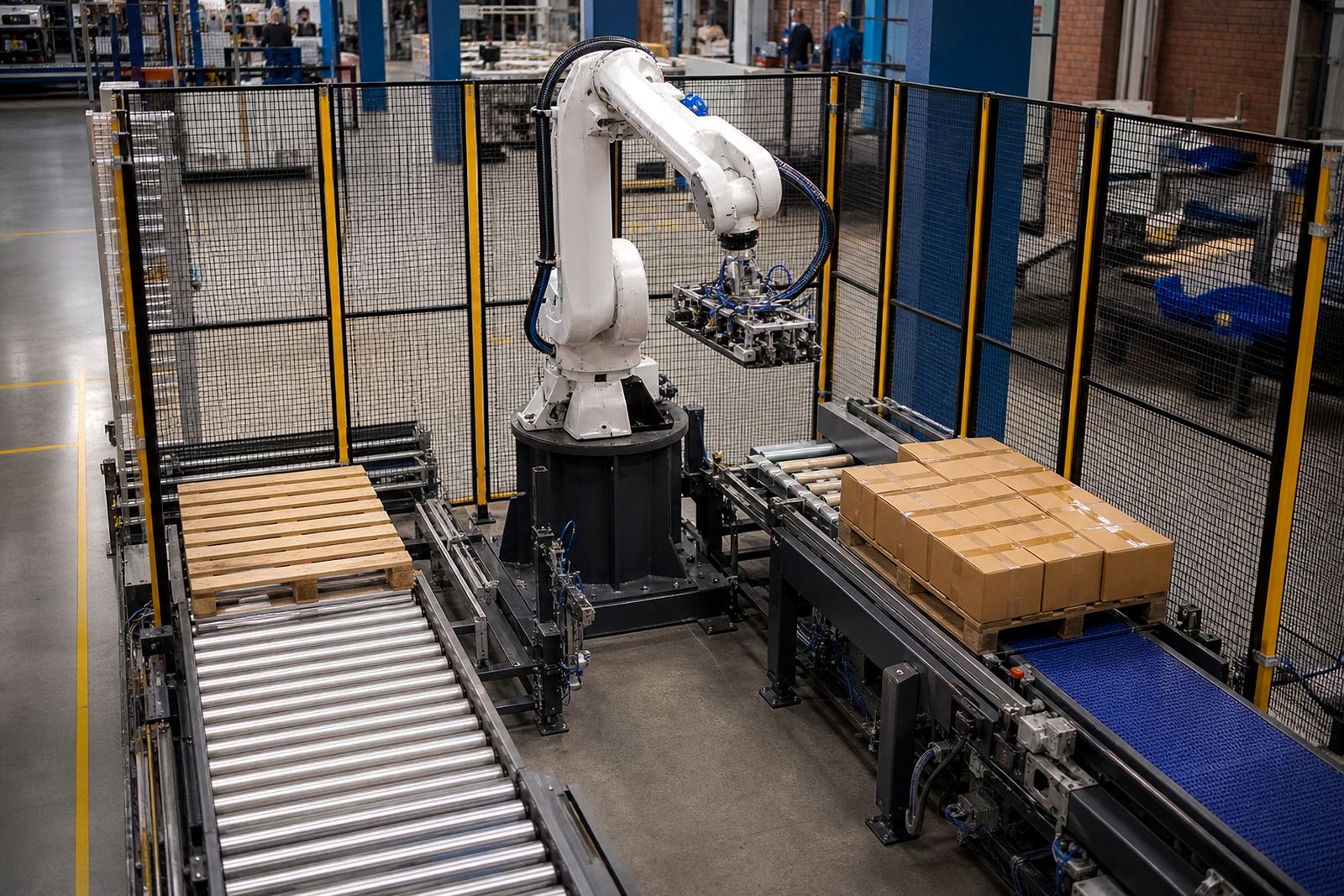
A good palletising retrofit is not only about the robot arm. It depends on how the existing conveyors feed product in and out of the cell. If cartons arrive too close together, if bags twist before the pick point, or if pallets are not staged properly, the robot will simply repeat the problem faster. That is why site line surveys matter. We look at infeed spacing, product orientation, stop points, pallet presentation and the available clearance around the line.
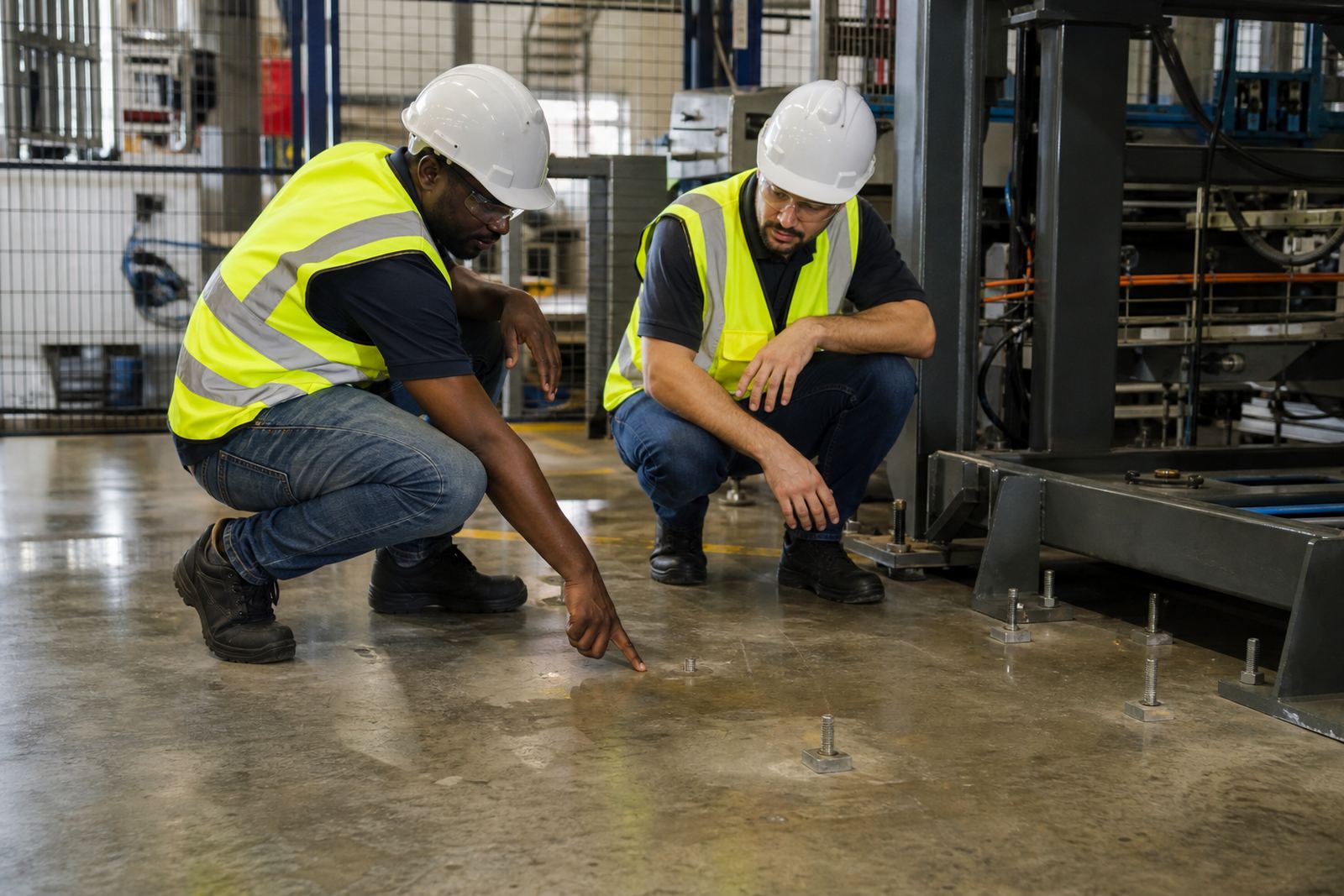
In many plants the best approach is to keep the current conveyor route and add the missing controls and guarding around it. The goal is to reduce manual lifting, improve consistency and avoid unnecessary civil work. Where floors are uneven or space is tight, the design has to be practical for the building, not just for the drawing. In Gauteng, coastal humidity is not the main issue, but dust and heat in some plant rooms still affect sensors, panels and cable routing, so those details matter.
- Check whether cartons can be gapped and squared before the pick point
- Confirm if the pallet position can be repeatable for each cycle
- Allow for access during maintenance, cleaning and changeover
Safety guarding is part of the retrofit, not an afterthought
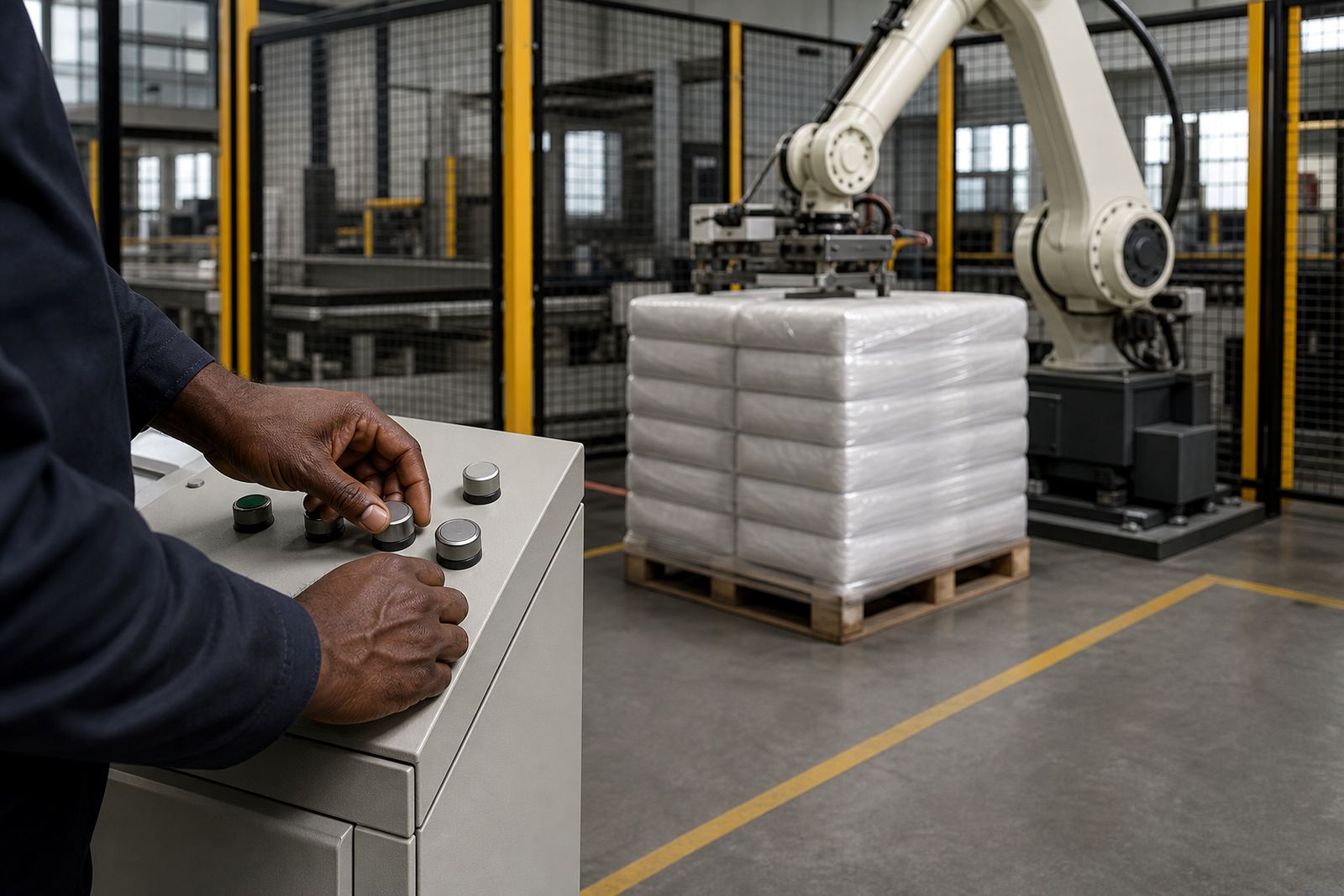
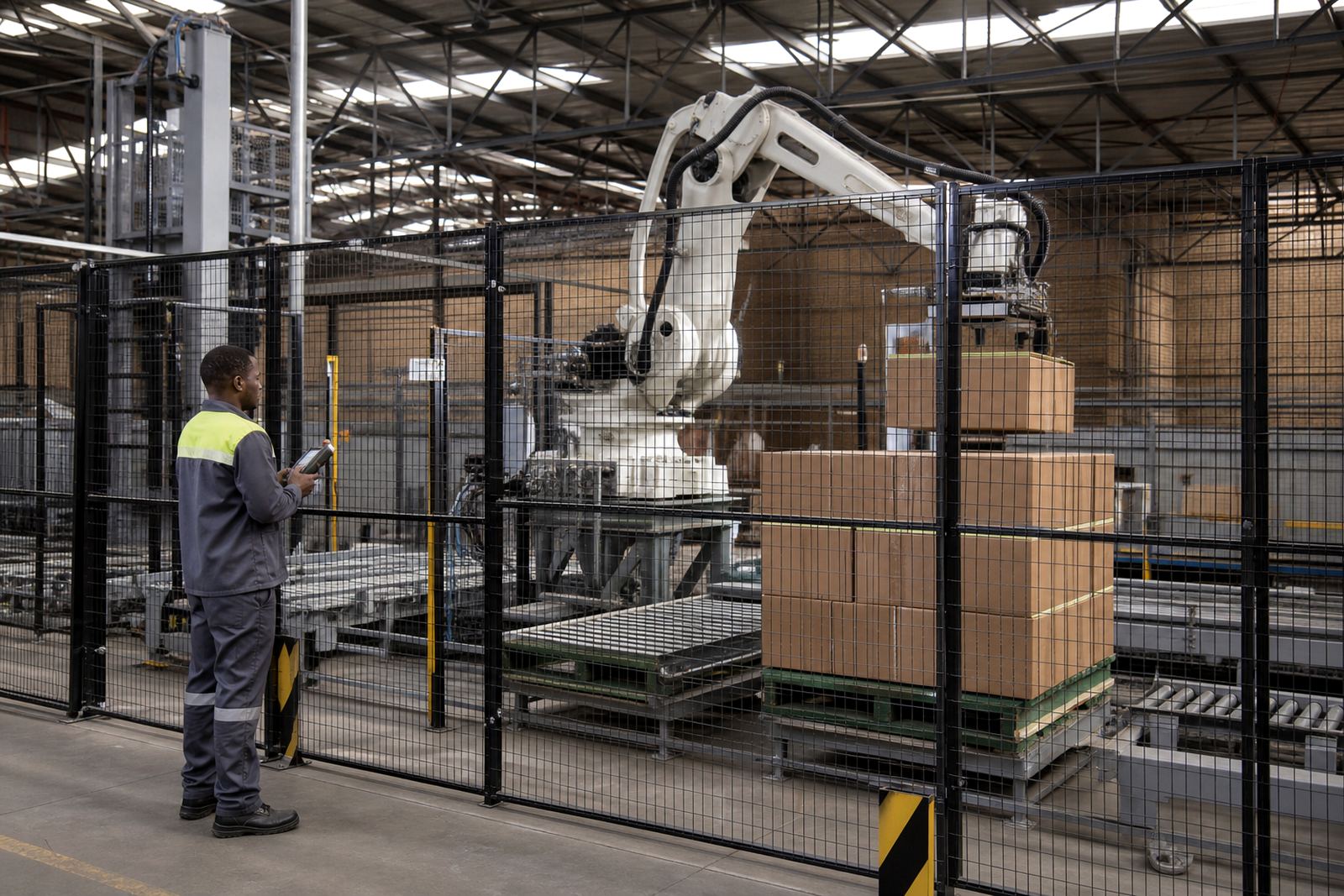
Industrial robots need proper guarding, access control and a clear operating method. A safe cell is not only about fencing. It also includes gate interlocks, stop circuits, warning signals, entry points for maintenance and a layout that keeps people out of the robot working envelope. Each site needs its own risk assessment because no two packing lines are exactly alike, even when the products look similar.
At a manufacturing site in Johannesburg, for example, the line may run through shifts with frequent pallet changes and limited floor space. At a Durban site, moisture and washdown areas may change the type of guarding and enclosure materials used. In Cape Town, a windy loading area can influence pallet transfer and staging. In Pretoria or Gqeberha, the room available for a safe turnaround can differ again. General safety rules are a start, but the final design must suit the actual line, the people working there and the municipal and site rules that already apply.
That is why safety guarding design and risk assessment support should move together with the mechanical and controls work. If the guarding blocks access for cleaning, operators will work around it. If the access is too easy, the cell may be unsafe. Getting that balance right is part of the retrofit job, not a seperate task.
Cobots have a place, but they are not the answer to every palletising problem
There is a common assumption that a cobot is always the easier option. In practice, the best choice depends on what the line must do. Cobots are useful when the product is lighter, the pace is moderate and staff need to work close to the process. They can be helpful for smaller factories, short runs or lines where there is frequent changeover. They also suit situations where space is tight and the cell must stay compact.
Conventional industrial robots are often selected when the duty is tougher. If the product is large, the pallet is full size and the operation must keep up with a high throughput line, the conventional option may be the more practical fit. That is not about prestige. It is about reach, duty cycle and consistency. A robot that is under-sized for the task becomes a maintenance problem. A unit that is oversized for the job can take up space and cost more than needed. The point is to match the machine to the line, not the other way round.
- Use cobots where human access and lighter loads are part of the task
- Use industrial robots where speed, reach and heavier cartons matter more
- Check whether the pallet pattern needs a full-size working envelope
Commissioning is where a retrofit becomes a working line
Design is only one part of the job. A retrofit has to be installed, tested and brought into service with the line operators and maintenance team in mind. Commissioning support covers the practical side: checking conveyor timing, proving the pick and place sequence, verifying safety stops and making sure the line can run through normal production conditions. On a live site, even a small delay in sensor feedback or a slight change in pallet position can affect the whole cycle.
Operator training matters as much as the hardware. If the team does not understand the basic sequence, fault recovery or safe restart procedure, the line will slow down. In busy plants across South Africa, from the East Rand to Midvaal, shifts change, product mix changes and pressure builds quickly. The system needs to be clear enough for the operators and service staff to manage without confusion. Practical maintenance support and spares planning help keep the line running when a sensor, cable or gripper component needs attention.
A local example: when the robot fit the line in Spartan
A packing line in Spartan may look simple from the outside, but once cartons are moving, pallets are waiting and operators are working around changeovers, the detail becomes important. In one typical retrofit scenario, the site already had conveyors in place and needed a more consistent palletising method without moving the whole production area. The line survey showed that the product flow was steady, the floor space was limited and manual stacking was slowing the dispatch side at peak times.
The practical answer was not to strip the line out. It was to design a robot station around the existing conveyor route, add suitable guarding, align the controls and make sure the pallet changeover process stayed straightforward. That is the sort of project where industrial robots fit well. They bring repeatability to a line that already works, but needs better output and less manual lifting. For manufacturers in Kempton Park, Johannesburg, Pretoria, Durban, Cape Town and Gqeberha, the same principle applies: if the line has a clear flow and the product is right for automation, a retrofit can be the most sensible step.
The key is honesty at the start. If the task is too light, too variable or too cramped, another solution may be better. If the line is stable and the goal is to improve packing or palletising without rebuilding the whole site, then an industrial robot can fit neatly into the process, and it can do so with less disruption than many managers expect.