Where Cobots Make Sense on a Real Production Floor
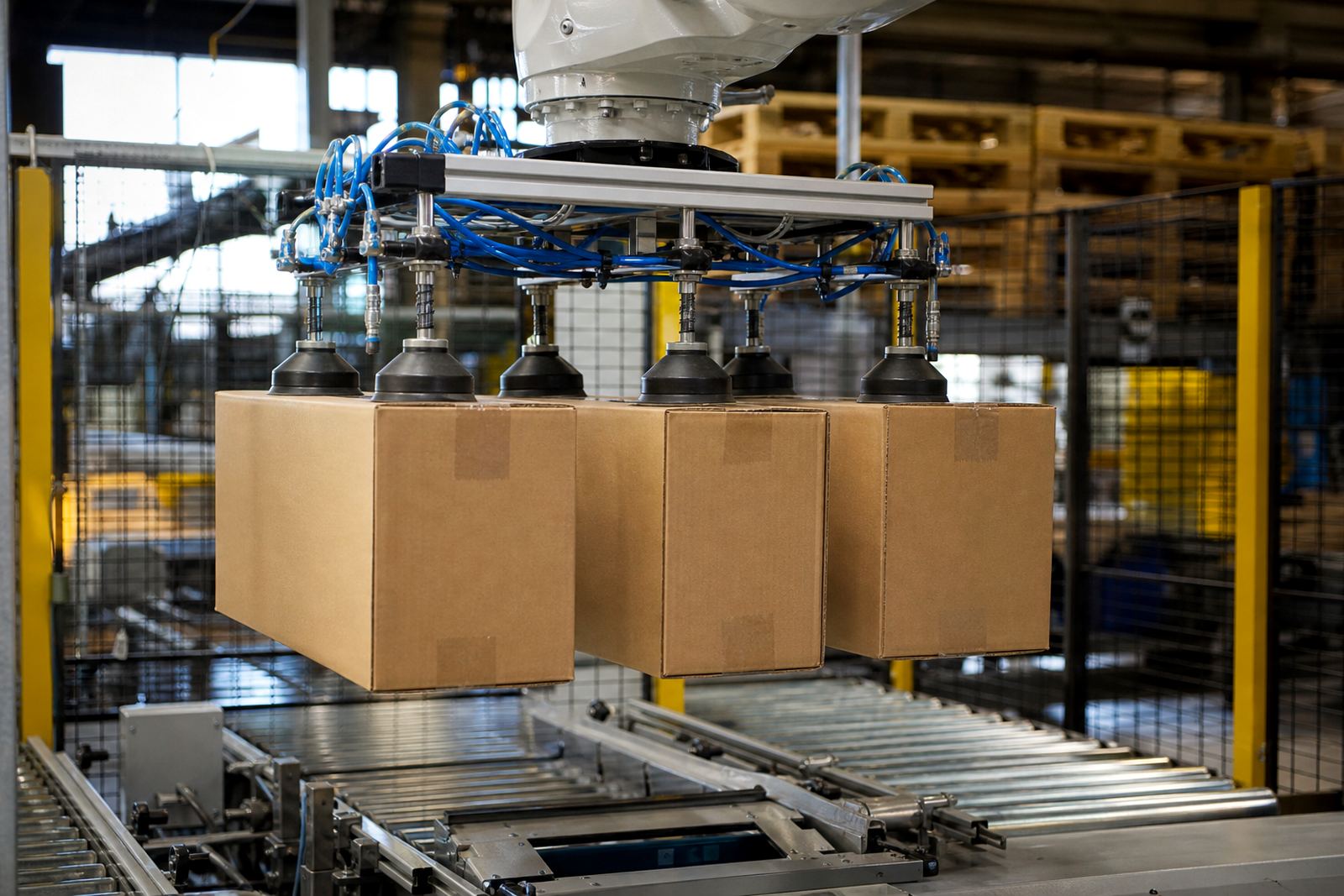
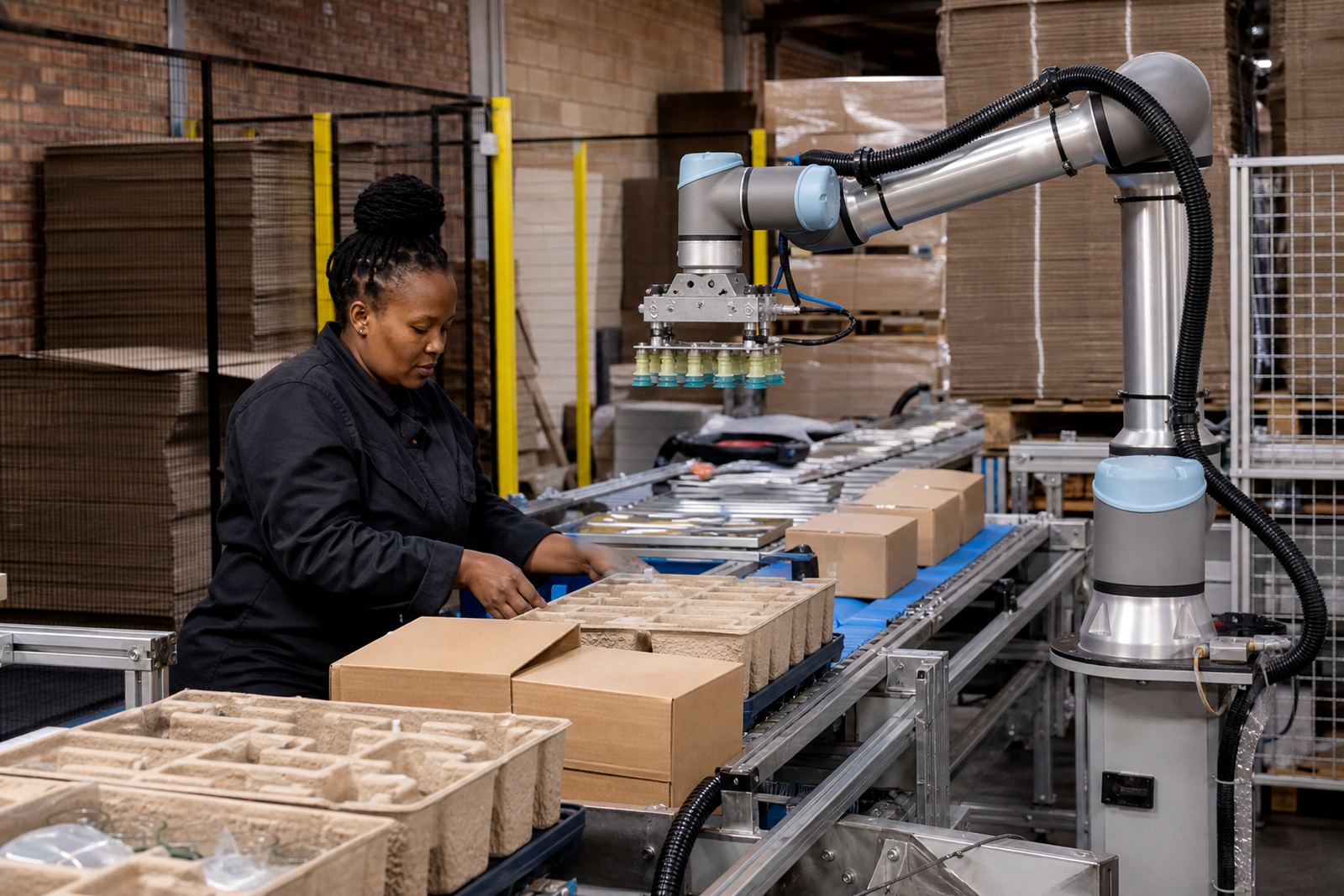
Cobots are best used where the job is repetitive, the loads are within a practical range and the process changes often enough to justify a more flexible setup. That usually means lighter packing tasks, box handling, case erection support, tray placement, layer forming or palletising smaller packs where operators and machines need to work close together. In a Spartan or Isando factory, space is often the first constraint, so a cobot can be placed into an existing line without redesigning the whole floor.
They are not the answer for every line. If the pack weight is high, the cycle is very fast or the reach is long, a standard industrial robot may be the better choice. A good retrofit starts with the product, the case size, the conveyor height and the changeover pattern, not with the robot itself. That is why site line surveys and process review matter before any final decision is made.
- Best suited to lighter cartons, trays, sleeves and similar repeatable packs
- Useful where product sizes change often during a shift or week
- Helpful when the line must keep manual access for supervision and quick intervention
- Better for controlled, moderate-speed operations than heavy-duty palletising
Why Flexibility Often Wins Over Raw Speed
Many South African manufacturers want to reduce manual lifting but cannot afford long shutdowns or a complete line rebuild. Cobots can help because they are generally easier to position around existing conveyors, tables and packing points. This matters in businesses serving Johannesburg, Pretoria, Durban, Cape Town and Gqeberha, where product mixes can change between customer orders and where floor space is often already committed.
For quick changeovers, the value is not just in the robot arm. It is also in how the line is set up for different pack sizes, how the grippers are changed and how the controls are handled. If the product mix is broad, a cobot can be programmed for multiple patterns and changeover steps can be kept simple. That can help teams avoid lengthy manual resets, though each site still needs a proper layout and a realistic cycle-time check.
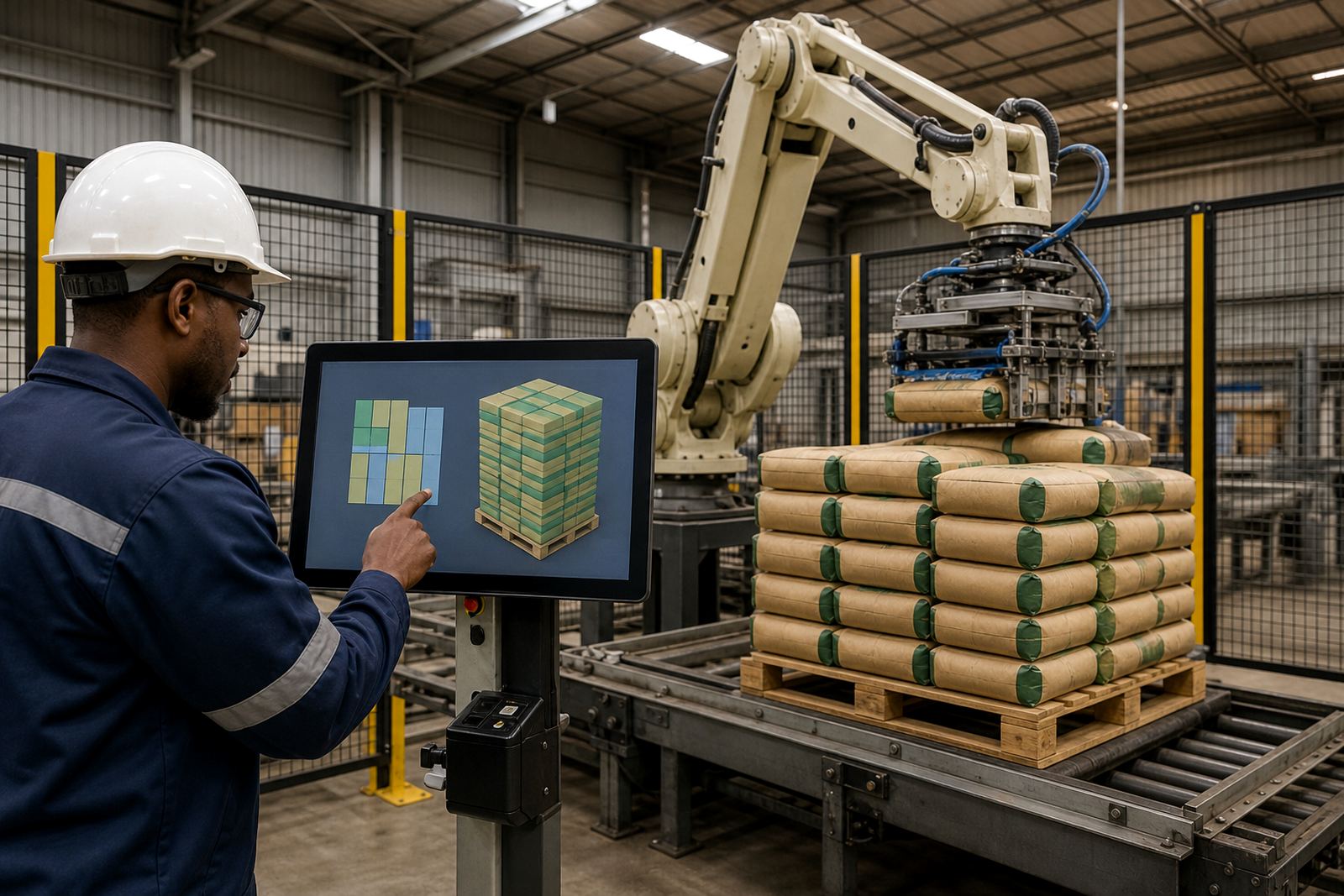
- Quicker swops between carton sizes, tray patterns and pallet layouts
- Less need for complex guarding around every movement if the risk profile allows it
- Can be integrated with existing conveyors and accumulation points
- Often easier to train operators on for routine line support
Safety Guarding Still Starts with a Site Risk Assessment
It is a mistake to think a cobot removes the need for safety planning. Every site needs its own risk assessment, because the load, speed, end effector, floor space and human access points all change the hazard profile. Some cobot applications can run with limited guarding and carefully managed collaborative access, while others need full perimeter protection, interlocks or restricted zones. The right answer depends on the task, not on a label.
A line that stops and starts often can create pinch points if controls are not thought through properly. Safety guarding design should therefore include entry points, emergency stops, visibility, signage and clear operating procedures. If people still need to reach into the cell for adjustments, the layout must allow that safely and with proper control of movement.
- Review access points, reach zones and stopping distances
- Check the weight, shape and stability of the product being handled
- Match guarding to the actual operation, not a generic template
- Confirm that operators understand manual mode, auto mode and fault recovery
How Cobots Fit Into Existing Conveyors and Controls
Retrofit work is usually about making new automation fit the line that is already there. That means looking at conveyor speeds, product spacing, reject points, transfer heights and signal logic. A cobot can be added at a pick point, a packing station or a pallet build area, but the handoff between the conveyor and the robot must be reliable. If cartons arrive skewed or too close together, the system will struggle no matter how good the robot is.
Controls integration is just as important as the mechanical side. Sensors, stop-start logic, jam detection and line permissives need to be matched to the existing equipment so the whole line works as one system. That may include making small changes to conveyor sensors, adding product presence checks or setting up alarms for low supply. On older lines, this part of the retrofit often decides whether the project feels simple or frustrating.
- Conveyor speed and spacing must suit the pick pattern
- Product presentation needs to be repeatable for consistent handling
- Controls should link the cobot to the rest of the line without confusing the operators
- Good integration reduces stoppages and makes fault finding easier
A Practical Example from a Gauteng Packing Line
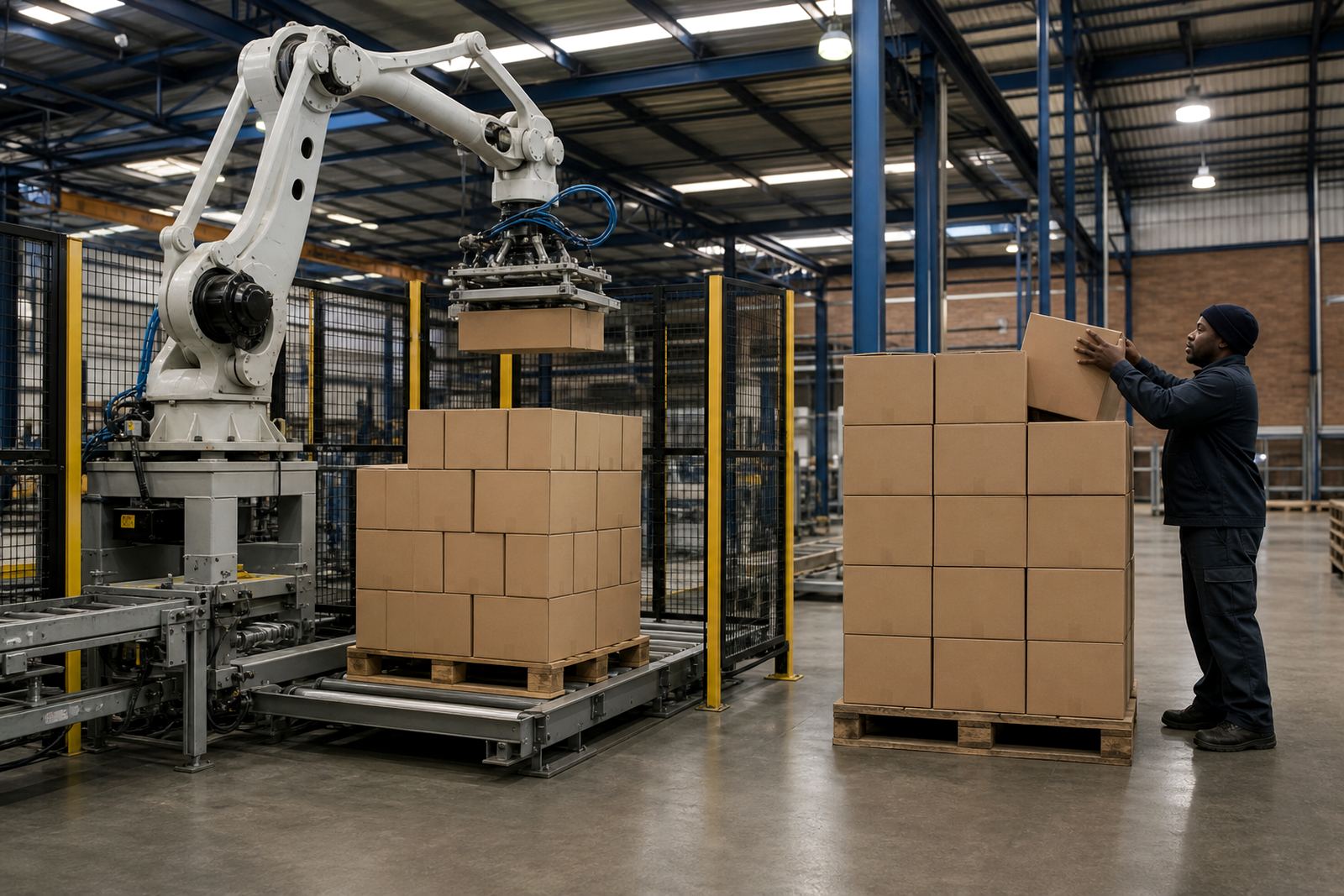
Consider a mid-sized manufacturer in Kempton Park packing cartons for retail distribution. The line is not new, but the business is handling more product variations and the team is under pressure to reduce manual lifting at the palletising point. A cobot may suit this kind of job if the cartons are manageable, the pallet pattern is straightforward and the factory wants to keep the existing conveyor path in place. In that setting, the goal is not maximum speed, but steadier handling and less strain on staff.
The process would usually begin with a site survey, followed by a retrofit layout that shows where the robot sits, how the cartons arrive, where the pallet is staged and how the operator enters or exits the area. From there, the installation plan covers guarding, controls, commissioning support and operator training. The same approach can work in Johannesburg, Pretoria, Midvaal, Durban or Cape Town when the line conditions are similar. It also helps maintenance teams because spares planning and breakdown response can be based on a known setup rather than an improvised one.
When a Cobot Is Not the Right Answer
Cobots are useful, but they should not be forced into the wrong job. If the product is heavy, unstable or awkwardly shaped, or if the cycle speed is too high for safe shared access, then another type of robot or a different line arrangement may be better. The same applies where the line needs long reach, very high throughput or a tightly enclosed cell to manage risk properly.
It is also worth asking whether the bottleneck is really packing or palletising at all. Sometimes the main issue is upstream supply, inconsistent carton forming, poor conveyor control or a layout that makes operators travel too far between tasks. A proper retrofit review looks at the whole line, not just the last station. That way the customer gets a solution that suits the factory floor, the staff and the product mix.
- Heavy loads and unstable packs may need a different automation approach
- Very high throughput can favour dedicated industrial equipment over collaborative handling
- Poor upstream feeding will still cause stoppages after retrofit
- A full line review usually gives a better result than a single-point fix
Choosing a Retrofit Partner That Knows the Line
For cobots to work well, the retrofit partner must understand conveyors, controls, guarding, operator flow and maintenance support. That includes line surveys, retrofit design, installation management, commissioning support, operator training and breakdown assistance. In practice, the best projects are the ones where the team plans for the real shift pattern, the real product sizes and the real maintenance conditions at the plant.
ReAutomated works from Spartan, Kempton Park and supports manufacturers across South Africa who need packing and palletising lines adapted to existing operations. The right question is not whether a cobot is modern or clever, but whether it solves the actual job safely and with enough flexibility for the next changeover. If the answer is yes, it can be a practical addition to a line that needs to do more with less manual labour.