Why guarding matters on retrofit lines
When a robotic cell is added to an existing packing or palletising line, the danger is usually not the robot alone. The wider system can include conveyors, transfer points, pallets, wrappers, sensors, lifts, compressed air and manual intervention points. Guarding helps separate people from hazardous movement, but the exact design depends on each site.
In many factories around Kempton Park, Johannesburg and Pretoria, the line was not originally built for robot access. That means the guarding plan has to fit around the real layout, the floor space available and the routes people use for clearing jams, checking product and moving stock. A neat fence is not enough if operators still need to reach through it every few minutes.
The best guarding strategy makes the safe path the easy path.
Start with a proper site risk assessment
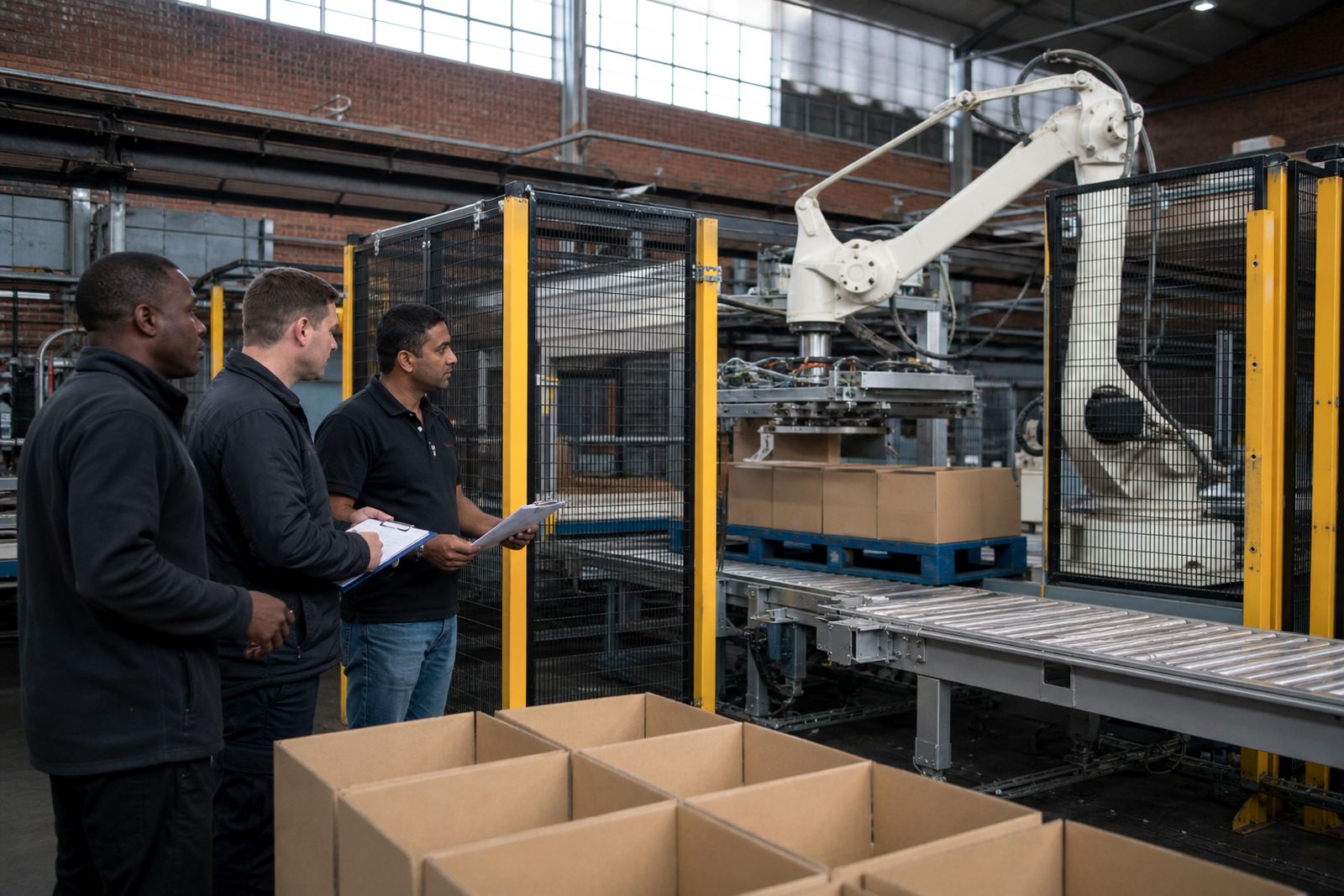
Every retrofit should begin with a site risk assessment. This is where the hazards are identified before equipment is installed, and it is where guarding decisions start to make sense. A line that handles cartons on one shift and drums on another will not need the same guarding arrangement. A coastal site in Durban may also need different materials or finishes than a dry inland plant in Midvaal.
The assessment should look at pinch points, reach distances, aisle access, emergency stops, product flow and tasks such as clearing blockages or changing film. It should also consider what happens when a guard is opened, a light curtain is broken or a control fault occurs. Safety rules are general, but each site needs its own risk assessment and its own final layout.
- Identify every moving part, including conveyors and transfer stations.
- Check where operators stand, walk and reach during normal production.
- Plan for maintenance access without creating unsafe shortcuts.
- Review restart behaviour after a stop, fault or power interruption.
Guarding works best when it is designed alongside controls integration, not added at the end as an afterthought. That is especially important on retrofits, where old and new equipment must work together without confusing the operator.
Guarding options that suit packing and palletising retrofits
There is no single guarding style that suits every line. On a straightforward palletising cell, fixed mesh panels may be enough to stop access to the operating zone. On a packing line with more manual loading, you may need a mix of fixed guards, interlocked access doors, barriers and sensing devices. Cobots can reduce some guarding needs, but they do not remove the need for a proper risk assessment.
Practical guarding choices should match the work being done. If staff need regular product changeovers, access points must be controlled and clearly signed. If a conveyor runs through a busy area, side guarding and controlled crossings may be needed. If pallets are being transferred into a stretch wrapper or outfeed lane, the movement zone should be separated from pedestrian routes.
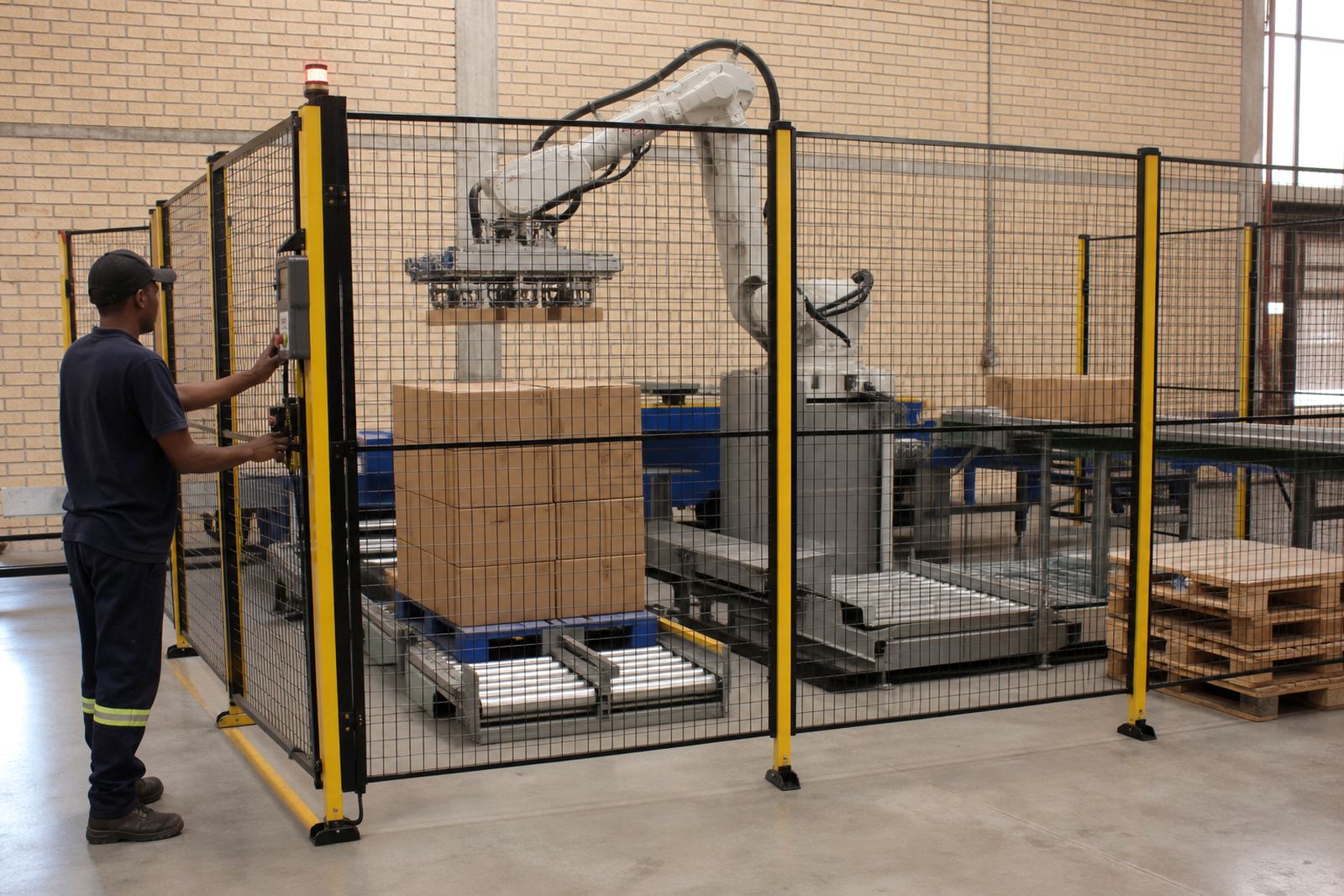
- Fixed mesh guarding for full separation around palletising areas.
- Interlocked gates for controlled maintenance or reset access.
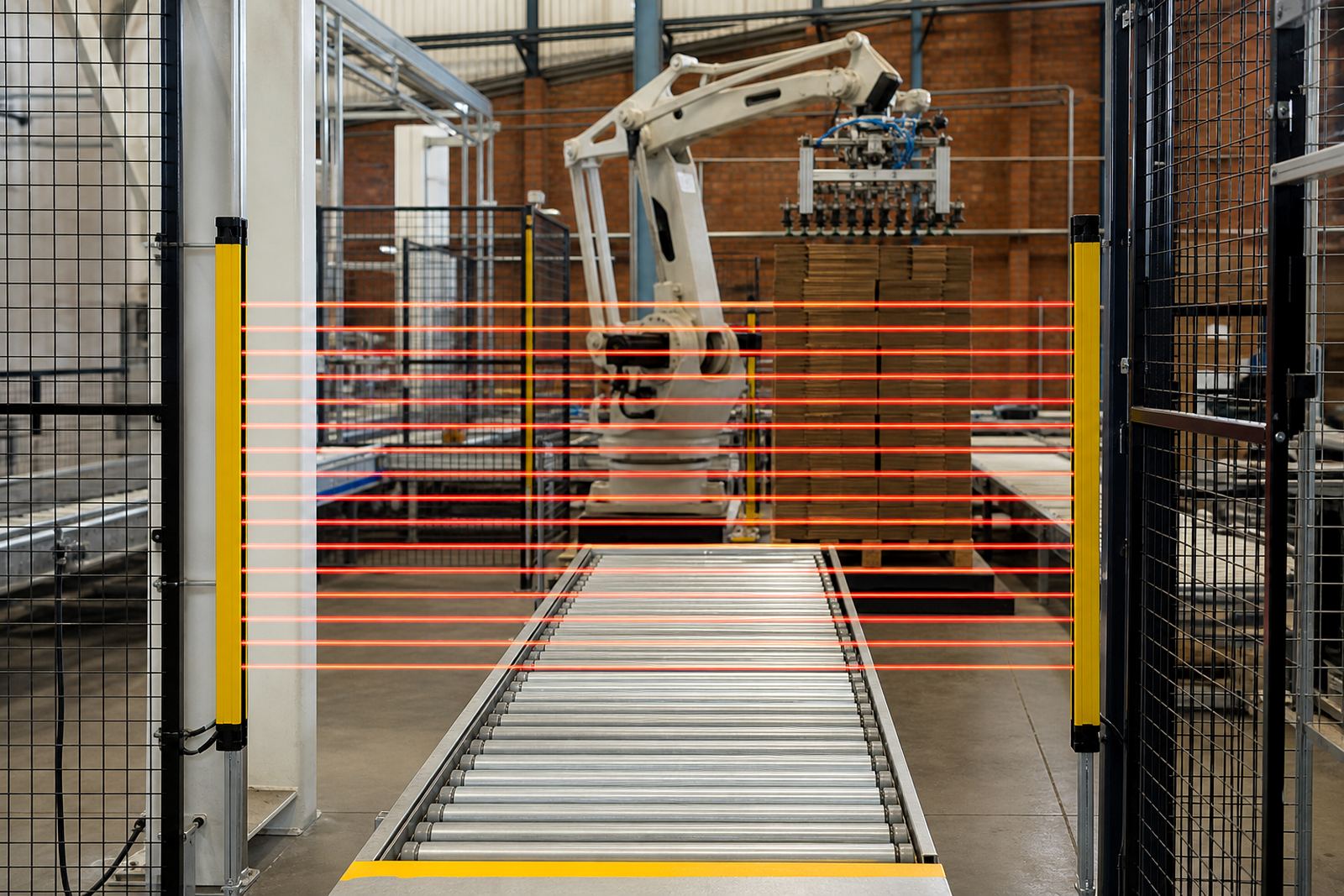
- Light curtains or sensing devices where entry must stop the line.
- Marked walkways and floor barriers to guide pedestrian movement.
The aim is not to make the line awkward to use. The aim is to make unsafe movement difficult and safe movement obvious.
Integrating guards with conveyors and controls
On retrofit projects, guarding has to fit existing conveyors, controls panels and stop circuits. If the guard layout is poorly planned, operators end up climbing around fences or reaching across moving product. That creates risk and slows the line down. A better approach is to map the flow first, then place guards, sensors and access points where they support the process.
Controls integration is important because a guard should do more than just stop a machine. It must stop the right sections, in the right order, and prevent unexpected movement when a gate is opened. This is where engineering detail matters. The line may need controlled shutdown zones, safe restart logic and clear indication of when an area is live.
For factories in Durban or Gqeberha, humidity, corrosion and dust can also affect sensor performance and panel condition. In those settings, guarding materials and fixings should be chosen with maintenance in mind, so that the safety system stays reliable over time and not just on the day of commissioning.
Operator habits make or break the system
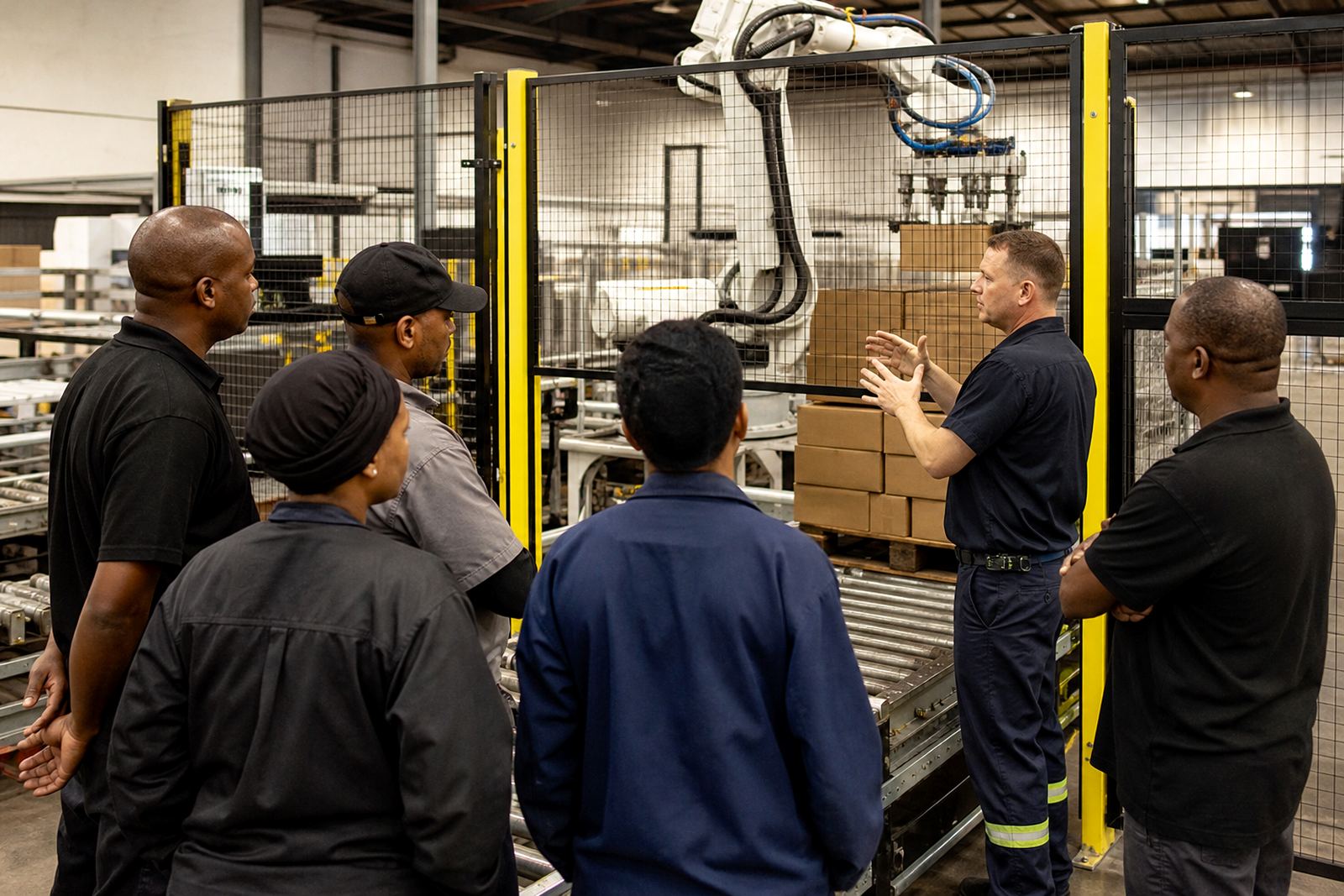
Good guarding can be undermined by poor habits. If staff prop open a gate to save time, the safest design is being bypassed. If supervisors do not enforce stop procedures before clearing a jam, people are exposed to unnecessary movement. That is why operator training has to form part of the retrofit, not sit outside it.
Training should explain what each guard is for, when it may be opened, who is allowed to isolate the line and what to do if a fault occurs during a shift. Simple, practical instruction works better than a long technical session that nobody remembers on a busy afternoon. In many plants, the strongest safety improvement comes from consistent routine, not expensive equipment.
Useful topics to cover with the team include:
- How to isolate and verify the line before entering a guarded area.
- What alarms mean and when production must stop.
- How to report missing panels, loose fixings or damaged sensors.
- Why temporary shortcuts create serious risk around moving equipment.
What a local retrofit example looks like
Take a packing line in Spartan, Kempton Park, where cartons move from a case sealer to a palletising zone and then onto dispatch. The original layout may have open access around the conveyor and a few informal walk paths for operators. Once a robot or cobot is introduced, the work area changes. The guarding has to protect the new movement pattern while still allowing product flow and maintenance access.
A sensible upgrade could include fixed guarding around the palletising zone, interlocked entry points for service work, floor markings for pedestrian routes and a revised control panel layout so operators can see the line status at a glance. If a nearby conveyor feeds product from another area, that upstream section should be included in the safety review too, because hazards rarely stop at the first fence.
This is the kind of practical work that helps a plant in the East Rand or Midvaal keep production moving without leaving people exposed to avoidable risk. The goal is straightforward: a line that is safer to work on, easier to supervise and less likely to be interrupted by preventable incidents.
Guarding should support the production day, not fight it
Well-planned guarding is part of a working production system. It should support normal operation, not create delays every time someone needs to check a sensor or clear a product issue. When the layout is planned carefully, the guarding becomes something the team trusts instead of something they work around.
For manufacturers across South Africa, especially where labour, uptime and space all matter, that is the practical test. If the guarding keeps people clear of moving parts, fits the workflow and can be maintained properly, it is doing its job. If not, the line will always be one bad decision away from trouble.
Retrofit projects work best when guarding, controls, conveyor changes and risk assessment are handled together from the start. That approach gives the site a safer line and a clearer process for years to come.