Why Light Curtains Suit Packing and Palletising Retrofits
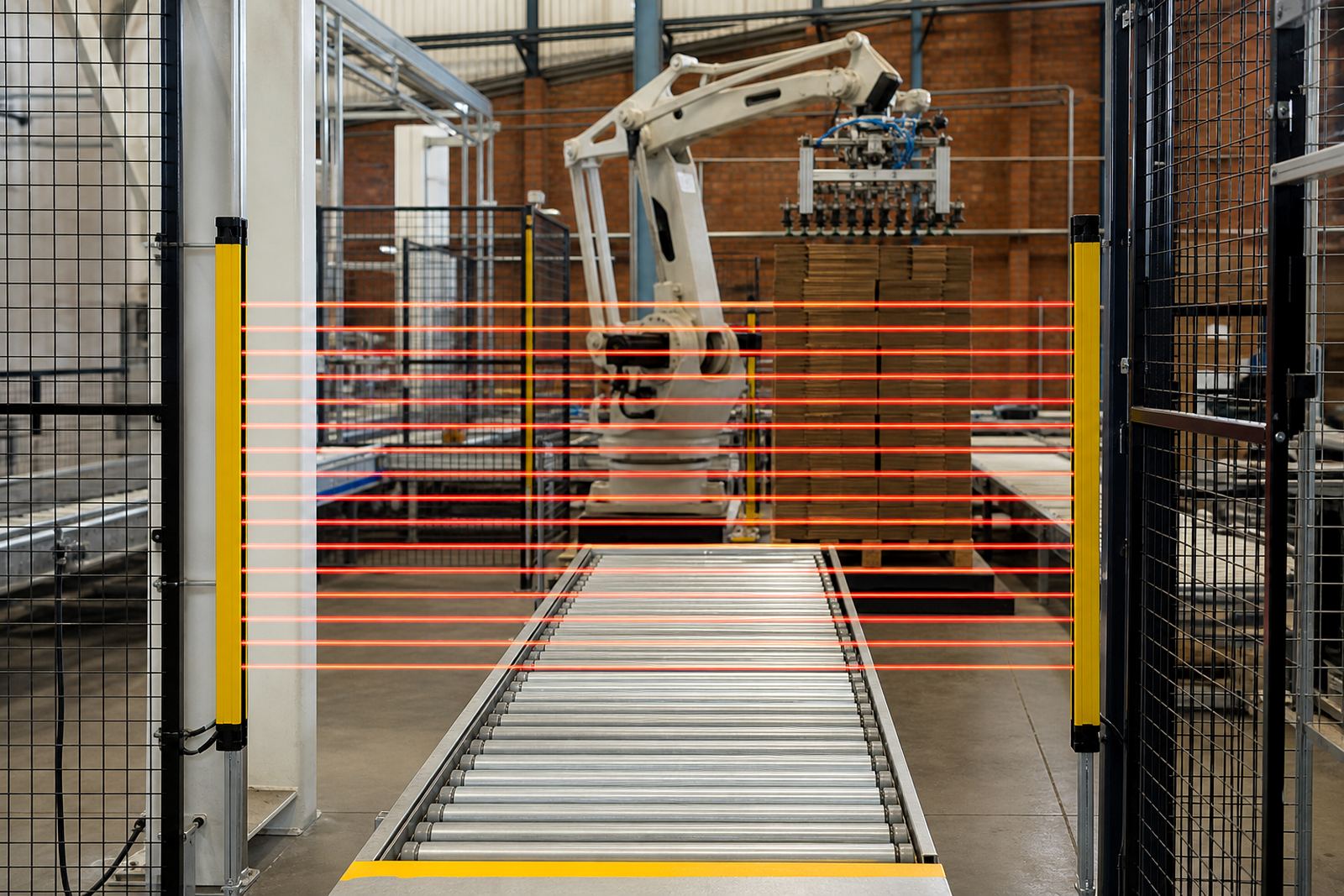
On older packing and palletising lines, the challenge is usually not the robot itself, it is the access around it. Operators need to feed product, clear a jam, change film, check a carton, or move a pallet into place. A light curtain gives you a detection zone across that opening so the machine can stop when a person enters the protected area.
For retrofit work, this is useful because it can protect a doorway, feed opening or transfer point without putting a solid barrier where product needs to pass. That matters on existing lines where conveyors, wrappers and palletisers were installed in stages and there is limited space to start over. In a Kempton Park warehouse or a Durban packaging room, you are often working with a fixed floor layout, low ceiling space and very little room for a full rework.
The real value is simple: people can be detected, product can keep moving in the intended path, and the line does not have to be redesigned from scratch.
How a Light Curtain Works on an Existing Line
A light curtain uses paired devices that create an invisible screen of beams. If a person, hand or body breaks those beams, the safety circuit reacts and the machine stops or enters a safe state. The spacing, height and position of the beams are selected based on the hazard, the opening size and the way people approach the area.
In a retrofit, the curtain is usually tied into the existing controls and safety circuit, then tested with the rest of the line. That means checking how it behaves with the conveyor start sequence, pallet transfer movement, robot motion and any manual mode used by maintenance staff. If the line has multiple access points, the curtain may form part of a wider safety arrangement with interlocked gates, reset stations and warning signals.
- Suitable for openings where product must pass through, but people must be detected
- Useful where frequent access makes a fixed guard impractical on its own
- Needs correct mounting, alignment and control integration to work properly
Where Light Curtains Work Best and Where They Do Not
Light curtains work well at infeed and outfeed points, pallet transfer openings, robot loading zones and certain access gaps around conveyors. They are especially useful where operators must reach through a protected opening for short tasks, provided the risk assessment supports that arrangement.
They are not a blanket solution for every hazard. If there is a risk of reaching around the protected area, climbing over it, or standing in a zone where a full guard is needed, then the curtain alone is not enough. Dust, vibration, forklift traffic and poor alignment can also affect performance, so the site conditions need to be checked before anyone commits to a layout.
On coastal sites, humidity and airborne dust can be part of the discussion too. In Cape Town or Gqeberha, for example, equipment choices and mounting positions need to take corrosion and cleaning routines into account. On a production floor in Pretoria or Midvaal, the bigger issue may be dust from cartons, stretch wrap and general handling around the palletising cell.
- Good for access openings with a clear line of detection
- Not suitable as the only safeguard where reach, climb or bypass risks remain
- Should be considered alongside guarding, layouts and work methods
Risk Assessment First, Then the Hardware
Every site needs its own risk assessment. That sounds obvious, but it is where many retrofits go wrong. A curtain that is fine on one line may be wrong on another because the product size, conveyor speed, operator tasks and maintenance routine are different. The opening may also change once the robot is installed or the pallet pattern is adjusted.
A proper assessment looks at the hazard, who is exposed, how often access is needed, what happens during fault finding and what the operator must do during a stoppage. It also looks at the reset logic, emergency stop arrangement and whether the machine can restart unexpectedly after the curtain clears. If safety guarding is needed around the base of the robot or the pallet load area, the curtain is only one part of the answer.
This is why safety work should sit with the line design from the start, not be added at the end when the panels are already mounted and production wants to start on Monday.
Integrating Curtains with Conveyors, Robots and Controls
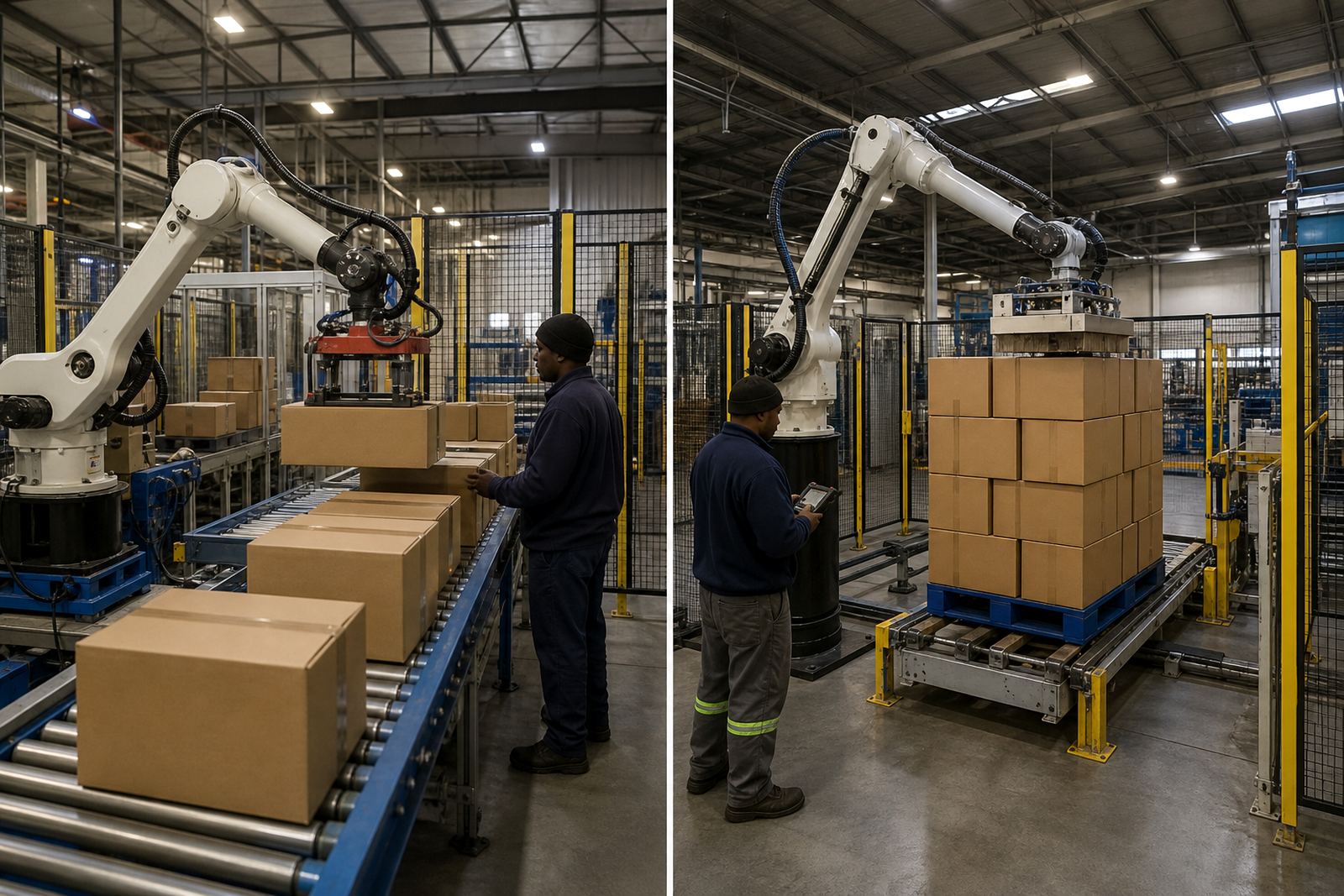
A packing or palletising retrofit rarely involves just one machine. The curtain must work with the conveyor logic, the robot cell, the infeed timing and the operator controls. If a carton is still on the transfer conveyor when the curtain is interrupted, the system should stop in a controlled way. If the line is reset, it should restart in the correct sequence, not all at once.
That is where controls integration matters. The safety inputs, safety outputs and standard control signals need to be mapped carefully so the machine behaves as intended. On older lines, a retrofit may need revised panel layout, new cabling routes or updated fault indication so maintenance staff can see exactly what caused the stop. In practice, that saves time during breakdowns and helps with operator training too.
Operators should know what the curtain protects, what a safe stop looks like and when an authorised person may enter the area for cleaning or clearing a jam.
A Practical Example from a Gauteng Plant
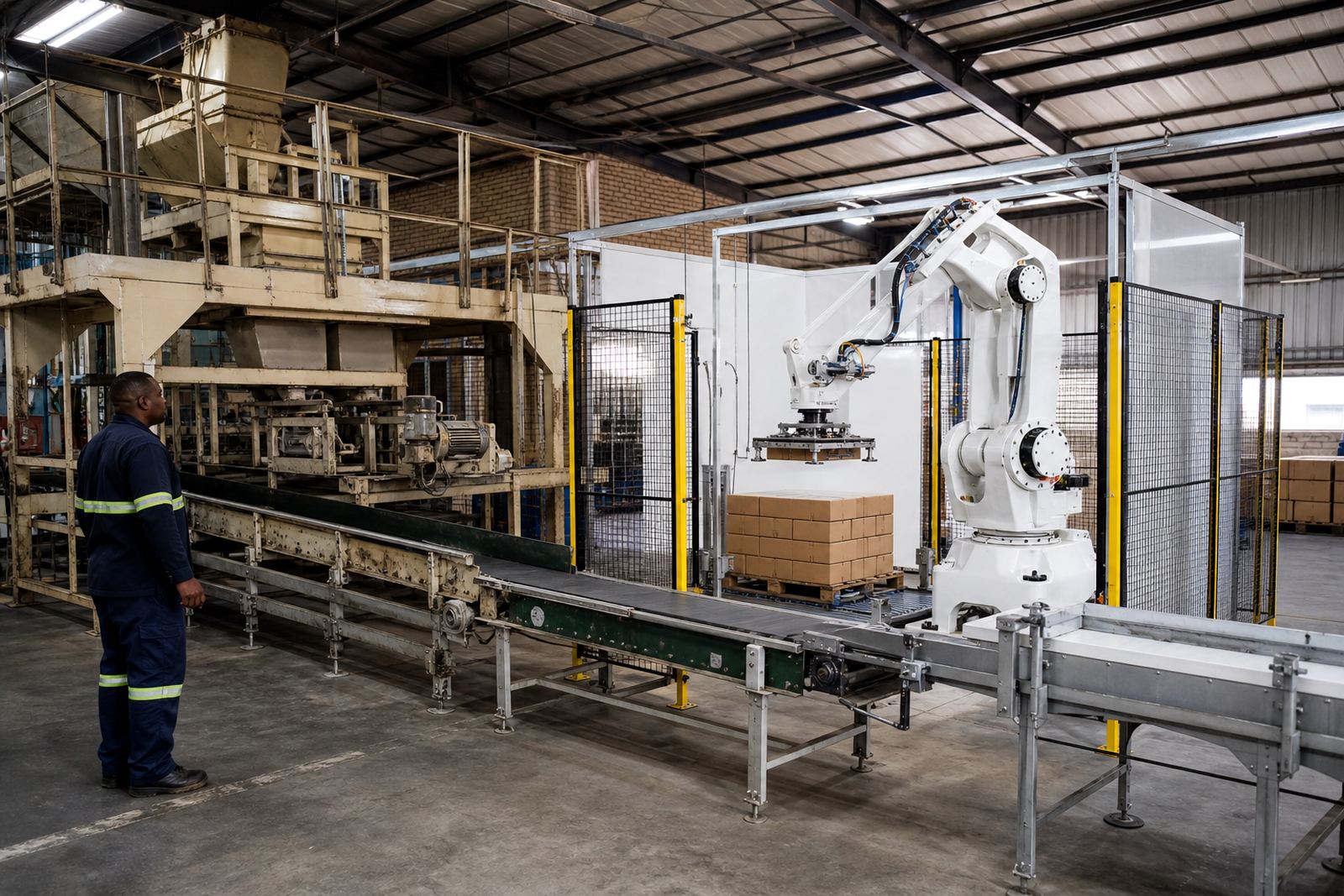
Consider a manufacturer in Spartan, Kempton Park, retrofitting a palletising robot onto an existing conveyor line. Pallets arrive on a transfer section, the robot builds loads and operators still need to reach the area for wrap checks and minor adjustments. A full fence would block useful access, but leaving the opening unprotected would not be acceptable.
In that situation, a light curtain can protect the access opening while allowing the pallet transfer path to remain clear. The installation would need careful alignment, clear warning labels, proper reset points and a risk assessment that matches the exact way the line is used. If the line also needs maintenance access from the rear, that side may need fixed guarding or an interlocked gate instead.
That mix of solutions is normal in South African factories. One side may need a curtain, another a gate, and a third a fixed barrier. The job is to make the whole cell practical for operators and safe for everyone who enters the area.
What to Ask Before You Choose a Curtain
Before selecting a light curtain, ask how the opening is used, who enters it, how often the machine must stop, and what happens if product passes through without a person present. Ask how the curtain will tie into the existing conveyors and whether the current controls support the safety logic you need. Also ask how the system will be checked after installation and who will be responsible for ongoing maintenance support.
A good retrofit should leave the line easier to use, not more difficult. If a solution looks simple on paper but is awkward for the shift team, it will soon cause shortcuts. The best setup is the one operators can understand, maintenance can test, and management can trust during an audit or a breakdown.
For manufacturers across Johannesburg, Durban, Cape Town, Pretoria and Gqeberha, that practical approach is usually the difference between a line that keeps moving and one that keeps causing trouble.
- Check the opening size and how product moves through it
- Confirm how the curtain connects to the existing control system
- Make sure the reset and restart logic suits the actual operation