Packing Gets the Product Ready For the Next Step
Packing is the point where loose product becomes a case, tray, pouch or carton that can move through the rest of the factory with less damage and less manual handling. On many South African lines, packing still starts with operators loading products by hand, checking counts, closing cases and moving them onto a conveyor. That works at lower speeds, but once volumes rise the line often starts to show gaps, spillage or inconsistent pack quality.
A packing retrofit is usually focused on accuracy and repeatability. The aim is to handle product gently, keep pack presentation consistent, and match the pace of the upstream process. In a biscuit plant in Kempton Park, for example, the real challenge is often not the robot itself but the change in flow from oven or wrapper to case packing. If the infeed is irregular, the whole line feels it.
Palletising Is About Stable Stacks and Safe Dispatch
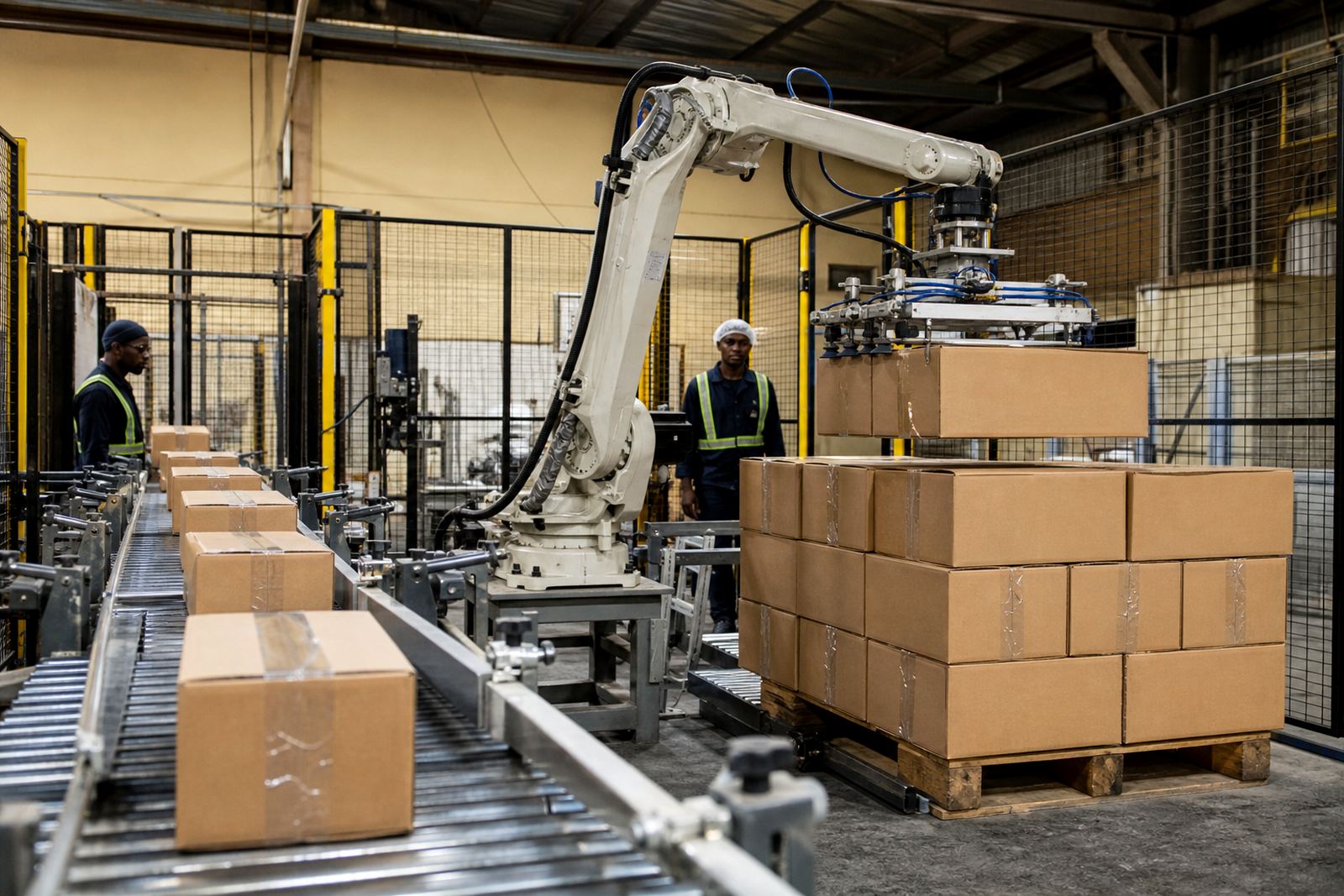
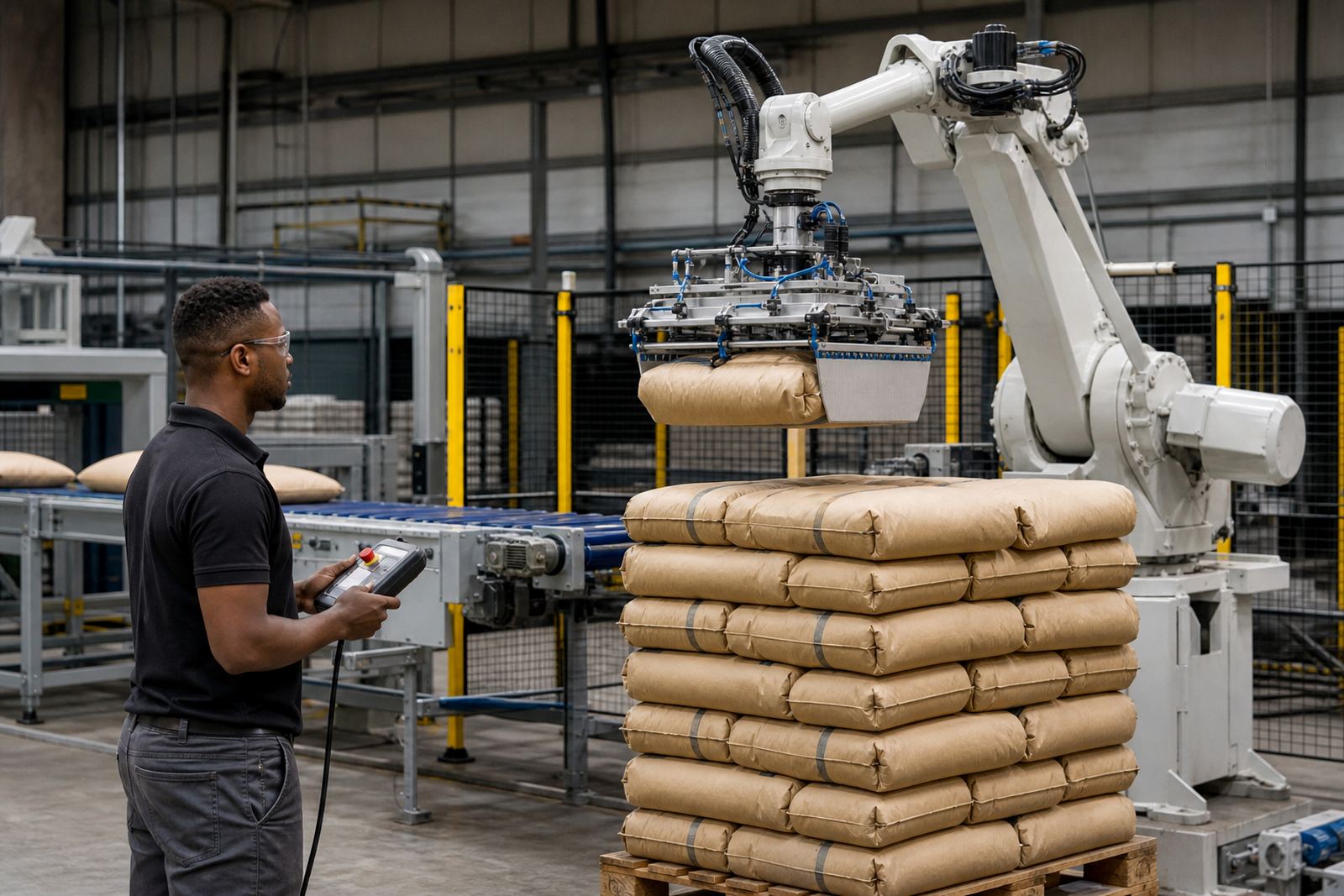
Palletising begins after the product has already been packed. The job is to stack cases, trays or bags onto a pallet in a way that is stable, easy to wrap and suitable for transport. The biggest difference from packing is that palletising has to think about load stability, pallet pattern and warehouse handling. A neat pack means little if the pallet leans during transport or collapses in a truck yard.
In practice, palletising retrofits are often installed to remove lifting strain, improve line consistency and reduce damage caused by rushed end of line handling. For sites in Durban, where humidity can affect carton strength and wrapping performance, pallet pattern and film containment need proper attention. A good palletising setup should suit the product weight, pallet size and the way the goods move through the warehouse, not just the speed of the robot.
- Pack quality affects how easy a case is to stack later
- Pallet pattern affects stability during transport and storage
- Moisture, dust and carton condition can change end of line performance
Why One Retrofit Often Needs Both Packing and Palletising Thinking
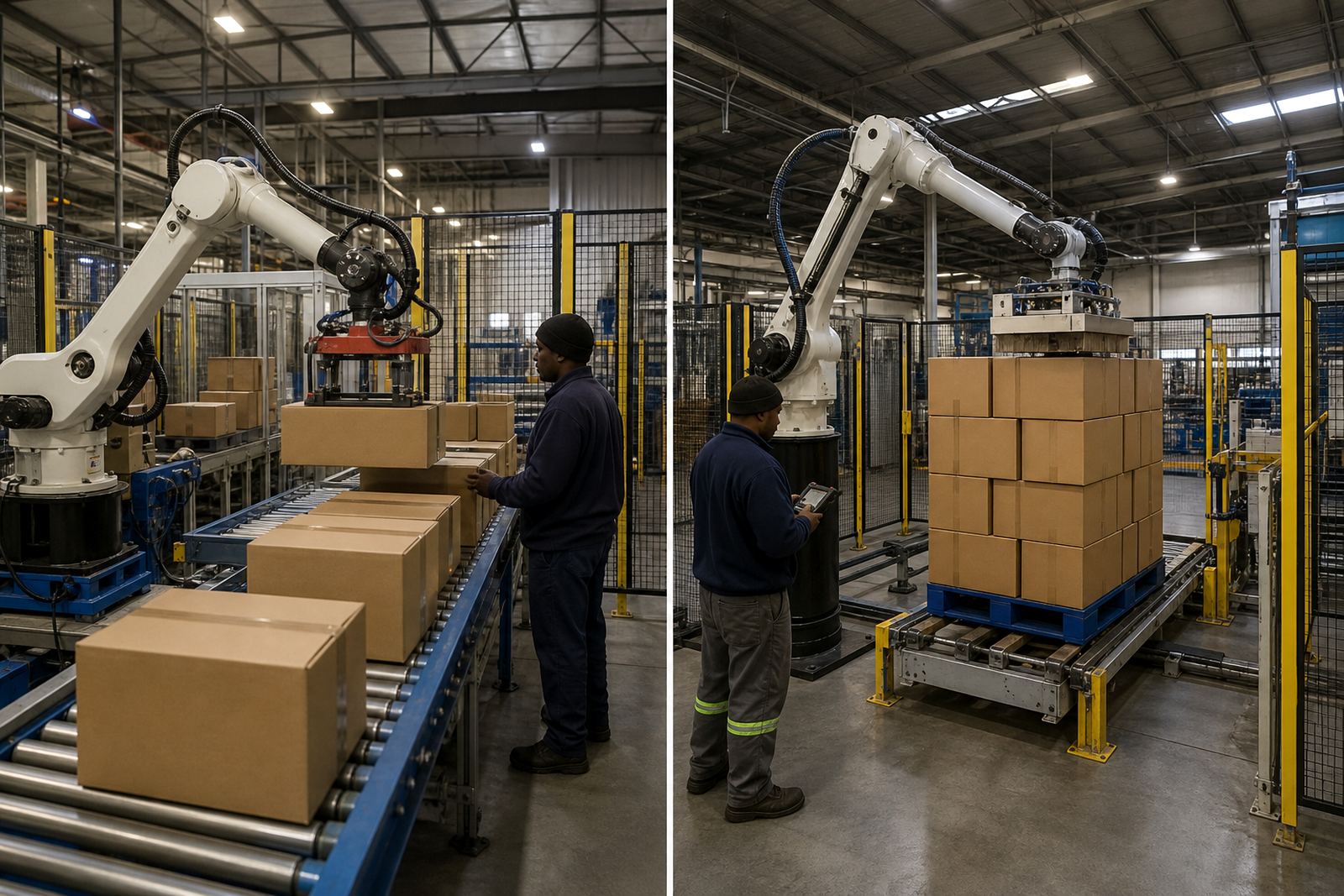
Many businesses ask whether they need packing automation or palletising automation first. The honest answer is that the line should be looked at as one system. A fast packer feeding a slow palletising area can create a bottleneck. The opposite is also true, where a palletiser waits on an inconsistent pack station and ends up underused.
That is why retrofit work starts with a site line survey and a proper look at conveyors, case transfer, product orientation and available floor space. In some plants, the best first step is packing support with a later palletising upgrade. In others, the immediate pressure is at the end of line, where manual stacking is creating fatigue and overtime. A retrofit should fit the current plant layout, power supply and maintenance capability, not force a full rebuild.
For manufacturers across Johannesburg, Pretoria and the East Rand, this often means making use of existing conveyors and installing the automation around them. That approach can keep shutdown time lower and reduce civil changes, which matters when production windows are tight and the plant cannot stop for long.
Cobots, Industrial Robots and the Right Fit for the Job
Both packing and palletising can be done with different types of automation. In some cases, a cobot is suited to lighter duties, slower cycle times or shared working areas. In other cases, a conventional industrial robot is the better fit for heavier loads, faster rates or repeat pallet patterns. The choice depends on the product, the target speed and the amount of human interaction required around the cell.
There is no single answer for every factory. A cobot may work well where pack sizes vary and the line needs flexibility, while a larger robot can suit a high volume palletising line feeding warehouse despatch.
- Use a cobot where flexibility and close operator interaction matter
- Use a larger robot where speed, reach and payload are the priority
- Check grippers, tooling and infeed control before choosing the robot type
Safety Guarding and Risk Assessment Cannot Be Treated as an Afterthought
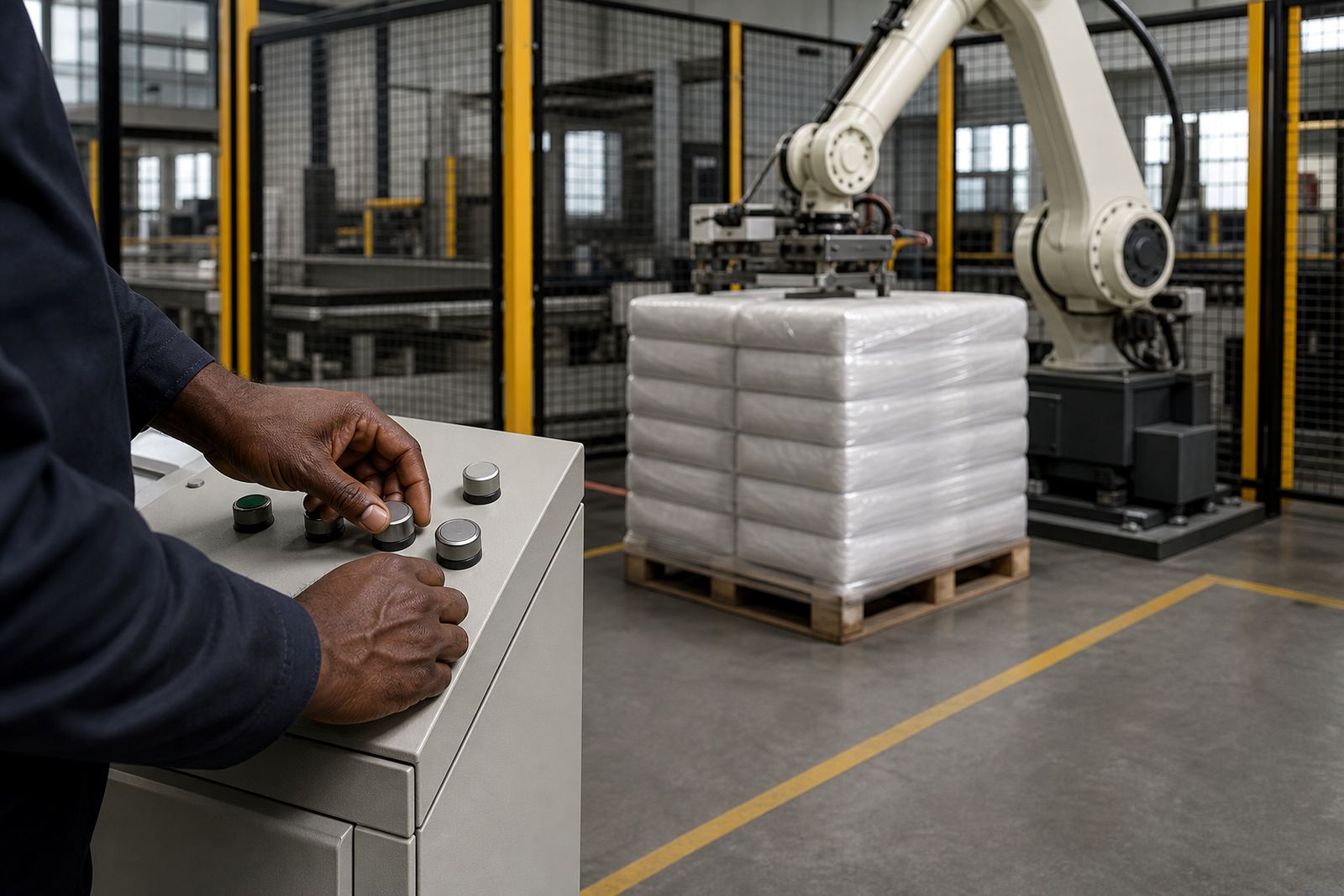
Every automated packing or palletising retrofit needs safety guarding and a site specific risk assessment. General safety rules are a starting point only. The final setup depends on walkways, forklift routes, operator access, maintenance needs and the way the line is used day to day. A guard fence that looks fine on paper can still block access to a critical changeover point or create a new pinch area if it is not planned properly.
On South African sites, safe design also needs to account for lockout procedures, emergency stops, restricted entry points and practical training for operators and maintenance staff. If the line is retrofitted into an older plant, the guarding must work with the existing conveyor frames and floor layout. Safety should support production, not fight with it. It is better to spend time on the layout now than to deal with stoppages later.
In Midvaal or Gqeberha, where some plants run older equipment alongside newer sections, integration of safety devices can be one of the trickiest parts of the job. The risk assessment should be reviewed for the actual site, with the actual product and actual operators in mind, not from a generic template.
Integration With Existing Conveyors Makes or Breaks the Retrofit
A packing or palletising retrofit usually succeeds or fails at conveyor level. Product has to arrive in the right position, at the right time and in the right orientation. If the conveyor timing is poor, the robot or packing machine ends up waiting, correcting or rejecting product. That means the controls integration has to be properly thought through from the start.
This includes start and stop signals, sensor placement, jam detection, case transfer, pallet feed, and how the line responds after a stoppage. Commissioning support is important here because the real test is not the installation day, it is the first few weeks of production when the line is dealing with real operators, mixed product runs and the odd power interruption.
Our team in Spartan, Kempton Park works with packing and palletising retrofits for manufacturers across South Africa, including Johannesburg, Pretoria, Durban, Cape Town and Gqeberha. The focus is always on getting the conveyors, guarding, controls and operator flow to work as one system, with enough room for maintenance and service access.
A Practical Way to Decide What You Need First
If your main problem is inconsistent product presentation, damaged packs or too much manual handling at the front end, then packing is likely the first area to address. If your product is already packed but staff are struggling with stacking, pallet quality or dispatch delays, palletising may be the better starting point. Many plants need both, but the order should follow the bottleneck, not the latest trend.
A practical retrofit plan usually includes line surveys, retrofit design, conveyor integration, controls integration, installation management, commissioning support, operator training and maintenance support. Spares planning matters too, because a line that cannot get a sensor, gripper part or drive component quickly can lose more time than expected. For many sites, the real value is not just in the machine itself but in how quickly the line can be returned to normal after a fault or breakdown.
At ReAutomated, the aim is to help local manufacturers choose the right level of automation for the job, whether that means a pack station, a pallet cell, or a phased upgrade across both. The best result is usually the one that fits the existing plant and the actual production target, not the fanciest option on paper.
- Fix the biggest bottleneck first
- Match the retrofit to the existing conveyor layout
- Plan safety, controls and maintenance from the start