Why carton handling matters before the palletiser
On a packing line, a carton is only as good as the way it leaves the case former, loader or manual packing station. If the board is soft, the corners are crushed, or the contents are sitting unevenly, the carton will not travel well on rollers or belts and it may tip, snag or open at transfer points.
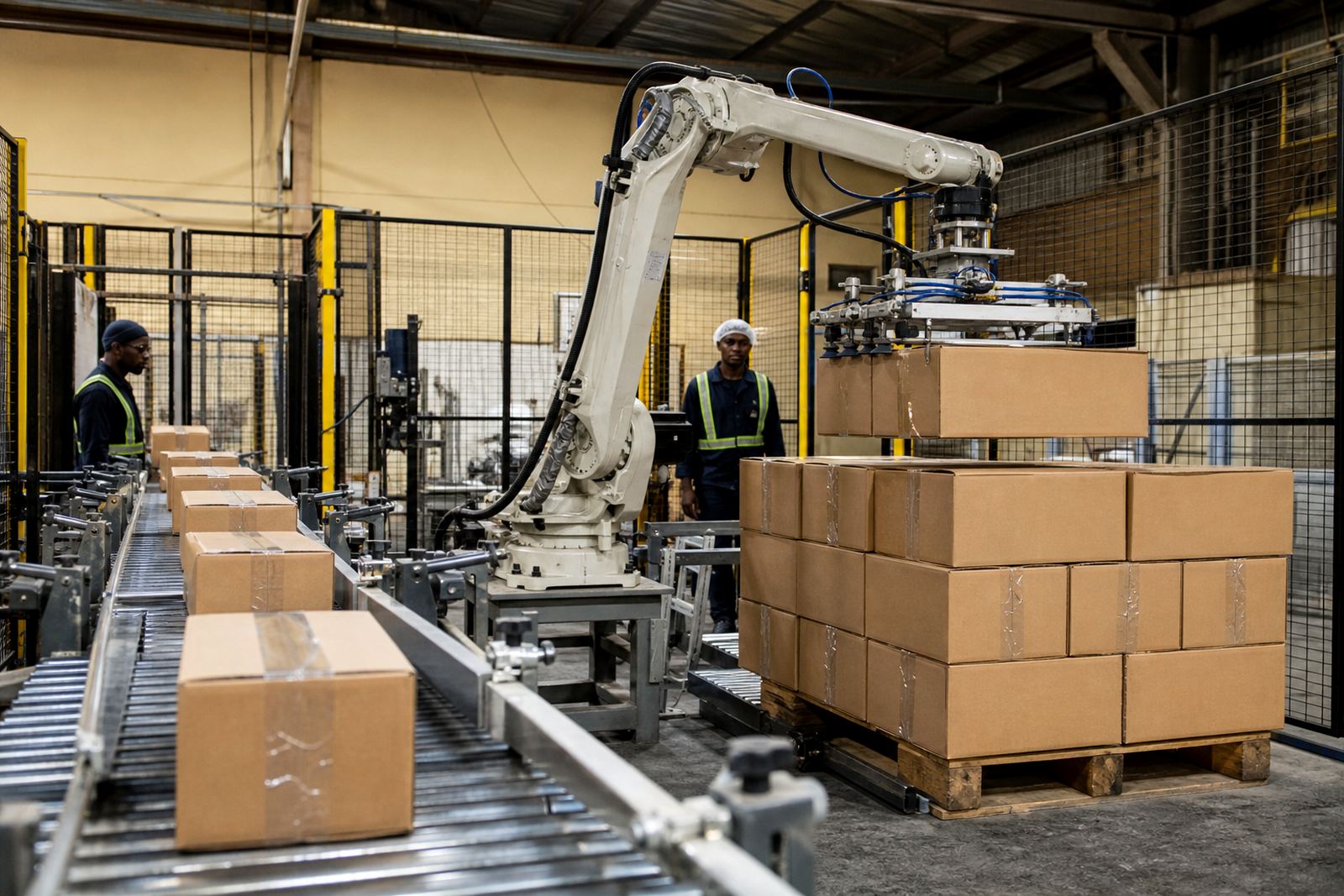
That is why carton handling needs to be treated as part of the full line, not only as a packing issue. A palletiser can only stack what it receives. If cartons arrive skewed, bulging or underfilled, the robot or palletising head has to work harder to place them neatly and the stack quality suffers.
Case strength, squareness and fill condition
Three carton details show up again and again on retrofit projects: board strength, squareness and fill condition. Weak board can collapse at the gripping point or when a layer clamps against it. A carton that is not square will wander on guides and create jams at merges, turns and transfers. A badly filled case can ride high on one side and low on the other, which makes top loading and pallet patterning less predictable.
- Check carton dimensions against the product being packed, not only the nominal board size.
- Confirm that glue, tape or tuck closures hold under real line speed and temperature conditions.
- Watch for overfill that bows the top panels and underfill that allows collapse during transfer.
- Where products shift inside the case, consider dividers, inserts or packing sequence changes.
In Gauteng, where daytime heat and dust can affect board storage, cartons often perform differently between the storeroom and the line. Coastal humidity in Durban or Gqeberha can create a different problem altogether, with board softening if storage and dispatch areas are not managed carefully.
Conveyor transfer quality is often the hidden cause
A lot of carton faults only appear when the box crosses from one conveyor to another. A small gap, worn belt, poor guide alignment or a transfer that is too aggressive can twist the carton and push it off centre. Once that starts happening, every downstream station has to compensate for the error.
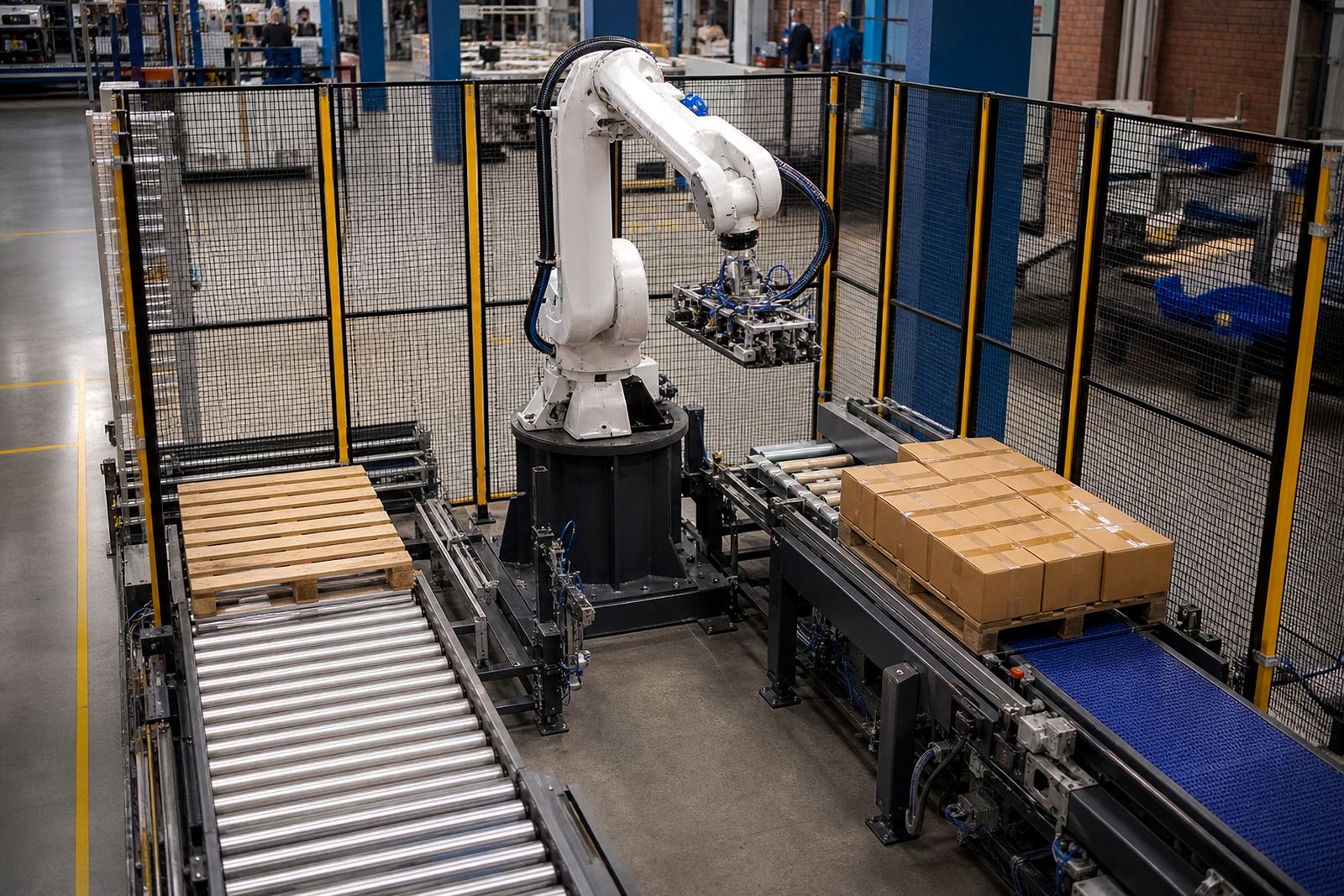
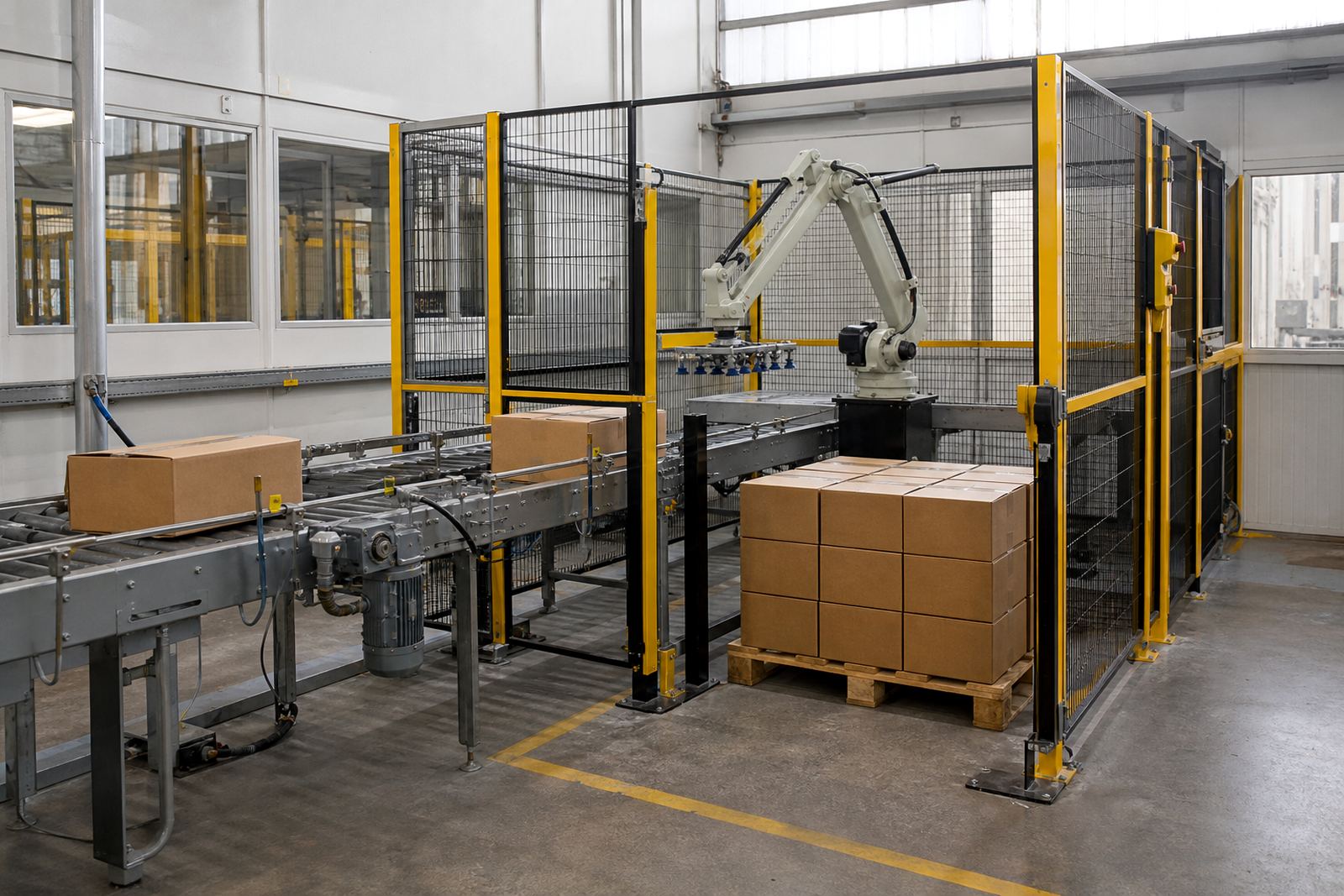
For retrofit work, transfer points deserve close attention. The chain line, accumulation zone, corner transfer and incline or decline section must suit the carton base and weight range. If the equipment is being updated to add a cobot or robot palletiser, the conveyor feed must be steady enough for the infeed timing and the carton pitch expected by the control system.
- Check that side guides support the carton without squeezing it.
- Look for build-up of glue, dust or wrap scraps that change friction.
- Measure transfer height changes and make sure the carton is not dropping or climbing too sharply.
- Verify that any accumulation zone can handle the expected back pressure.
What to look for in a site line survey
A proper site line survey gives the retrofit team the facts needed to design around the real carton conditions on site. It should cover carton sizes, product weight, case material, line speed, existing conveyor layout, available floor space and the way operators currently pack, seal and move cases. On older lines, the biggest issue is often not the robot itself but the space and handling pattern around it.
For manufacturers in Kempton Park, Johannesburg or Pretoria, we often see lines that have grown in stages over many years. One section may be modern while another still runs on older guides, manual packing points or uneven transfer heights. A careful survey helps to find where the carton is being damaged, and where a small mechanical change will save a lot of trouble later.
- Measure carton orientation at every transfer point.
- Record top load, fill level and any visible panel damage.
- Note where operators are correcting cartons by hand.
Retrofitting robots without upsetting the line
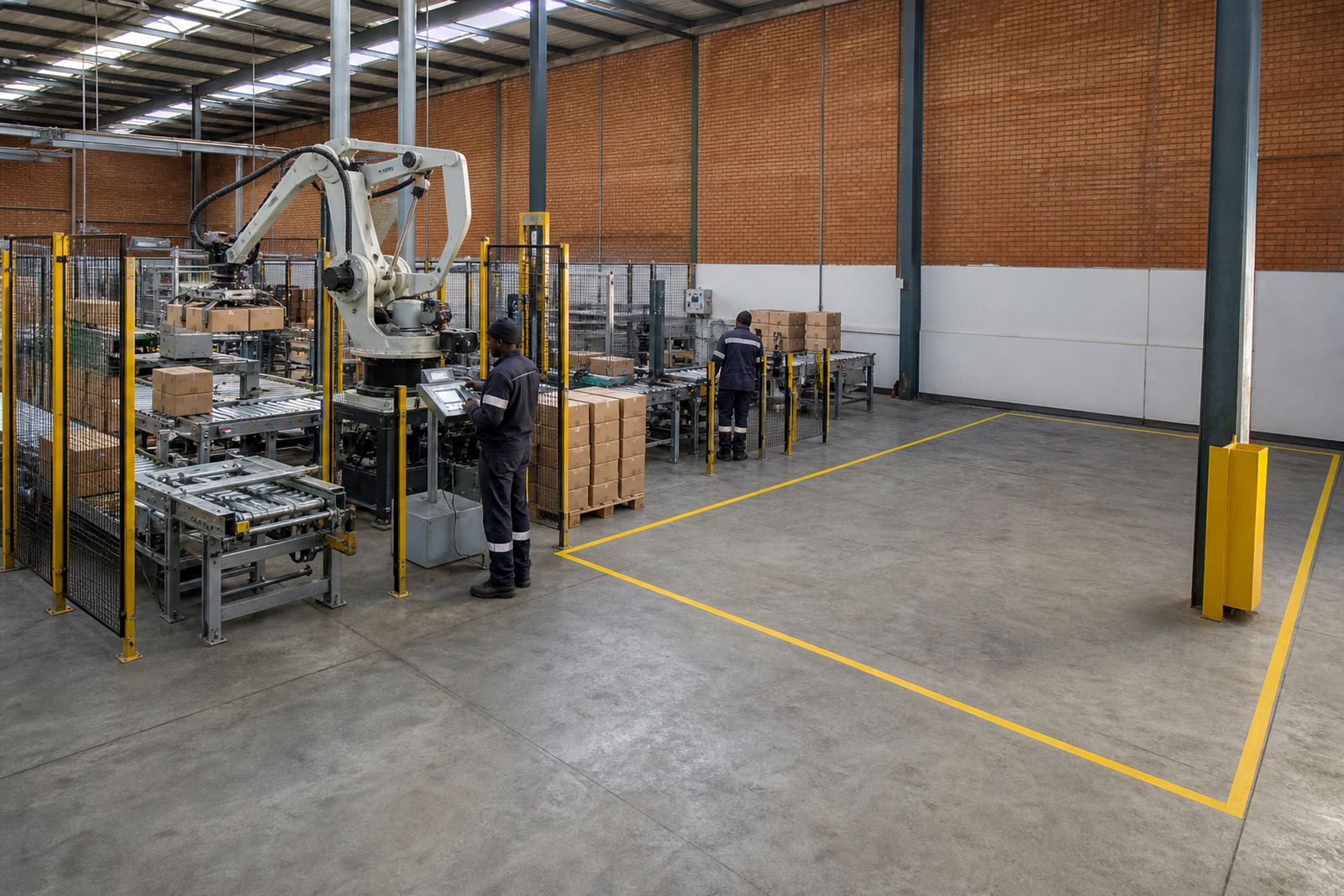
When a robot or cobot is added to an existing packing or palletising line, the carton has to arrive in a predictable position and condition. That means the retrofit design must work with the current conveyors, not fight them. Controls integration, conveyor timing, safety guarding and operator access all need to be planned together so the line can run without constant stops.
In practical terms, that may mean changing carton presentation, adding a short buffer, adjusting guide rails or improving the sealing step before the robot takes over. In some cases, the answer is not more automation but better carton preparation upstream. A neat, square carton is easier to handle, easier to palletise and less likely to cause nuisance stops.
Safety guarding must be matched to the movement of the robot and the surrounding equipment. Each site needs its own risk assessment, especially where people still load cases manually or where forklifts work close to the palletising zone. General safe practice is not enough on its own.
A local example from a South African packing floor
On a busy manufacturing floor in the East Rand, cartons were reaching the palletiser with one crushed corner and a slight twist after a tight conveyor turn. The issue was not obvious at the packing station, but it showed up when the cases were transferred onto the final belt and then again at the palletising point. Operators were stopping the line to straighten boxes by hand, which slowed output and added strain during shift changes.
The practical fix was simple in principle: improve the transfer geometry, review carton fill consistency, and add better side support before the palletising zone. Once the cases were presented more squarely, the robot had a cleaner flow and the pallet stacks became more uniform. That kind of result usually comes from small changes, not one big change, and it is why line surveys and risk review matter so much.
Keeping carton handling stable after commissioning
Once the retrofit is commissioned, carton handling still needs attention. Board suppliers, product mix, pack weight and ambient conditions can change over time. A line that ran well in winter may behave differently in summer, or after a new carton spec is introduced. Maintenance support should include checks on guides, sensors, seals, transfer belts and any wear points around the infeed and palletising area.
Operator training also matters. Staff need to know what a healthy carton looks like, where to stop the line, and what signs point to a transfer problem rather than a product problem. Good spares planning helps too, because a delayed belt, damaged sensor bracket or worn guide can turn a minor issue into a full shift stoppage.
For plants in Durban, Cape Town and Gqeberha, humidity and corrosion can make these checks even more important. In inland sites around Kempton Park, Johannesburg and Midvaal, dust and vibration can be the bigger concern. Either way, carton handling works best when the line is monitored as a system, not as separate machines.