Why retrofit downtime planning starts before the robot arrives
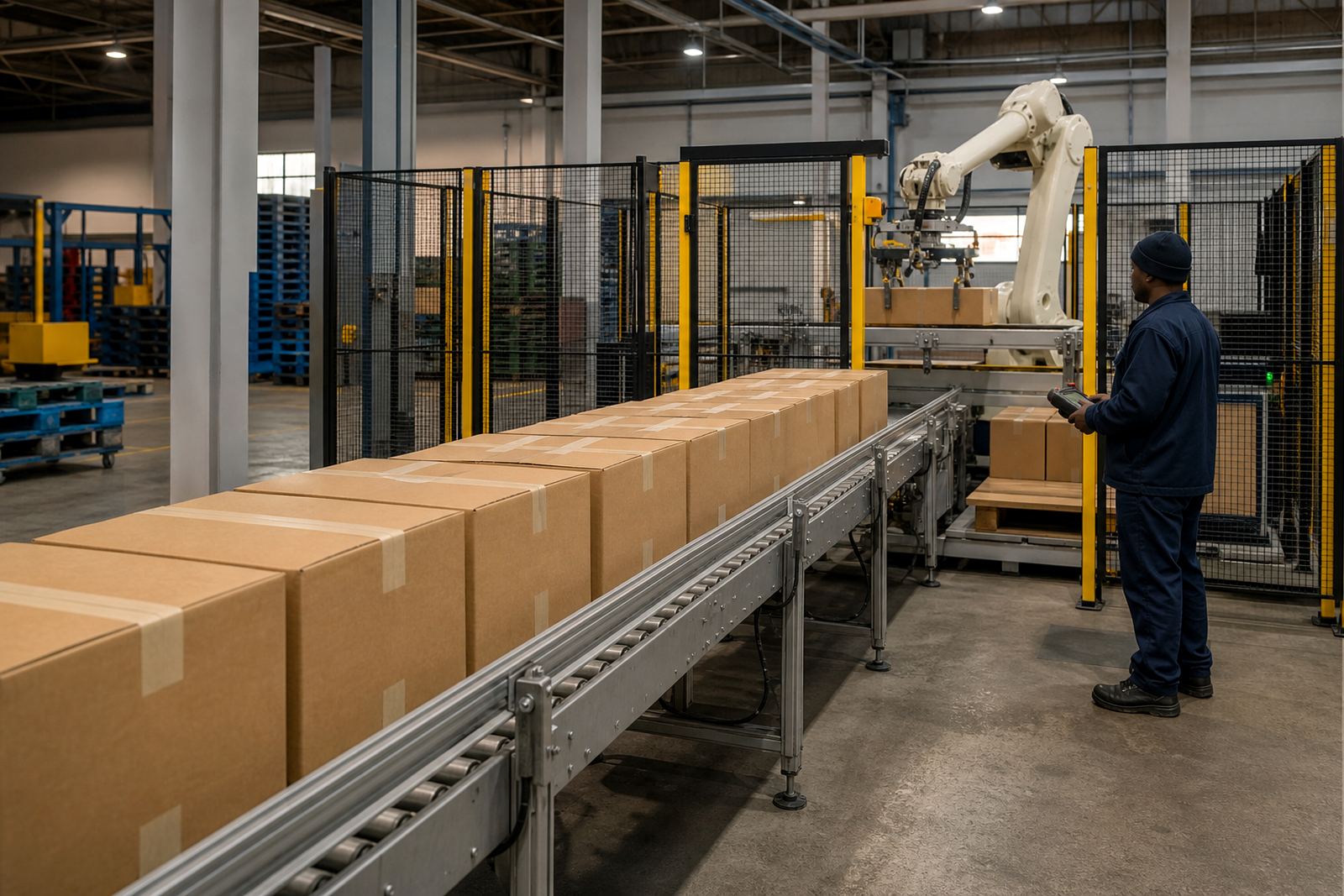
On a packing or palletising line, the biggest risk is not the robot itself, it is the time needed to stop, strip, fit and commission the work without disrupting customer orders. A good downtime plan starts with a clear view of what must happen on site, what can be prepared off site, and which parts of the line must stay available for production until the very last moment.
For manufacturers in Kempton Park, Johannesburg or Pretoria, that often means planning around shift changes, dispatch times, annual shutdowns and weekend windows. If a plant is running chilled products, export cartons or high-volume FMCG packs, even a few extra hours can create congestion, missed loads and overtime pressure. A proper plan keeps everyone honest about the actual sequence, not the hopeful one.
Map the line before you book the shutdown window
Before any retrofit date is agreed, the line needs to be surveyed properly. That includes conveyor routes, pack flow, pallet build pattern, available floor space, pallet infeed direction, service clearances and access to control panels. If the site has low ceilings, tight forklift routes or shared aisles, those details affect the installation order and the outage length.
- Confirm where the robot or cobot will stand and how pallets will move in and out
- Check whether existing conveyors need height changes, side guides or product stops
- Identify power, air and control cable routes early
- Mark the safe isolation points for each machine section
- Allow space for temporary barriers, test pallets and tool access
This stage also helps spot issues that would otherwise show up during shutdown, such as worn conveyor sections, unstable product handling or a panel that cannot be accessed once guarding is in place.
Choose the right work to do during planned downtime
Not every task belongs inside the shutdown period. Smart downtime planning splits the work into pre shutdown, shutdown and post start-up tasks. Items like design checks, panel build, cable labelling, software preparation and guarding fabrication can often happen before the line goes offline. That leaves the shutdown window for physical tie-in work, final alignment and tested commissioning.
When a retrofit includes packing equipment, palletising equipment, conveyors and safety guarding, the best schedule is usually staged. For example, a Durban plant might keep production running on one line while a second line is prepared for the changeover. In Cape Town or Gqeberha, where humidity can affect stored electrical parts, it may be worth completing more assembly before the shutdown so exposed parts are not sitting around on site longer than needed.
- Pre shutdown: surveys, drawings, fabrication, software prep, spares checks
- Shutdown: removal, installation, wiring, guarding, mechanical alignment
- Start-up: I/O checks, dry runs, live trials, operator handover
Build the shutdown around safety and legal duties
Every retrofit site needs its own risk assessment. A packing line that handles cartons is not the same as a palletising cell next to forklifts, stretch wrap and foot traffic. Safety guarding, lockout points, access gates, emergency stops and pedestrian routes must be reviewed for the actual installation, not assumed from a previous job. General safety rules are a start, but they are not enough on their own.
Good downtime planning includes who may isolate equipment, who can restart it, where test runs will happen, and how access is controlled while the team is working. If an installation affects existing conveyors, the risk changes again because a belt that used to be a simple transfer point may become part of a robot feed or discharge zone. In Midvaal and East Rand plants especially, where multiple contractors may be on site, coordination matters just as much as the hardware.
Protect production with realistic sequencing and spare parts
A retrofit can lose hours when small items are missing. A cable gland, proximity sensor, fastener set or a bracket that was never checked against the final drawing can hold up the whole shift. That is why spares planning belongs in downtime planning, not as an afterthought. If the original conveyor is older or has mixed components, the team should verify what can be reused and what should be replaced before the shutdown starts.
Sequencing also matters. A site supervisor needs a clear order for stripping old equipment, moving it off the line, positioning the new cell, connecting controls, testing safety circuits and running the first product. If a palletiser is being added to an existing packing line, the packer, conveyor transfer and pallet outfeed all need to be checked as one system. One missed link can slow the entire line, and that is where overtime costs creep in.
- Keep critical spares on site before shutdown begins
- Label every cable and pneumatic line before removal
- Agree the start-up sequence with operations and maintenance teams
- Prepare temporary product handling if the line must feed another area
- Plan for a short recheck after the first live production run
How local plants reduce lost time during retrofit work
In Spartan, Kempton Park, many plants are working around freight collections, supplier deliveries and limited yard space. A retrofit team that arrives without a detailed access plan can burn half a shift just moving pallets, clearing walkways and finding a place for removed parts. The better approach is simple: agree access times, loading points, safety induction requirements and crane or forklift support before the team arrives.
For a Johannesburg manufacturer planning a palletising retrofit over a long weekend, the most efficient schedule may be to isolate the line after the last production run on Friday, complete mechanical work on Saturday, finish controls and guarding on Sunday, then use Monday morning for controlled start-up support. That kind of plan only works when everyone knows the handover points and nobody is waiting on a late decision. It saves stress too.
What good downtime planning looks like on the day
On the day of the shutdown, the focus should be on discipline. Each step should have an owner, a check point and a clear next action. If the work is being done at a plant with multiple shifts, the outgoing team needs to hand over exact status, not a rough summary. A short delay at the start can ripple through the entire installation, so progress tracking matters.
When everything is planned well, the team can move from isolation to installation to commissioning without guessing. The line is tested in stages, operators are trained while the equipment is still fresh in everyone’s mind, and the production handover happens with less drama. That is the real value of downtime planning: fewer surprises, safer work and a cleaner return to output.