Why presentation decides whether a retrofit succeeds
Robotic retrofits often get judged on the robot arm, the gripper or the speed of the cycle. In practice, the product itself is usually the first point of failure. If bags are leaning, cartons are skewed or tubs arrive bunched up, the robot has to correct for problems that should have been handled upstream. That adds complexity, slows the line and increases the chance of a stoppage.
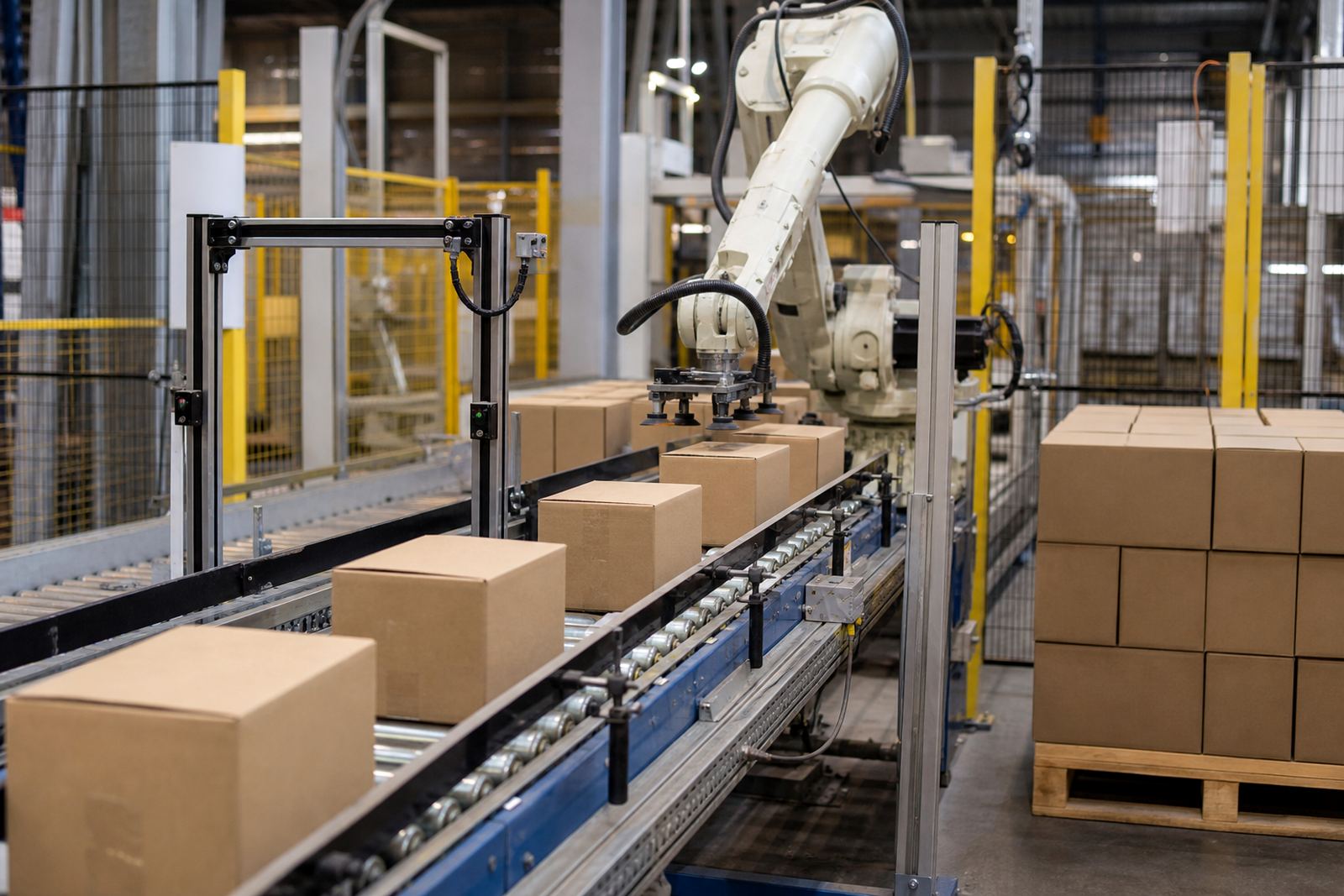
For packing and palletising lines, product presentation means the item reaches the robot in a position it can recognise, grasp and place with confidence. The closer the product is to the same orientation every time, the more reliable the whole system becomes. A stable feed also makes it easier to integrate existing conveyors, guides, stops and transfer points without major rebuilds.
What stable presentation looks like on a real line
Good product presentation is not only about straight lines and neat packaging. It is about control through the full path from the previous machine to the robot cell. On a high-speed line, that may mean side guides, product spacing, accumulation control, orienting rails or a simple transfer table that removes the wobble before the pick point.
- Cartons should arrive square, not twisted or crushed on one corner.
- Bags and pouches should be settled, with excess air controlled where possible.
- Cases or trays should be separated to the required pitch, with no bunching.
- Product height and footprint should stay within the limits of the gripper and pallet pattern.
- Any labels, printed codes or open edges should be kept in the same position for each cycle.
That sounds basic, but many lines still rely on operators to correct presentation by hand. Once labour is removed, those small inconsistencies show up fast.
Where retrofits usually need the most help
In Kempton Park and across Gauteng, we often see packing rooms where equipment from different periods has been tied together over time. A filler may run one speed, an older conveyor another, and a palletising point may sit in a cramped corner with limited access. The product reaches the robot, but not always in the same state. That is when a retrofit needs more than a machine purchase. It needs line control, conveyor timing and sensible guarding around the working area.
Facilities in coastal areas such as Durban and Gqeberha can also face humidity related problems. Cartons soften faster, labels loosen and slip between belts changes. In those conditions, product presentation must be checked in real operating conditions, not only on paper. Good layout planning helps avoid chasing faults later on.
At one Midvaal site, for example, a case packing line kept feeding cartons with slight skew because the transfer section was too short. The result was a robot that spent too much time correcting position. Once the transfer was extended and the side guides were adjusted, the line settled down and the robot could work as intended. Nothing fancy, just proper control of the product before the pick.
The role of conveyors, sensors and controls
A retrofit works best when the conveyor system and controls support the robot instead of fighting it. Sensors need to confirm product position, detect gaps and stop the line when the feed is out of tolerance. Where products vary in size, controls logic must allow for those changes without constant manual intervention.
- Photoelectric sensors can confirm product presence and spacing.
- Stops and gates can hold items in a repeatable pick position.
- Conveyor speed control can match upstream flow to robot cycle time.
- Reject points can remove damaged or misaligned product before it reaches the cell.
- Operator panels should be simple enough for shift staff to use after training.
When all these pieces are matched properly, the robot is no longer compensating for random feed conditions. It becomes part of a stable process instead of a patch over an unstable one.
Safety guarding and risk assessment cannot be afterthoughts
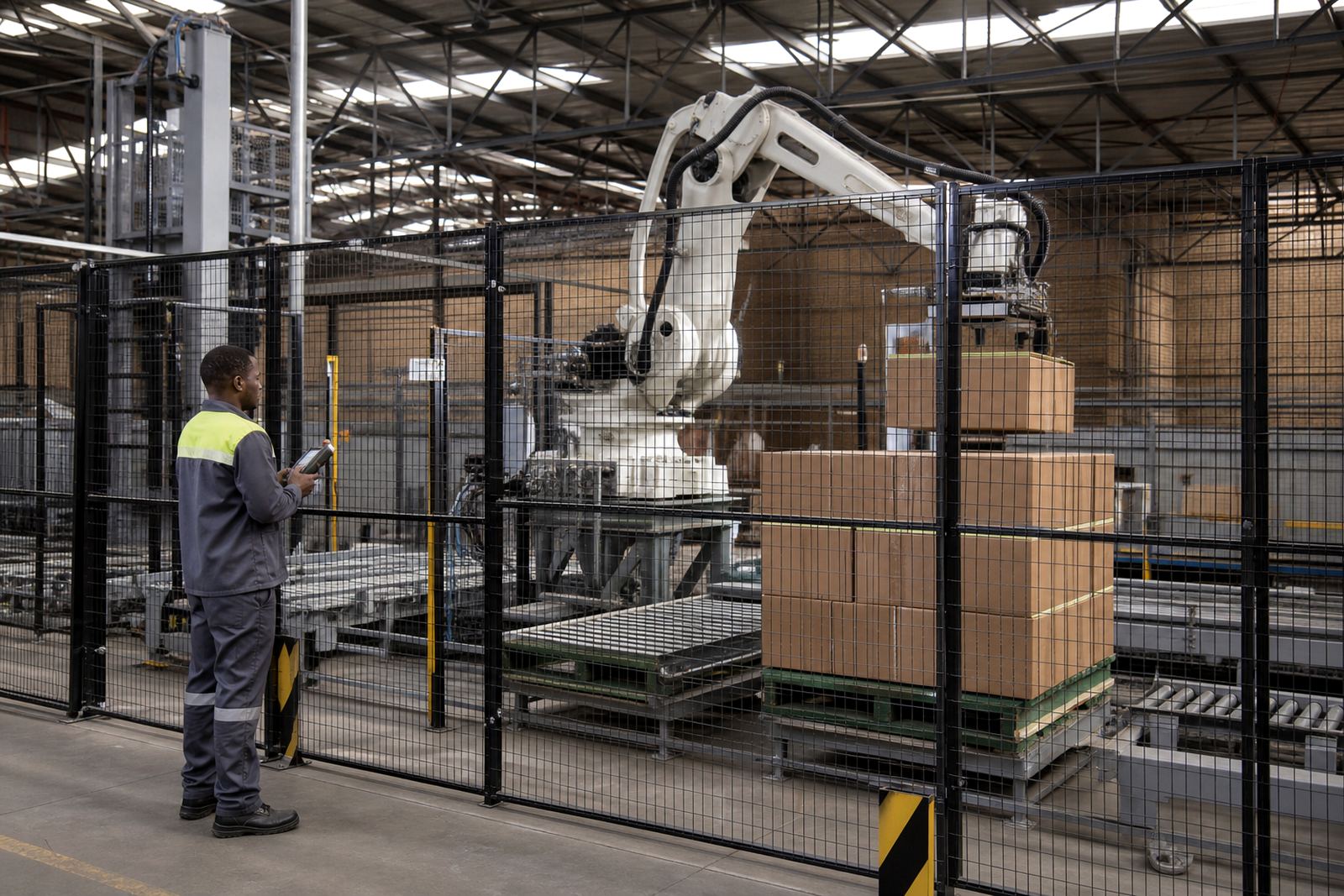
Any robotic retrofit needs site specific safety work. General rules apply, but each line has its own hazards, traffic routes, access needs and maintenance routines. That is why a proper risk assessment matters before installation, during commissioning and again when the line changes later. Guarding, interlocks, access doors and emergency stops must suit the actual working area, not a generic layout.
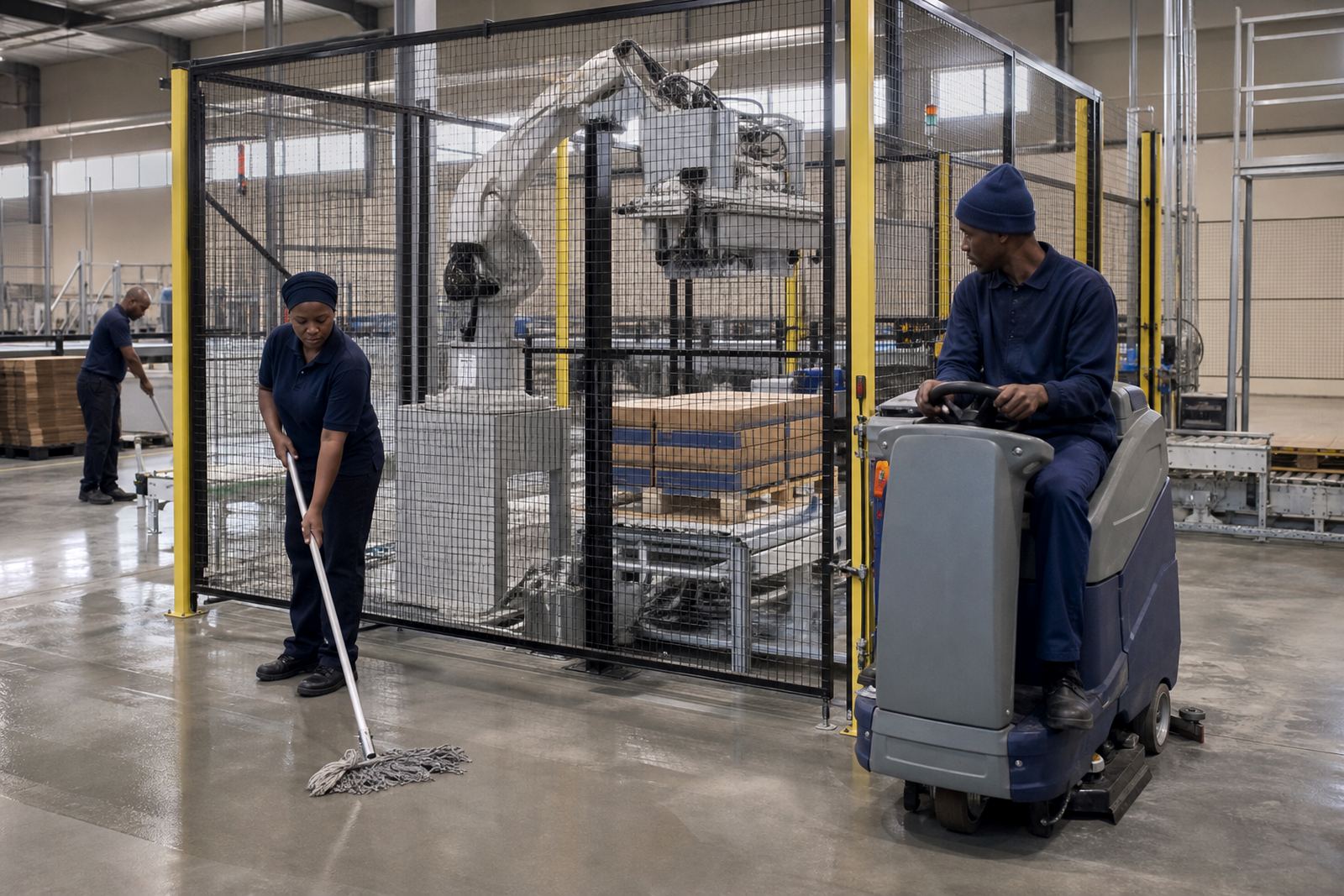
On South African sites, this matters just as much in a busy Johannesburg plant as it does in a Cape Town or Durban facility. Forklift movement, pedestrian routes, loading bay access and cleaning routines all affect the final design. If product presentation is poor, operators are also more likely to step into unsafe areas to correct it by hand. Good presentation reduces that pressure and supports safer working conditions.
For cobots, the same principle applies. They are often chosen for closer human interaction, but they still need a clear risk assessment, controlled speeds, suitable end of arm tooling and proper training. A cobot does not remove the need for discipline, it just changes how the work is arranged.
Planning for uptime, not only installation day
A retrofit is not successful because it runs once during commissioning. It succeeds when it keeps running after the first few weeks, through shift changes, product variation and maintenance cycles. That is why spares planning, operator training and breakdown support must be part of the project from the start. If a simple guide plate wears or a sensor is out of alignment, the whole line can drift off spec quickly.
Teams in Pretoria, the East Rand and Spartan often want a line that can be handed over without constant engineering callouts. That is realistic if the presentation upstream is controlled and the staff know what good looks like. A practical training session should cover fault finding, safe clearing of jams and what to check before restarting the line. It should also cover when to stop and call for support, rather than pushing a line that is already out of tolerance.
Product presentation may not sound exciting, but it is usually the difference between a robot that works hard and one that works well. If the item arrives in the same position every time, the rest of the system has a fair chance.