Start With the Pack, Not the Robot
When a packing or palletising line is being retrofitted, the first question is not which robot to use, but what it must pick up. Cartons, bags, shrink wrapped bundles, tubs, trays and pails all behave differently. A gripper that works well on a flat carton may struggle with a soft sack that flexes as it lifts, or a polished pack that offers very little grip.
The pack surface matters just as much as the weight. Smooth film, corrugated board, powder residue, condensation and dusty bag tops all change the way a gripper holds on. In Gauteng factories, where dust and vibration are common, that detail can decide whether the cell runs cleanly or stops every few minutes. Good gripper selection begins with a proper site survey, sample packs and clear handling goals.
- Check the pack shape and whether it changes after filling
- Measure the actual loaded weight, not just the nominal pack weight
- Note whether the product is rigid, flexible, slippery or fragile
- Confirm how the load must be placed on the pallet or case
Common Gripper Types and Where They Fit
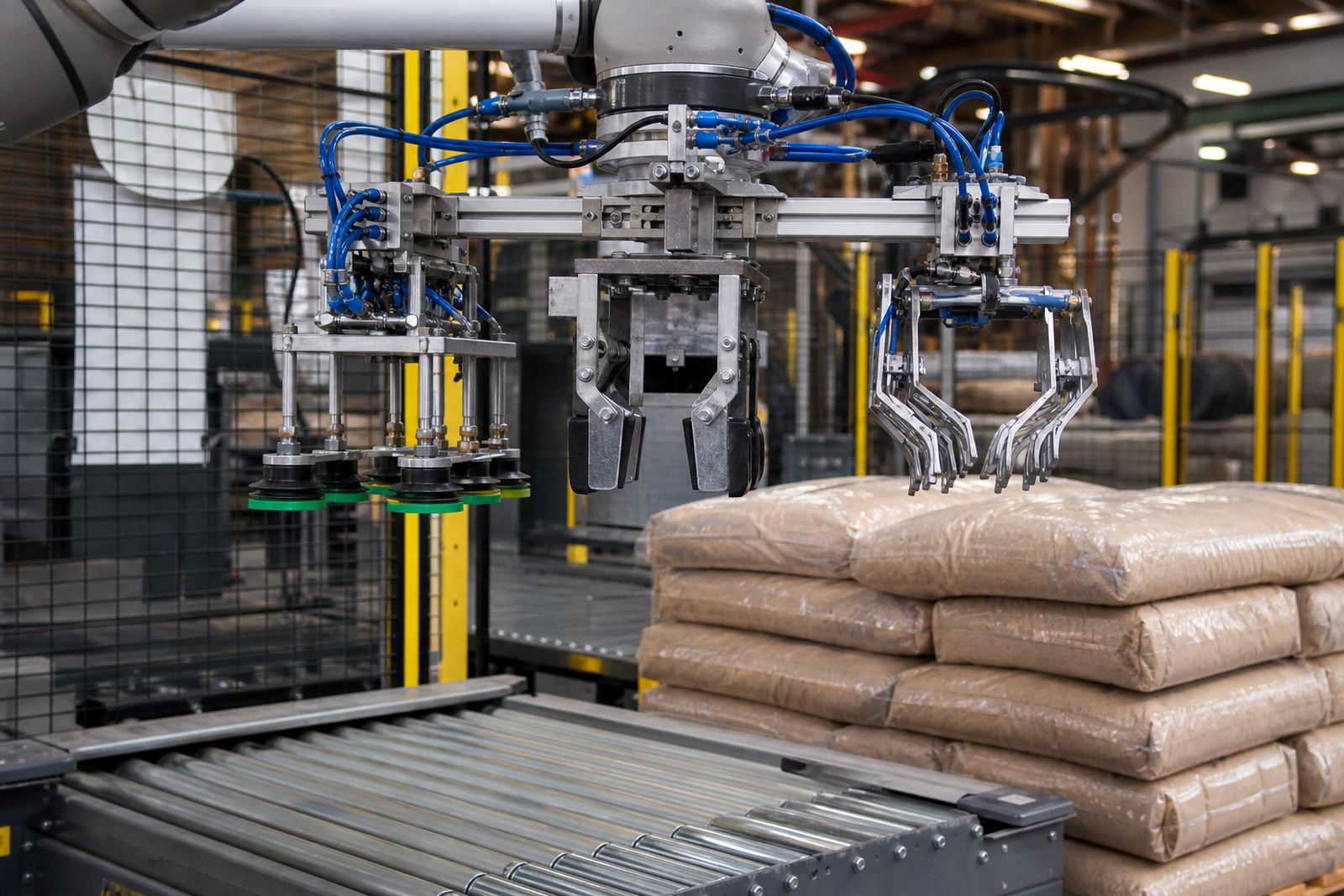
There is no single gripper that suits every line. Suction grippers work well on flat, sealed, or top-facing surfaces where a stable vacuum seal can be formed. Mechanical grippers suit cartons and crates where the sides can be held securely. Fork style end effectors can be practical for some bagged or bundled loads, while clamp or pinch designs can suit packs that need side support during transfer.
For high-mix lines, cobots often need a simpler end effector that can handle more than one pack style with limited changeover. For faster palletising lines, a more specialised gripper may be better if the product range is narrow. The point is to match the tool to the product family, not to force one design to handle every case on the line.
- Suction: best for flat tops, cartons and smooth surfaces
- Mechanical clamp: useful for rigid packs and cases
- Fork or blade type: can suit bags and some bundled products
- Custom hybrid: chosen when one line handles mixed pack formats
Weight, Fragility and Load Stability
Weight is only part of the story. A light pack can still be awkward if it shifts in transit, while a heavier pack may be easy to lift if its shape is consistent. Fragile products need gentler acceleration and a gripper that spreads the load rather than concentrating it on one spot. If a carton roof is weak, or a printed sleeve can crease easily, the gripper has to protect the package as well as hold it.
Load stability matters most during transfer from conveyor to pallet. If the pack is likely to slide, tilt or twist, the gripper must control that movement. On some lines, this means adding guides, support plates or a vacuum layout that keeps the pack square through the full move. It is worth remembering that a line can look fine at low speed and still fail once the cycle rate increases.
- Use gentle motion for fragile packs and thin cartons
- Check centre of gravity for irregular loads
- Allow for product compression, especially on soft sacks
- Test the gripper at working speed, not only in slow manual mode
How the Gripper Must Place the Load
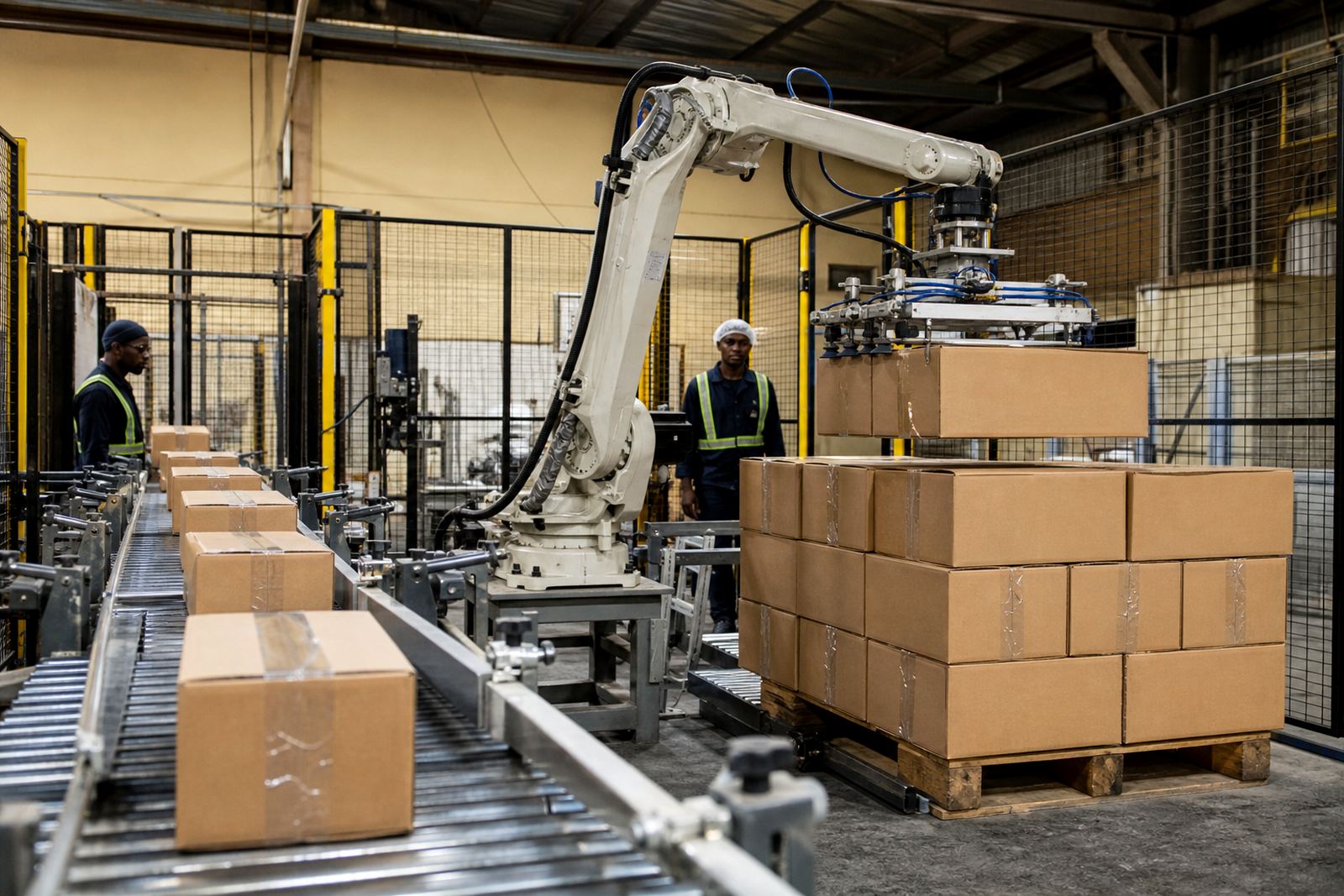
The way a load lands on the pallet is just as important as the pick. Some packs need to be placed with exact edge alignment so the layer stays square. Others must be released in a way that avoids bounce or side drag. For wrapped pallets, the gripper and the line layout must allow enough clearance so the load can be placed cleanly without snagging film or striking nearby guarding.
Layer formation also influences the choice of gripper. If the line builds interlocked patterns, the robot may need better orientation control. If the load is stacked straight, the gripper can be simpler. In many South African plants, especially where floor space is tight, the palletising cell has to fit around existing conveyors and manual stations, so the gripper and motion path need to work within the available footprint, not in an ideal world.
- Define whether the pack is dropped, set down, or slid into place
- Confirm the required pack orientation on every layer
- Allow clearance for wrap, posts, fencing and pallet access
- Plan for mixed pallet patterns if the product range changes
Why Safety and Risk Assessment Come First
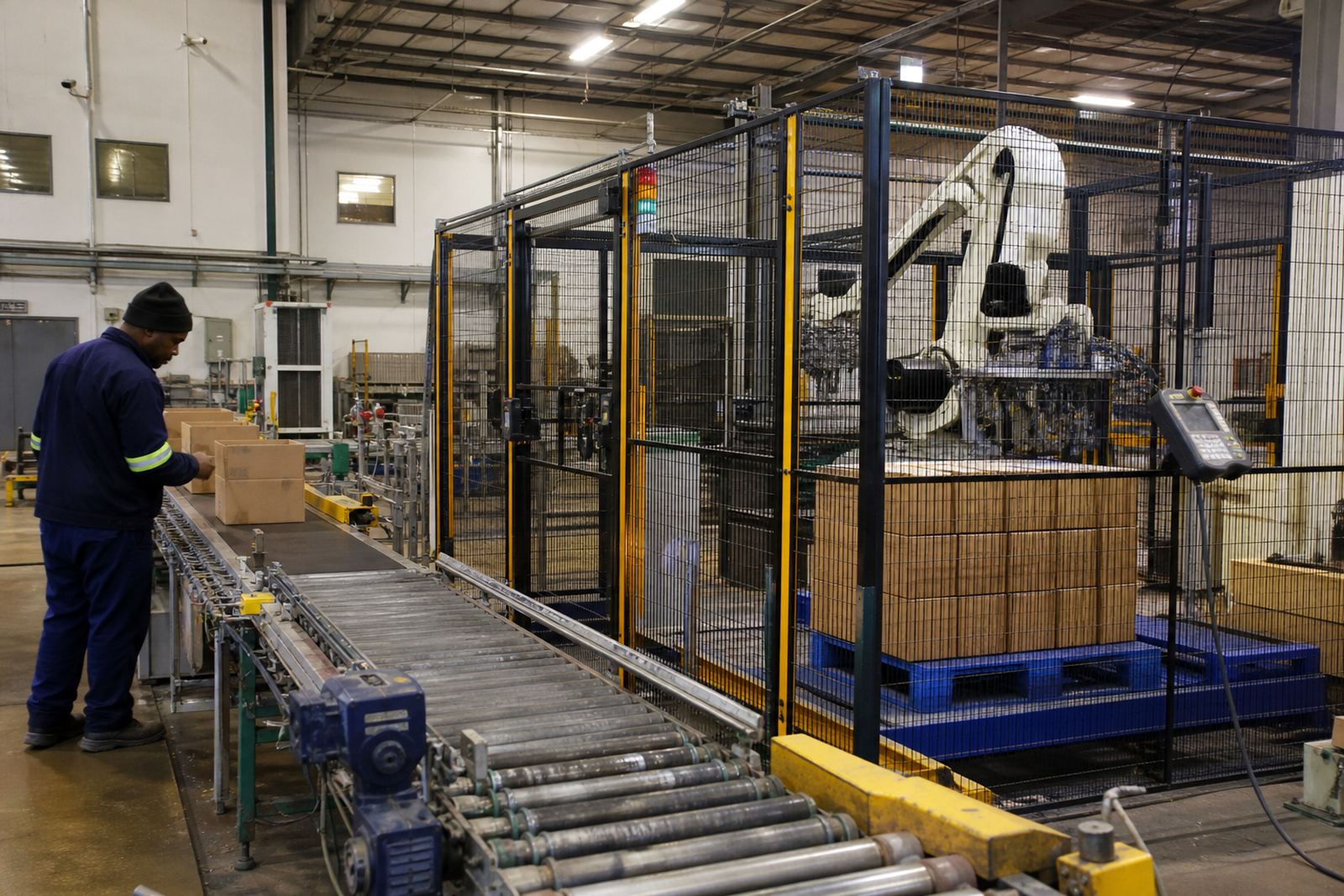
Any robotic retrofit needs a site specific risk assessment. That is true for cobots as well as faster industrial palletisers. Safety guarding, interlocks, access gates, emergency stops and safe operating distances must be designed around the actual line and the actual risks. A gripper that reaches over conveyors or into a busy transfer zone can create pinch points if the cell is not planned properly.
Each site has its own dust levels, traffic routes, forklift movement, cleaning routine and maintenance access. In coastal areas such as Durban or Gqeberha, humidity can also affect packaging, suction performance and corrosion control.Good risk assessment is not paperwork on the side, it is part of the design.
- Assess access during cleaning, maintenance and jam clearing
- Check how operators will load, monitor and recover the line
- Match guarding to the motion range of the robot and end effector
- Include restart behaviour after power loss or an emergency stop
A Practical Gauteng Example
In Spartan, Kempton Park, a manufacturer may have an ageing conveyor line that still works well mechanically, but the final packing stage is too labour heavy. If the packs are carton based and the tops are flat, a suction gripper may be a clean option. If the line also handles shrink wrapped multipacks and the cartons vary in height, a mechanical or hybrid solution may be more suitable. The final decision comes from the product, the speed and the space around the line.
That is why retrofit work begins with a line survey, sample testing and controls integration review. A gripper cannot be chosen in isolation. It must suit the conveyor speeds, the PLC logic, the available air supply and the way operators already work on the floor. When those details line up, the result is a line that handles product more consistently and with less manual lifting.
Choosing the Gripper That Will Keep Working
The best gripper is the one that can handle the real product, on the real line, day after day. It should pick cleanly, place accurately and cope with normal variation in pack quality. In packing and palletising retrofits, that usually means balancing speed, grip, safety and simplicity. A clever design that is hard to maintain will cause trouble later, while a practical design can keep a line moving for years.
For manufacturers in Johannesburg, Pretoria, Durban, Cape Town, Gqeberha and across the East Rand and Midvaal, the right choice depends on the pack and the process, not guesswork. Once the pack is understood, the gripper choice becomes much clearer, and the rest of the cell can be built around it with confidence.