Cape Town Line-End Automation for Existing Plants
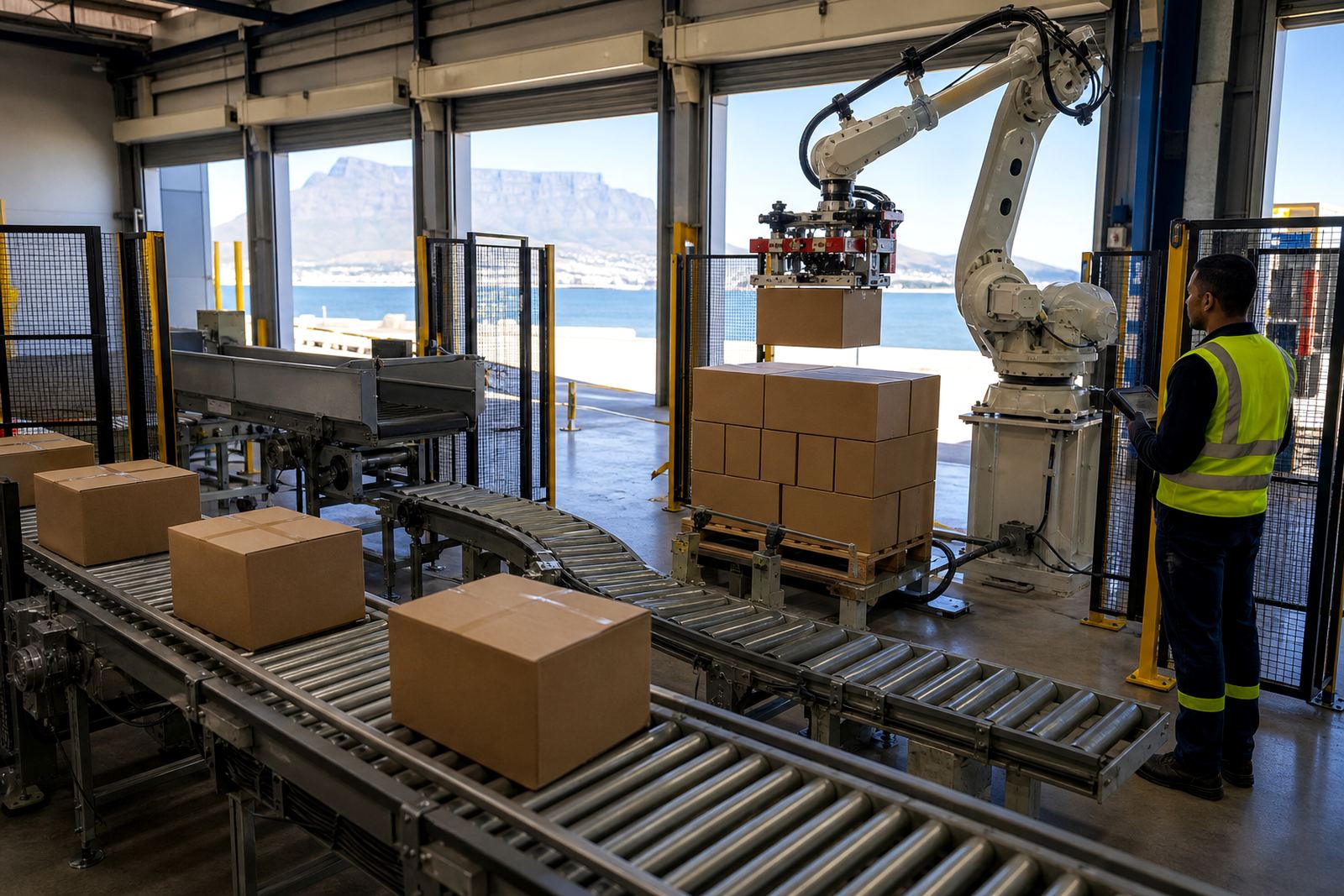
In Cape Town, many factories are working with older packing and palletising lines that still run well but need more consistency, less manual handling and better uptime. ReAutomated focuses on retrofitting robots and cobots into existing production layouts, so the line can keep moving without a full plant rebuild.
We work with manufacturers handling cartons, bags, shrink-wrapped packs, trays and mixed load patterns. Typical applications include end-of-line packing, palletising, layer handling and product transfer between conveyors and robot cells.
- Retrofits for packing and palletising lines
- Cobot and industrial robot integration where suitable
- Connection to existing conveyors and product infeed systems
- Cell layouts that suit limited floor space
Where We Support Cape Town Facilities
We assist manufacturers in Cape Town, Bellville, Montague Gardens, Epping, Paarden Eiland, Airport Industria and surrounding industrial zones. We also support clients working further out toward the Northern Suburbs, the airport side and selected warehouse and light industrial sites where packing and palletising upgrades are needed.
Because many sites are in established buildings with fixed columns, old floor layouts or limited access for heavy lifting, retrofits need careful planning. We look at the existing conveyor heights, the available floor space, the pallet infeed direction, service access and the movement of forklifts, stretch wrappers and loaded pallets. That practical detail matters, especially where production cannot stop for long.
- Food, beverage and consumer goods packing lines
- Warehousing and dispatch areas with pallet movement
- Building products, plastics and general manufacturing
- Sites needing staged upgrades rather than full replacement
Travel, Turnaround and On-Site Planning
Our base is in Spartan, Kempton Park, but we work nationally and regularly support sites in Cape Town as part of planned projects and service visits. For the Western Cape, turnaround is usually driven by the project scope, the condition of the current line and how quickly we can complete the site survey, design checks and installation planning.
When a site is ready for a retrofit, we prefer to start with a line review and practical measurements rather than guessing. That helps us plan the work around production hours, maintenance shutdowns and any municipal or site safety requirements. If a plant is running under pressure, we can phase the work so that conveyor tie-ins, guarding and controls changes happen in manageable sections.
- Site Line Surveys before retrofit design
- Installation management during shutdown windows
- Commissioning support after mechanical and controls work
- Operator training once the line is running
Safety Guarding and Risk Assessment Support
Any robotic retrofit needs site-specific safety work. A guard layout that suits one factory may not fit the next, so we never treat safety as a one-size-fits-all exercise. We support risk assessment planning, guarding design and the physical separation needed between people, pallets, conveyors and robot movement zones.
On Cape Town sites, this often includes checking how operators feed products, where maintenance staff need access, how emergency stops are arranged and how forklifts move around the cell. Coastal humidity can also affect certain components and enclosures, so equipment selection and placement need practical thought, not just neat drawings.
General safety measures commonly considered on retrofit projects include:
- Perimeter guarding or fenced cells where required
- Interlocked access points and safe maintenance access
- Emergency stop placement that suits the actual work area
- Clear floor markings and traffic routes for forklifts and pedestrians
Each site needs its own risk assessment and final sign-off process based on its actual process, layout and operating conditions.
Integration with Existing Conveyors and Controls
Most packing and palletising retrofits need the robot cell to work with conveyors that are already on site. That may include infeed conveyors, accumulation sections, transfer points, discharge conveyors, pallet staging or wrapper interfaces. We look at product spacing, line speeds, signals, sensor positions and how the current controls will communicate with the new equipment.
Our controls integration work is aimed at making the line run in a sensible way for operators and maintenance teams. That can include start-stop logic, fault handling, product presence checking, handshakes between machines and safe restart procedures after stoppages. In some plants, the biggest gains come not from more speed but from fewer jams, less manual intervention and a cleaner palletising pattern.
- Conveyor integration for new and existing line sections
- Controls integration to suit the site layout
- Fault handling and restart logic
- Commissioning support to verify the full sequence
Local Support for Parts, Training and Breakdown Response
We keep a practical service focus for Cape Town clients who need support after installation. That includes maintenance support, breakdown assistance and spares planning for the parts that are most likely to be needed at short notice. Where a site operates across shifts, we also help with operator training so the team understands the basic sequence, safety points and daily checks.
For clients in coastal areas, spares planning is worth doing properly because humidity, dust and hard running conditions can shorten the life of certain parts if they are not selected and maintained with care.
Enquiries for Cape Town and the wider Western Cape come through the contact page form. We review the line details, the product type, the current bottlenecks and the area where the upgrade is needed before arranging the next step.
- Maintenance support after handover
- Breakdown assistance where needed
- Spares planning for critical wear items
- Operator familiarisation and refresher training